







Definition and Meaning
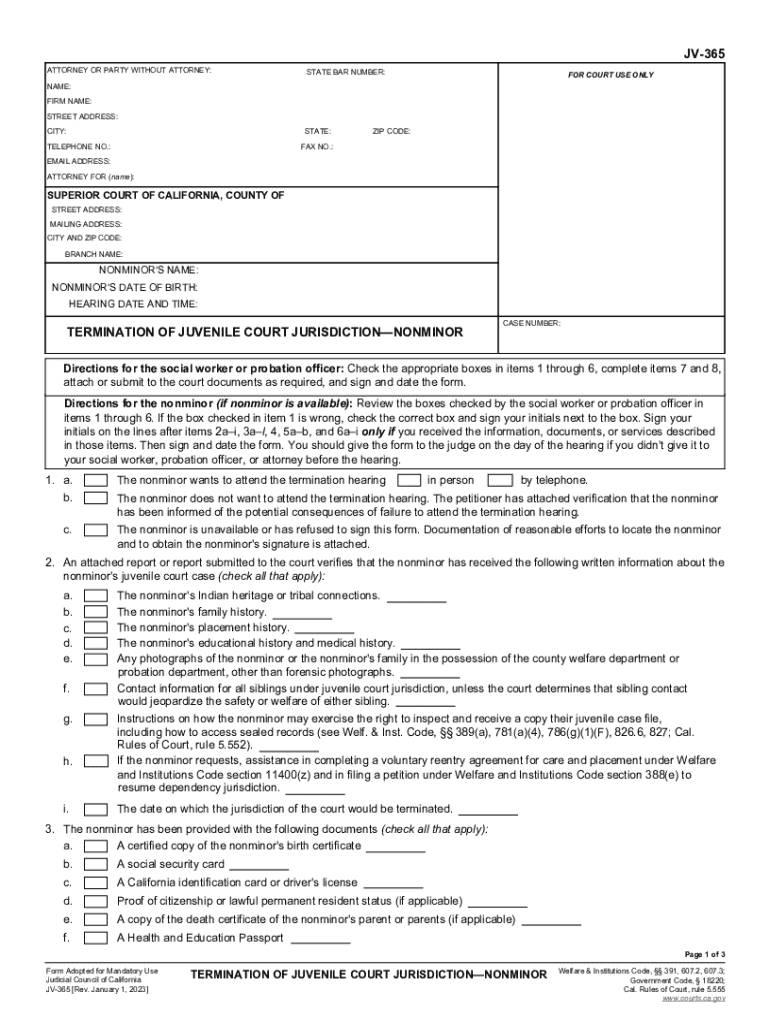
The JV-365 form, known as "Termination of Juvenile Court JurisdictionNonminor," is utilized in the Superior Court of California to end juvenile court jurisdiction over a nonminor. This document serves as a formal declaration that marks the conclusion of court oversight, indicating that the nonminor has fulfilled the requirements necessary for exiting the juvenile system. It contains instructions for social workers or probation officers and guidance for nonminors on attending hearings, obtaining relevant information, and accessing services crucial for transition into adulthood.
How to Obtain the JV-365 Form
Securing the JV-365 form is a straightforward process. Typically, the form can be obtained directly from the Superior Court of California's website where it's available for download. Additionally, court clerks or social workers may provide the form to nonminors or their representatives upon request. It's important to ensure that the form version is current to avoid any complications during submission.
- Online Downloads: Visit the Superior Court of California’s official site and navigate to their forms section.
- In-Person Requests: Court clerks can be a helpful resource for obtaining physical copies.
Steps to Complete the JV-365 Form
Completing the JV-365 requires meticulous attention to detail. The following steps outline the process for accurate form submission:
- Personal Information: Fill in the nonminor's personal details, including name, address, and case number.
- Supporting Details: Input specific circumstances necessitating the termination of jurisdiction, as observed by social workers or probation officers.
- Verification: Confirm the provision of documents and services crucial for the nonminor’s transition.
- Signatures: Ensure all required signatures, including that of the social worker or probation officer, are present.
- Review and Submission: Double-check all sections for completeness before submitting to the court.
Why Use the JV-365 Form
The JV-365 form serves an essential function in the juvenile justice system, providing a structured means of concluding court jurisdiction for nonminors who meet specific criteria. This document formalizes the transition from supervised status to independence, ensuring that nonminors receive all necessary documents and support services. By completing the JV-365, relevant parties ensure a smooth adjustment into society, reducing the likelihood of future legal or social service dependencies.
Key Elements of the JV-365 Form
Several critical components are contained within the JV-365 form, each playing a vital role in its purpose:
- Jurisdiction Details: Outlines the authority being relinquished and any pertinent agencies involved.
- Transition Services: Specifies the resources and documents provided to the nonminor, such as identification cards, medical records, and educational certificates.
- Hearing Requirements: Enumerates any obligations for the nonminor to attend specific court sessions as part of the termination process.
Important Terms Related to JV-365
Understanding specific terminology linked with the JV-365 is crucial for proper completion and compliance:
- Nonminor: An individual transitioning out of juvenile jurisdiction, usually around eighteen years or older.
- Termination of Jurisdiction: The legal process of concluding court oversight.
- Transition Services: Support interventions designed to aid nonminors in their transition from court jurisdiction to independence.
Legal Use of the JV-365 Form
Legally, the JV-365 form is used to document that a nonminor has met all requirements for ending juvenile court jurisdiction. Its completion indicates that each process, such as counseling and educational support, has been delivered and acknowledged, safeguarding the legal transition of responsibility from the state to the individual. This is vetted by social workers and other authorized personnel, ensuring that the transition is both lawful and meets state-determined criteria.
Examples of Using the JV-365 Form
Real-world applications of the JV-365 form illustrate its vital role in the juvenile justice system. Consider a case where a nineteen-year-old has been under the court's jurisdiction due to previous circumstances warranting juvenile oversight. Upon meeting the necessary criteria, the JV-365 form is completed and filed, confirming the nonminor’s readiness to move into various forms of societal participation without court-assigned supervision. This process involves collaborative efforts from social workers, legal representatives, and the court.




