




01. Edit your certificate vision impairment form online
Type text, add images, blackout confidential details, add comments, highlights and more.

Type text, add images, blackout confidential details, add comments, highlights and more.

Draw your signature, type it, upload its image, or use your mobile device as a signature pad.

Send it via email, link, or fax. You can also download it, export it or print it out.
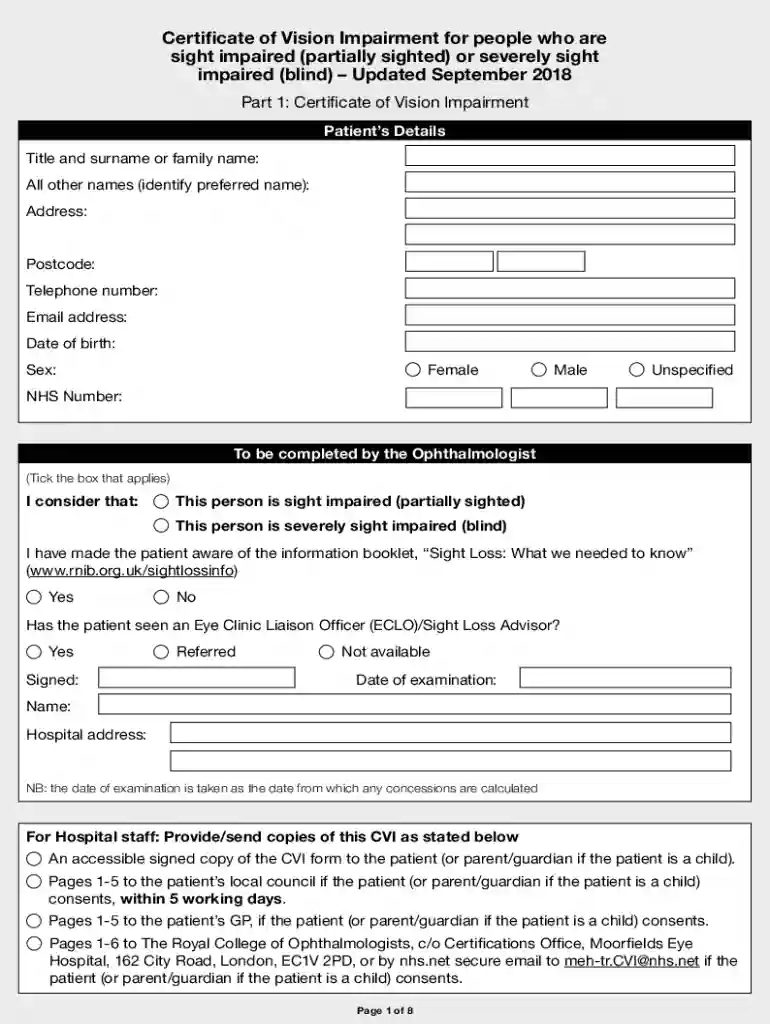
The Certificate of Visual Impairment (CVI) is an essential document for individuals diagnosed as sight impaired or severely sight impaired. This certificate, often used within the UK, serves as a formal acknowledgment of an individual's visual condition. Its primary purposes include enabling access to specialized support services, facilitating the registration with local councils, and contributing to national data on eye health. By formally documenting visual impairment, the CVI also helps inform healthcare strategies and improve eye care services.
Accessing the Certificate of Visual Impairment offers several benefits for those who are diagnosed as sight impaired. It ensures legal recognition of visual impairment, which enables the individual to receive tailored support services. Additionally, the certificate speaks to various government and non-government agencies to streamline the provision of aids, financial support, and accessibility resources. Furthermore, it plays a role in gathering data on vision loss, aiding eye care professionals in enhancing preventive and supportive measures.
Holding a CVI provides an avenue for individuals to connect with rehabilitation services. These services often include mobility training, orientation, and life skills education, which are crucial for adapting to visual limitations. Access to assistive technologies designed to enhance independence is also a key benefit.
The process for acquiring a Certificate of Visual Impairment involves several steps. Typically, an ophthalmologist or an optometrist must assess the individual. Based on these assessments, the healthcare provider completes the CVI form, documenting the level of sight impairment. Following the completion of the form, the patient or their representative submits it to the local council.
The Certificate of Visual Impairment serves a critical legal function for individuals with declared visual impairments. It sets the foundation for legal protections under disability rights laws and facilitates access to resources typically provided by local government agencies. It also plays a significant role in insurance matters, disability evaluations, and workplace accommodations for affected individuals.
Providing accurate and comprehensive details within the CVI form is imperative. Errors or omissions can delay access to support services and may result in improper data collection, which is vital for understanding public health trends.
Primarily, individuals diagnosed with a significant level of visual impairment use the Certificate of Visual Impairment. These individuals often rely on the document to gain recognition of their condition, access specialized support, and ensure appropriate accommodations in various environments.


Understanding the terminology surrounding the Certificate of Visual Impairment is critical for those using or processing the document.
Real-world applicability of the Certificate of Visual Impairment spans multiple domains. For example, in healthcare, the CVI enables coordinated care plans that address individual needs. In social services, it supports applications for disability benefits and home modification grants.
Engaging with the Certificate of Visual Impairment involves understanding its comprehensive use, the benefits it provides, and the processes involved in obtaining and utilizing it effectively.
We've got more versions of the certificate vision impairment form form. Select the right certificate vision impairment form version from the list and start editing it straight away!
At DocHub, your data security is our priority. We follow HIPAA, SOC2, GDPR, and other standards, so you can work on your documents with confidence.


