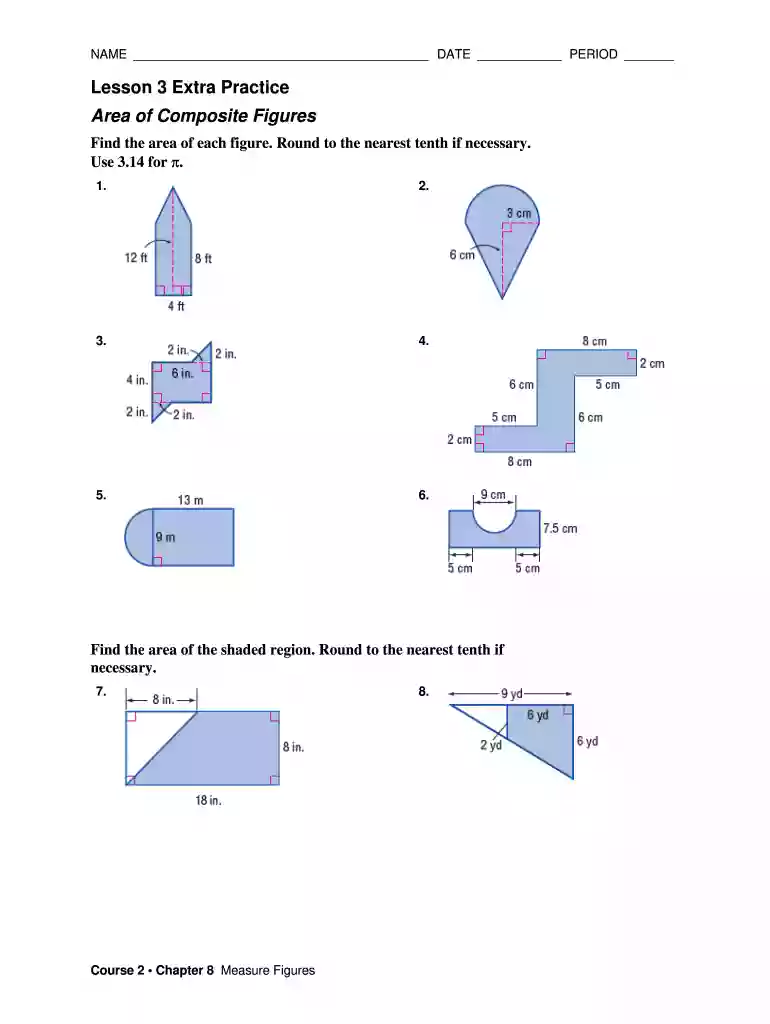
Lesson 3 extra practice area of composite figures answer key 2026

Get Form
district area composite figures Preview on Page 1

Here's how it works

01. Edit your district area composite figures online
Type text, add images, blackout confidential details, add comments, highlights and more.

02. Sign it in a few clicks
Draw your signature, type it, upload its image, or use your mobile device as a signature pad.

03. Share your form with others
Send it via email, link, or fax. You can also download it, export it or print it out.

How to use or fill out lesson 3 extra practice area of composite figures answer key with our platform

Form edit decoration
9.5
Ease of Setup
DocHub User Ratings on G2
9.0
Ease of Use
DocHub User Ratings on G2
  1. Click ‘Get Form’ to open the lesson 3 extra practice area of composite figures answer key in the editor.
  2. Begin by entering your name, date, and period in the designated fields at the top of the form. This personalizes your document and ensures proper identification.
  3. Proceed to each question where you will find areas listed for various figures. Use the provided dimensions and apply the formula for area as needed, rounding your answers to the nearest tenth.
  4. For questions that require finding the area of shaded regions, carefully analyze the figure and apply subtraction if necessary. Ensure you round your final answers appropriately.
  5. Once all fields are completed, review your entries for accuracy before saving or exporting your document directly from our platform.

Start using our platform today to effortlessly complete your lesson 3 extra practice area of composite figures answer key for free!

be ready to get more

Complete this form in 5 minutes or less

Get form

Got questions?

We have answers to the most popular questions from our customers. If you can't find an answer to your question, please contact us.
Contact us
Any number that is divisible by itself, 1, and another number is considered a composite number. The smallest composite numbers that students will encounter are 4, 6, 8, and 9 each of which has at least three factors. Four, for example, is divisible by 1, 2, and 4.
These composed figures are often called irregular figures or composite figures. In most cases, you can separate the composite figures into simpler shapes whose areas you can find, and then add these areas together. It is important to note that these simple shapes may not overlap.
A house is a common example of a composite figure. The house shape is made up of a square and a triangle. An example of a composite figure can be seen in an ice cream cone. The ice cream cone shape is made up of a triangle and a semicircle.
0:53 10:06 And one square to find out the area of this composite. Figure we just need need to get the area ofMoreAnd one square to find out the area of this composite. Figure we just need need to get the area of each geometric shape. And combine them together.
We can think of a composite shape as one that is made from a number of smaller shapes. Many complicated shapes can be made by combining simple shapes like triangles, squares, rectangles, and parallelograms in different ways. The rectangle on the left is a composite shape built from two smaller constituent triangles.

Security and compliance

At DocHub, your data security is our priority. We follow HIPAA, SOC2, GDPR, and other standards, so you can work on your documents with confidence.

Learn more
ccpa2
pci-dss
gdpr-compliance
hipaa
soc-compliance

People also ask

0:44 1:20 And a triangle thats the second shape in the third. Example if you draw this invisible. Line weMoreAnd a triangle thats the second shape in the third. Example if you draw this invisible. Line we have two basic shapes a rectangle shape one and a triangle shape two and in the last. Example.

Related links