
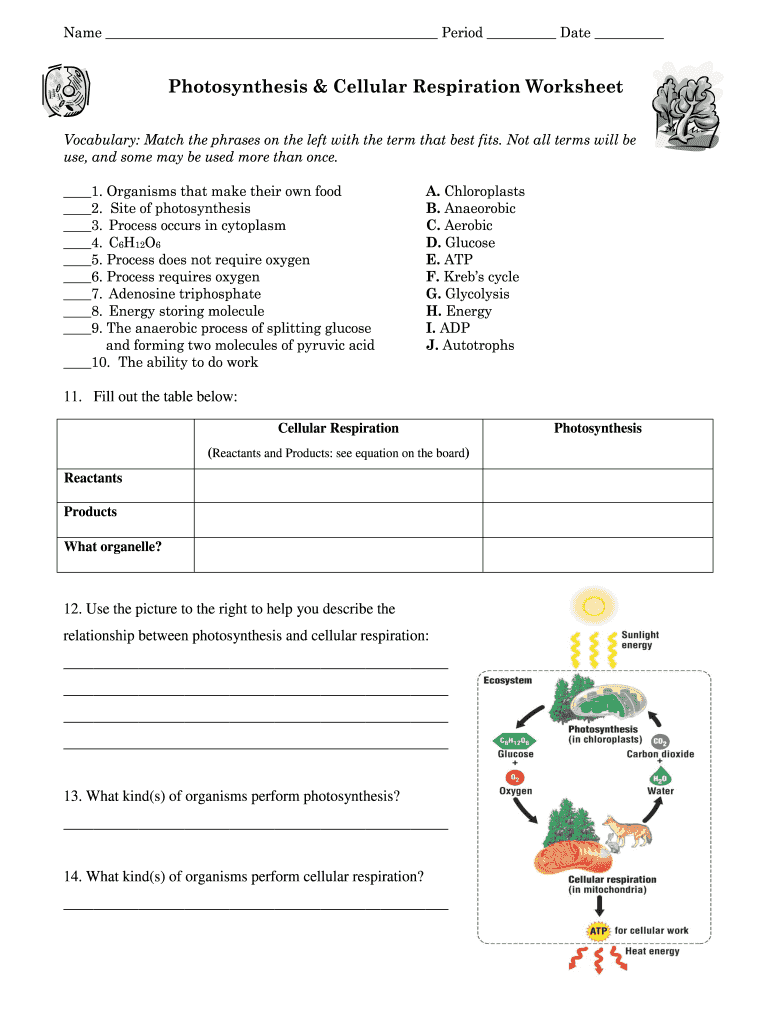







Definition and Meaning of Cellular Respiration Worksheet
The cellular respiration worksheet is an educational tool designed to facilitate the understanding of the processes of cellular respiration, a fundamental biological function in living organisms. This worksheet typically includes various formats such as fill-in-the-blank questions, multiple-choice items, and vocabulary matching exercises that help reinforce key concepts. It is commonly used in middle school and high school science curricula to assess students’ knowledge of essential terms and processes related to cellular respiration, including glycolysis, the Krebs cycle, and electron transport chains.
This worksheet aims to deepen comprehension of how cells convert glucose and oxygen into energy, carbon dioxide, and water. It highlights the relationship between cellular respiration and photosynthesis, as both processes play critical roles in the energy dynamics of ecosystems.
How to Use the Cellular Respiration Worksheet
Using a cellular respiration worksheet effectively involves following a systematic approach to enhance learning outcomes. Here are the key steps:
- Review the Material: Before tackling the worksheet, students should review their class notes or textbooks on cellular respiration to solidify their understanding.
- Complete the Questions: Carefully read each question and answer them to the best of your ability. Pay close attention to terms like ATP, mitochondria, anaerobic respiration, and fermentation.
- Collaborate with Peers: Discussing answers with classmates can clarify doubts and enhance understanding. Group study often leads to deeper insights.
- Check Answers: After completing the worksheet, students should compare their answers against the provided answer key, if available.
By engaging with these steps, students can reinforce their knowledge while identifying areas needing further clarification.
Key Elements of the Cellular Respiration Worksheet
Several crucial components make up the cellular respiration worksheet, ensuring comprehensive coverage of the topic. Key elements typically include:
- Vocabulary Section: This often involves matching terms with their definitions. Essential vocabulary may include aerobic, anaerobic, glycolysis, and ATP.
- Process Diagrams: Visual representations of the cellular respiration processes are often included to help students visualize complex pathways.
- Sample Questions: These may encompass various formats such as:
- Fill-in-the-blank questions about key reactants and products.
- True/false statements to test comprehension of basic facts.
- Short answer questions that require elaboration on specific processes, such as the differences between aerobic and anaerobic respiration.
By integrating these elements, the worksheet serves as a holistic educational resource that caters to different learning styles.
Examples of Using the Cellular Respiration Worksheet
There are various practical scenarios where a cellular respiration worksheet proves valuable in educational settings. Some examples include:
- Classroom Assignments: Teachers may assign the worksheet after a unit on cellular respiration to assess students' grasp of the topic.
- Study Guides: Students can utilize the worksheet as a self-study guide, revisiting it before tests to solidify key concepts.
- Group Projects: In group settings, students can divide sections of the worksheet, allowing them to present respective portions to the class, fostering collaborative learning.
These applications show how the worksheet extends beyond mere evaluation, becoming a dynamic tool for knowledge acquisition.
Important Terms Related to Cellular Respiration Worksheet
Familiarity with important terms enriches a student's understanding of cellular respiration. Key terms often found on the worksheet may include:
- Glycolysis: This is the initial stage of cellular respiration where glucose is split into two molecules of pyruvate.
- Krebs Cycle: Also known as the citric acid cycle, this stage involves a series of chemical reactions to produce energy carriers.
- Electron Transport Chain: This is the final stage of cellular respiration, where the bulk of ATP is produced through oxidative phosphorylation.
Understanding these terms enables students to engage more deeply with the subject matter and enhances their ability to navigate discussions surrounding cellular respiration.


