Request For Safety Footwear 2026

Get Form
request for safety shoes email Preview on Page 1

Here's how it works

01. Edit your request for safety shoes email online
Type text, add images, blackout confidential details, add comments, highlights and more.
02. Sign it in a few clicks
Draw your signature, type it, upload its image, or use your mobile device as a signature pad.
03. Share your form with others
Send safety shoes request letter sample via email, link, or fax. You can also download it, export it or print it out.

How to use or fill out Request For Safety Footwear with our platform

Form edit decoration
9.5
Ease of Setup
DocHub User Ratings on G2
9.0
Ease of Use
DocHub User Ratings on G2
  1. Click ‘Get Form’ to open the Request For Safety Footwear in the editor.
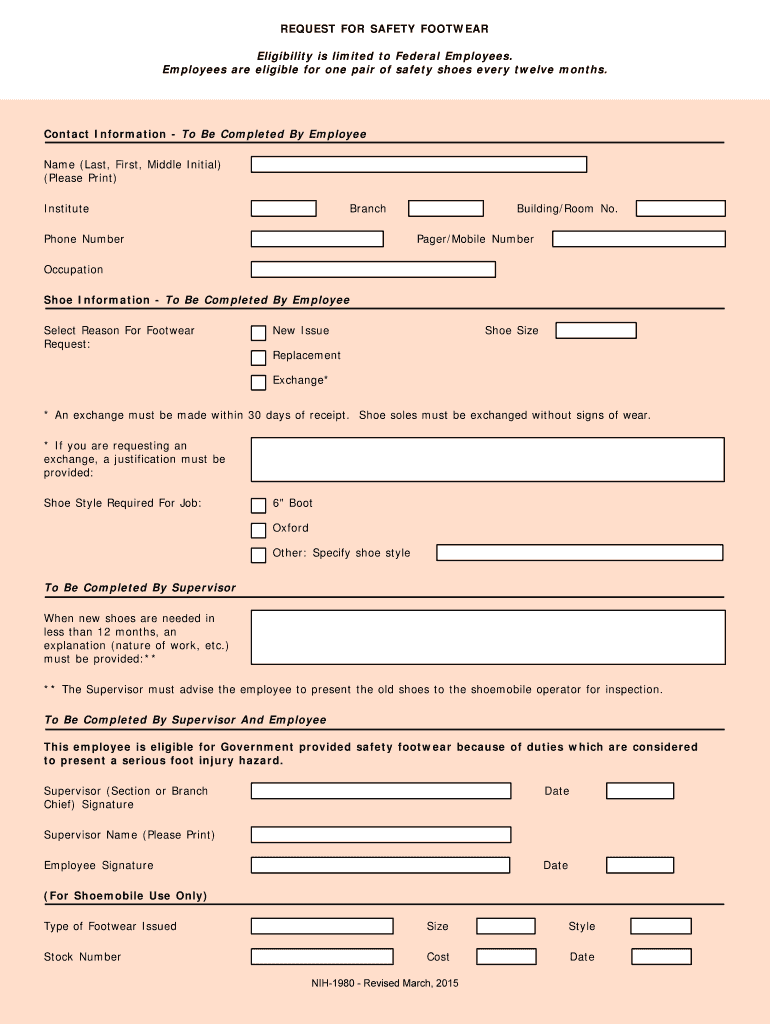
  2. Begin by filling out your contact information. Enter your name (Last, First, Middle Initial), institute, branch, phone number, building/room number, pager/mobile number, and occupation in the designated fields.
  3. Next, move to the Shoe Information section. Select the reason for your footwear request: New Issue, Replacement, or Exchange. If you choose Exchange, ensure you provide a justification as required.
  4. Specify your shoe size and style required for your job from the options provided (6" Boot, Oxford, or Other).
  5. The supervisor must complete their section if new shoes are needed in less than 12 months. They should provide an explanation and advise you to present old shoes for inspection.
  6. Finally, both you and your supervisor need to sign and date the form at the bottom before submission.

Start using our platform today to easily fill out and submit your Request For Safety Footwear form for free!

be ready to get more

Complete this form in 5 minutes or less

Get form

Got questions?

We have answers to the most popular questions from our customers. If you can't find an answer to your question, please contact us.
Contact us
Consistent with the federal OSHA regulations, Cal/OSHA regulations provide that [a]ppropriate foot protection shall be required for employees who are exposed to foot injuries from electrical hazards, hot, corrosive, poisonous substances, falling objects, crushing or penetrating actions, which may cause injuries or who
With few exceptions, OSHA requires employers to pay for personal protective equipment when it is used to comply with OSHA standards. These typically include: hard hats, gloves, goggles, safety shoes, safety glasses, welding helmets and goggles, face shields, chemical protective equipment and fall protection equipment.
I would like to bring to your notice that my safety shoes have become old and worn out. So I request you to issue me a new pair of safety shoes. I am working in the production department of your company for the past ten years. I was given new safety shoes three years back.
Employers duties If any risks are found then they must be removed or reduced. The Personal Protective Equipment at Work Regulations 1999 also say that, if a risk has been identified and cannot be controlled any other way, then protective equipment must be provided. This includes footwear.
The standard EN ISO 20345 defines both the basic and additional requirements for safety shoes for commercial use. Footwear in accordance with EN ISO 20345 is intended to protect the wearer from bumps, crushing, falling or rolling objects, from walking into sharp or pointed objects, heat or cold, and hot substances.

Security and compliance

At DocHub, your data security is our priority. We follow HIPAA, SOC2, GDPR, and other standards, so you can work on your documents with confidence.

Learn more
ccpa2
pci-dss
gdpr-compliance
hipaa
soc-compliance

People also ask

Safety footwear has a toecap that reliably protects the foot from pressure and shocks of up to 200 joules of energy and has the EN ISO 20345 standard. It should be used where there is a risk of injury due to a fall of a heavy object, impact, or sharp objects.
Safety toe protective footwear must be worn at all times regardless of the presence of a hazard; and the safety toe protective footwear must meet the following requirements - leather uppers, oil resistant and non-skid soles, and American Society for Testing and Materials (ASTM) F2413-05 with an impact resistance rate

sample request letter for new safety shoes