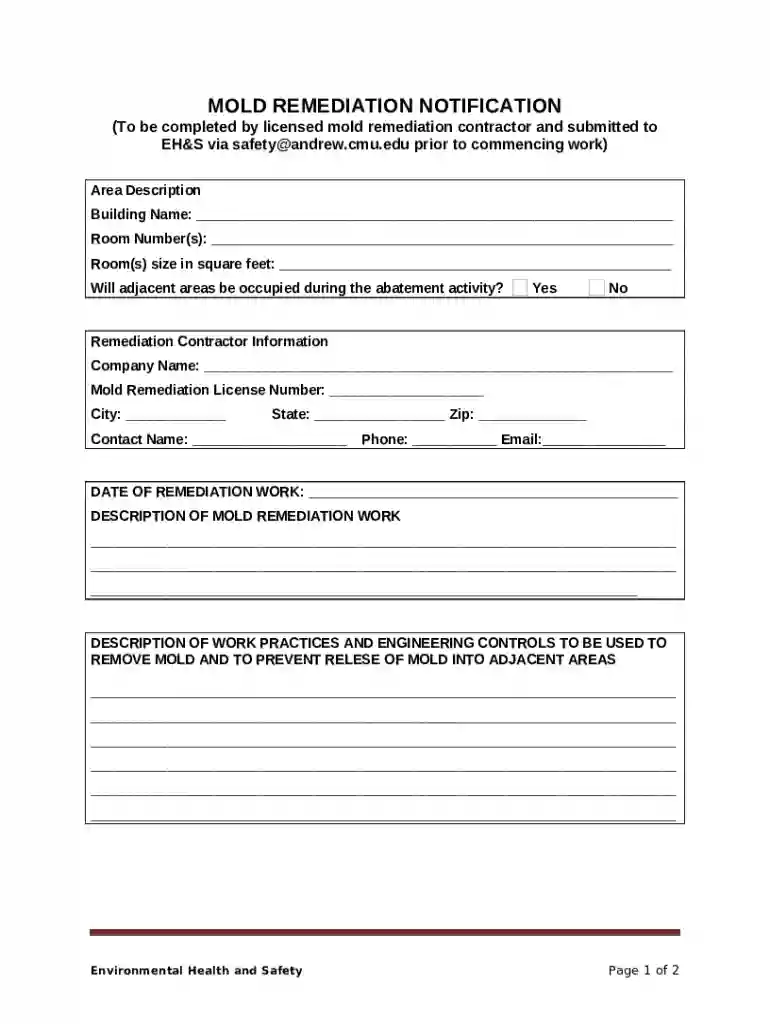
Mold Remediation Notification 2026

Get Form
mold remediation certification virginia Preview on Page 1

Here's how it works

01. Edit your mold remediation certification virginia online
Type text, add images, blackout confidential details, add comments, highlights and more.

02. Sign it in a few clicks
Draw your signature, type it, upload its image, or use your mobile device as a signature pad.

03. Share your form with others
Send it via email, link, or fax. You can also download it, export it or print it out.

How to use or fill out Mold Remediation Notification with our platform

Form edit decoration
9.5
Ease of Setup
DocHub User Ratings on G2
9.0
Ease of Use
DocHub User Ratings on G2
  1. Click ‘Get Form’ to open the Mold Remediation Notification in the editor.
  2. Begin by filling out the 'Area Description' section. Enter the building name, room number(s), and the size of the room(s) in square feet. Indicate whether adjacent areas will be occupied during remediation by selecting 'Yes' or 'No'.
  3. In the 'Remediation Contractor Information' section, provide your company name, mold remediation license number, city, state, and zip code. Include your contact name, phone number, and email address for communication.
  4. Specify the date of remediation work and describe the mold remediation activities planned. Be detailed in outlining work practices and engineering controls that will be implemented to prevent mold release into adjacent areas.
  5. Detail personal protective equipment that will be worn by personnel during remediation. Additionally, describe waste disposal procedures for mold-contaminated materials and post-remediation cleanup processes.
  6. Attach any relevant information such as plans or proposals regarding the remediation project before submitting it via email to EH&S.

Start using our platform today to streamline your Mold Remediation Notification process for free!

See more Mold Remediation Notification versions

We've got more versions of the Mold Remediation Notification form. Select the right Mold Remediation Notification version from the list and start editing it straight away!
Versions Form popularity Fillable & printable
2021 4.1 Satisfied (50 Votes)
2021 4.4 Satisfied (40 Votes)
be ready to get more

Complete this form in 5 minutes or less

Get form

Got questions?

We have answers to the most popular questions from our customers. If you can't find an answer to your question, please contact us.
Contact us
The Health of You and Your Family Members If you have a strong immune system, can you stay in your home during mold remediation? Not necessarily. Experts generally dont recommend being anywhere near a mold infestation because of the serious health risks.
The only time mold will return to the same area as it was growing in during pre-remediation is when the source of the mold problem was not originally taken care of. This could include: Broken or leaky pipes. Poor insulation.
Mold remediation should be done as soon as you detect visible mold or suspect hidden mold growth. Delays in addressing the issue can lead to structural damage, health risks, and increased remediation costs. If you notice a musty odor, water damage, or experience allergy-like symptoms, its time to act.
However, extensive mold growth, persistent odors, or mold caused by water damage require professional remediation. A good rule of thumb is to hire a pro when the mold is in an area larger than 10 square feet, poses health risks, or affects the structural integrity of your home.
What are symptoms and effects of mold exposure? Nasal and sinus congestion. Eye irritation, such as itchy, red, watery eyes. Wheezing and difficulty breathing. Cough. Throat irritation. Skin irritation, such as a rash. Headache.

Security and compliance

At DocHub, your data security is our priority. We follow HIPAA, SOC2, GDPR, and other standards, so you can work on your documents with confidence.

Learn more
ccpa2
pci-dss
gdpr-compliance
hipaa
soc-compliance

People also ask

Some people are at risk of significant and even severe health effects from mold exposure. These individuals should not take part in cleaning up: People with allergies, who may be more sensitive to molds. People with immune suppression or underlying lung disease, who are at higher risk of fungal infections.

Related links