DOR Sales & Use Tax e-File Transmission 2026

Get Form
DOR Sales & Use Tax e-File Transmission Preview on Page 1

Here's how it works

01. Edit your form online
Type text, add images, blackout confidential details, add comments, highlights and more.

02. Sign it in a few clicks
Draw your signature, type it, upload its image, or use your mobile device as a signature pad.

03. Share your form with others
Send it via email, link, or fax. You can also download it, export it or print it out.

How to use or fill out DOR Sales & Use Tax e-File Transmission with our platform

Form edit decoration
9.5
Ease of Setup
DocHub User Ratings on G2
9.0
Ease of Use
DocHub User Ratings on G2
  1. Click ‘Get Form’ to open the DOR Sales & Use Tax e-File Transmission in the editor.
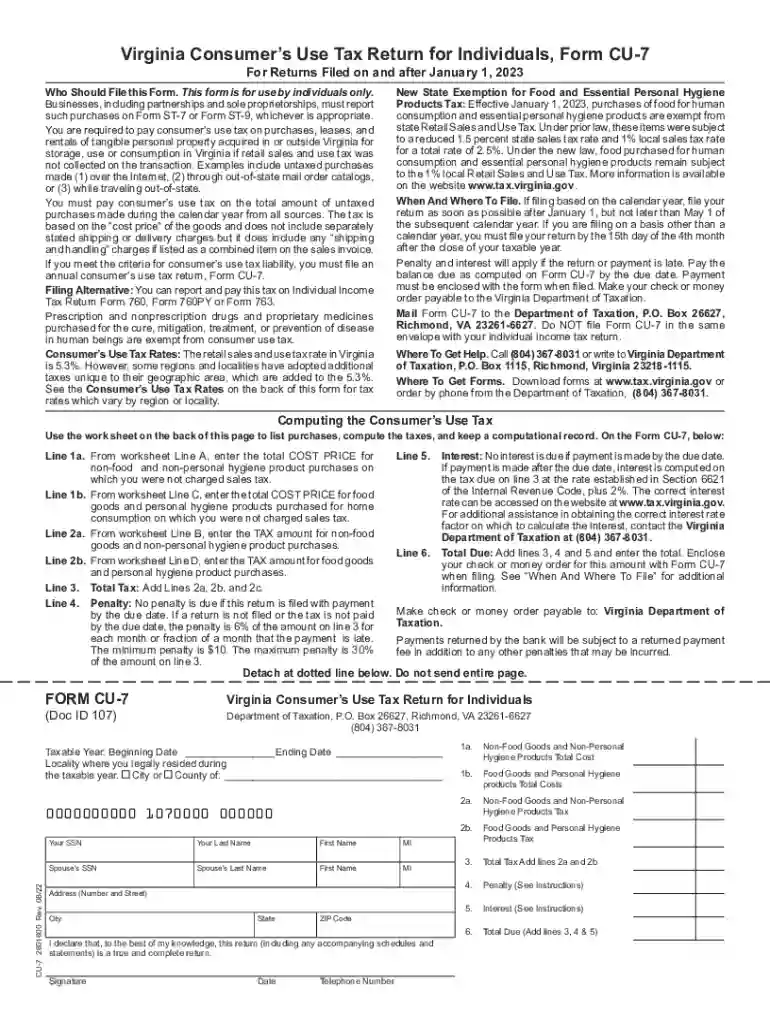
  2. Begin by entering your personal information, including your name, Social Security Number, and address. Ensure all details are accurate for proper processing.
  3. In the 'Taxable Year' section, specify the beginning and ending dates of your taxable year. This is crucial for determining your tax obligations.
  4. Use the worksheet provided to calculate your total cost price for non-food goods and personal hygiene products. Enter these amounts in Lines 1a and 1b respectively.
  5. Calculate the tax due based on your total costs from the worksheet. Input these figures into Lines 2a and 2b.
  6. Add up all relevant lines to determine your total tax due on Line 3. Include any penalties or interest as applicable in Lines 4 and 5.
  7. Finally, review all entries for accuracy before submitting. Once satisfied, save or print your completed form directly from our platform.

Start using our platform today to simplify your DOR Sales & Use Tax e-Filing process for free!

See more DOR Sales & Use Tax e-File Transmission versions

We've got more versions of the DOR Sales & Use Tax e-File Transmission form. Select the right DOR Sales & Use Tax e-File Transmission version from the list and start editing it straight away!
Versions Form popularity Fillable & printable
2023 4.6 Satisfied (33 Votes)
2022 4.8 Satisfied (81 Votes)
2021 3.8 Satisfied (28 Votes)
2020 4.1 Satisfied (63 Votes)
2019 4.1 Satisfied (26 Votes)
2019 3.7 Satisfied (31 Votes)
2016 4.2 Satisfied (71 Votes)
2015 4.2 Satisfied (56 Votes)
2014 4.3 Satisfied (29 Votes)
2012 4.3 Satisfied (38 Votes)
2010 4 Satisfied (37 Votes)
2008 4.2 Satisfied (74 Votes)
2007 4 Satisfied (43 Votes)
2006 4.2 Satisfied (59 Votes)
be ready to get more

Complete this form in 5 minutes or less

Get form

Got questions?

We have answers to the most popular questions from our customers. If you can't find an answer to your question, please contact us.
Contact us
Definition. A transmitter sends the electronic return data directly to the IRS. Electronic Return Originators (EROs) may apply to be transmitters and transmit return data themselves, or they may contract with an accepted third-party transmitter to transmit the data.
The 80/80 rule applies when more than 80 percent of your sales are food and more than 80 percent of the food you sell is taxable. If the 80/80 rule applies and you do not separately track sales of cold food products sold to-go, you are responsible for tax on 100 percent of your sales.
If you pay online on the due date, your transaction must be completed by 3:00 p.m. Pacific time, to ensure your funds are deposited into CDTFAs bank account by the next banking day.
A 10 percent penalty if your tax payment is late. If you file a late return and make a late tax payment, your penalty will not exceed 10 percent of the amount of tax due for the reporting period.
electronic filing (e-file) The transmission of tax information directly to the IRS using the Internet. Electronic filing options include (1) Online self-prepared using a personal computer and tax preparation software, or (2) using a tax professional.

Security and compliance

At DocHub, your data security is our priority. We follow HIPAA, SOC2, GDPR, and other standards, so you can work on your documents with confidence.

Learn more
ccpa2
pci-dss
gdpr-compliance
hipaa
soc-compliance

People also ask

When to file. If youre a calendar year filer and your tax year ends on December 31, the due date for filing your federal individual income tax return is generally April 15 of each year.
Tax transmission refers to sending the return to the taxing authority.

Related links