




Here's how it works

01. Edit your schedule ec form online
Type text, add images, blackout confidential details, add comments, highlights and more.

02. Sign it in a few clicks
Draw your signature, type it, upload its image, or use your mobile device as a signature pad.

03. Share your form with others
Send massachusetts ec via email, link, or fax. You can also download it, export it or print it out.
How to use or fill out Residential Renewable Energy Income Tax Credit with our platform

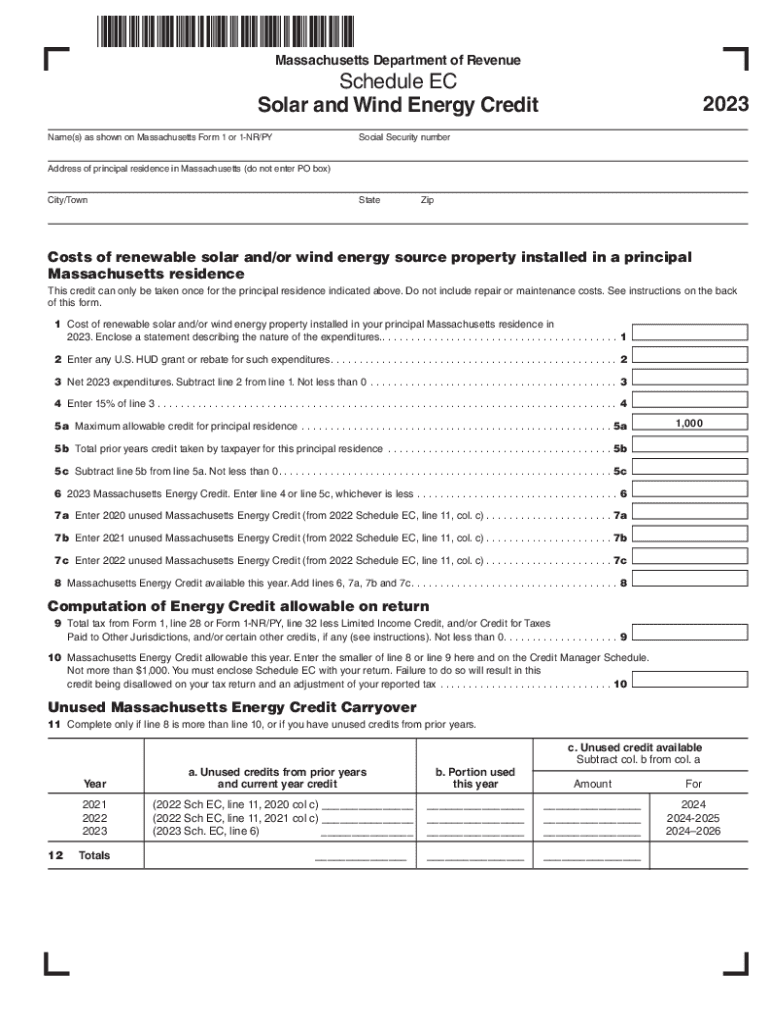
- Click ‘Get Form’ to open the Residential Renewable Energy Income Tax Credit in the editor.
- Begin by entering your name(s) as shown on Massachusetts Form 1 or 1-NR/PY, along with your Social Security number and address of your principal residence in Massachusetts. Ensure you do not use a PO box.
- In line 1, input the total cost of renewable solar and/or wind energy property installed in your principal residence for 2023. Remember to exclude repair or maintenance costs.
- For line 2, enter any U.S. HUD grant or rebate received for these expenditures.
- Calculate net expenditures by subtracting line 2 from line 1 and enter this amount in line 3. Ensure it is not less than zero.
- In line 4, calculate and enter 15% of the amount from line 3.
- Complete lines 5a through 10 to determine your maximum allowable credit and ensure you enclose Schedule EC with your return.
Start using our platform today to easily fill out your Residential Renewable Energy Income Tax Credit form for free!
Fill out Residential Renewable Energy Income Tax Credit online
It's free
It's free
See more Residential Renewable Energy Income Tax Credit versions
We've got more versions of the Residential Renewable Energy Income Tax Credit form. Select the right Residential Renewable Energy Income Tax Credit version from the list and start editing it straight away!
| Versions | Form popularity | Fillable & printable |
|---|---|---|
| 2025 | 4.3 Satisfied (34 Votes) | |
| 2024 | 4.6 Satisfied (29 Votes) | |
| 2023 | 4.2 Satisfied (42 Votes) | |
| 2022 | 4.2 Satisfied (20 Votes) | |
| 2021 | 4.8 Satisfied (84 Votes) | |
| 2020 | 4.3 Satisfied (77 Votes) | |
| 2018 | 4.3 Satisfied (112 Votes) | |
| 2016 | 4.4 Satisfied (179 Votes) | |
| 2011 | 4.4 Satisfied (364 Votes) |
Security and compliance
At DocHub, your data security is our priority. We follow HIPAA, SOC2, GDPR, and other standards, so you can work on your documents with confidence.
Learn more


