




Here's how it works

01. Edit your form online
Type text, add images, blackout confidential details, add comments, highlights and more.

02. Sign it in a few clicks
Draw your signature, type it, upload its image, or use your mobile device as a signature pad.

03. Share your form with others
Send it via email, link, or fax. You can also download it, export it or print it out.
How to use or fill out Live Local Act: Sales Tax Refund for Affordable Housing with our platform

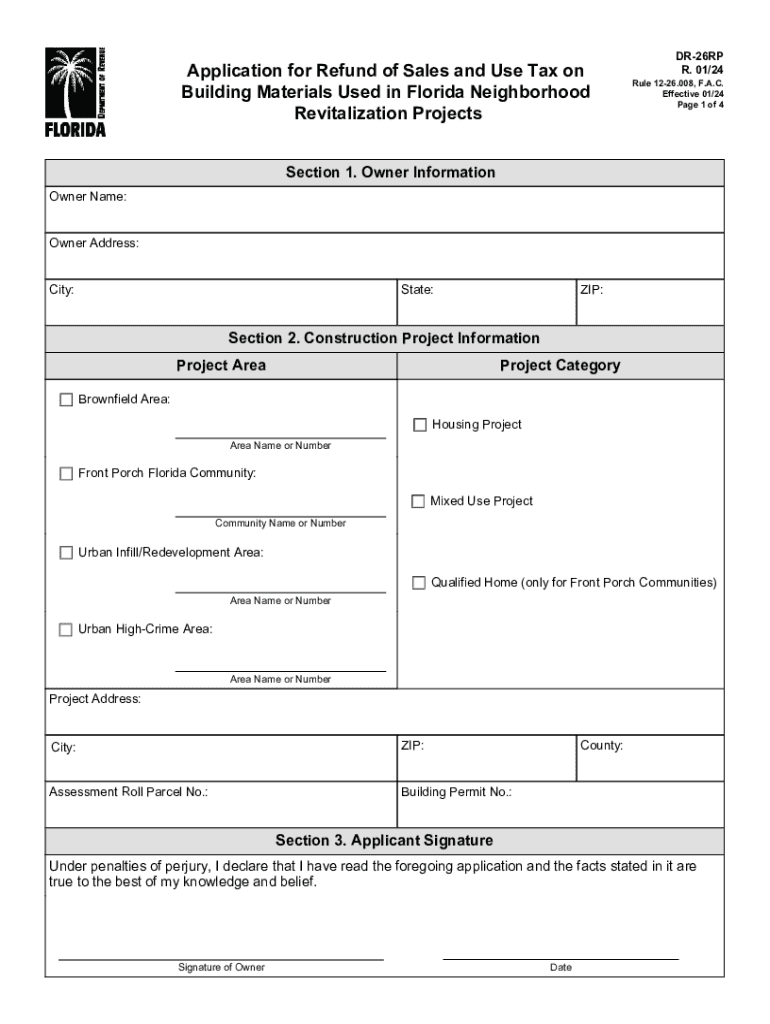
- Click ‘Get Form’ to open the Live Local Act: Sales Tax Refund for Affordable Housing in the editor.
- Begin by filling out Section 1, Owner Information. Enter your name, address, city, state, and ZIP code accurately.
- Proceed to Section 2, Construction Project Information. Provide details about the project area and category. Specify if it’s a housing project or mixed-use project and include relevant area names or numbers.
- In Section 3, Applicant Signature, ensure you sign and date the application. This declaration confirms that all information provided is true to the best of your knowledge.
- Gather required documentation as outlined in the general instructions. This includes building permits, invoices showing sales tax paid, and any necessary sworn statements.
- Once completed, submit your application along with all documentation either by mail or electronically through our platform for a streamlined process.
Start using our platform today to simplify your form completion process for free!
Fill out Live Local Act: Sales Tax Refund for Affordable Housing online
It's free
It's free
See more Live Local Act: Sales Tax Refund for Affordable Housing versions
We've got more versions of the Live Local Act: Sales Tax Refund for Affordable Housing form. Select the right Live Local Act: Sales Tax Refund for Affordable Housing version from the list and start editing it straight away!
Got questions?
We have answers to the most popular questions from our customers. If you can't find an answer to your question, please contact us.
Contact us
What is the property tax exemption for the Live Local Act?
Units within eligible developments that serve households from 80-120 percent AMI receive a 75 percent property tax exemption and units that serve households below 80 percent AMI receive a 100 percent property tax exemption.
How do you qualify for the Live Local Act in Florida?
Passed as part of the 2024 Legislative Sessions tax package (House Bill 7073), this amendment to the Live Local Act allows taxing authorities to opt-out from providing the 75 percent Missing Middle property tax exemption in their jurisdiction to those units that fall within the 80-120 percent AMI affordability
What is the live local tax credit program?
The Live Local Tax Credit Program gives businesses the opportunity to contribute to the Florida Housing Finance Corporation to benefit the State Apartment Incentive Loan (SAIL) Program, which provides low-interest loans for the development of quality affordable rental housing that can benefit a communitys workforce,
How do you opt out of the Live Local Act?
Can a county, city or school district opt out of the Live Local Act? A governing board of a county, city or school district can opt out of the missing-middle property-tax exemption through a supermajority vote of at least two-thirds of the board.
What is the Live Local Act for affordable housing?
The law applies to both counties and municipalities including the City of Fort Myers. The Live Local Act also authorizes the State to spend up to $811million in funds statewide on affordable housing. The new law also preempts rent control in the City. The Live Local Acts land use mandate expires October 1, 2033.
Security and compliance
At DocHub, your data security is our priority. We follow HIPAA, SOC2, GDPR, and other standards, so you can work on your documents with confidence.
Learn more


People also ask
What is the tax abatement for affordable housing?
Tax abatement programs can be used by state or local governments to provide a financial incentive for developers of multifamily rental housing. Often these only apply to rents affordable to certain income levels, or that are developed or rehabilitated in certain areas.