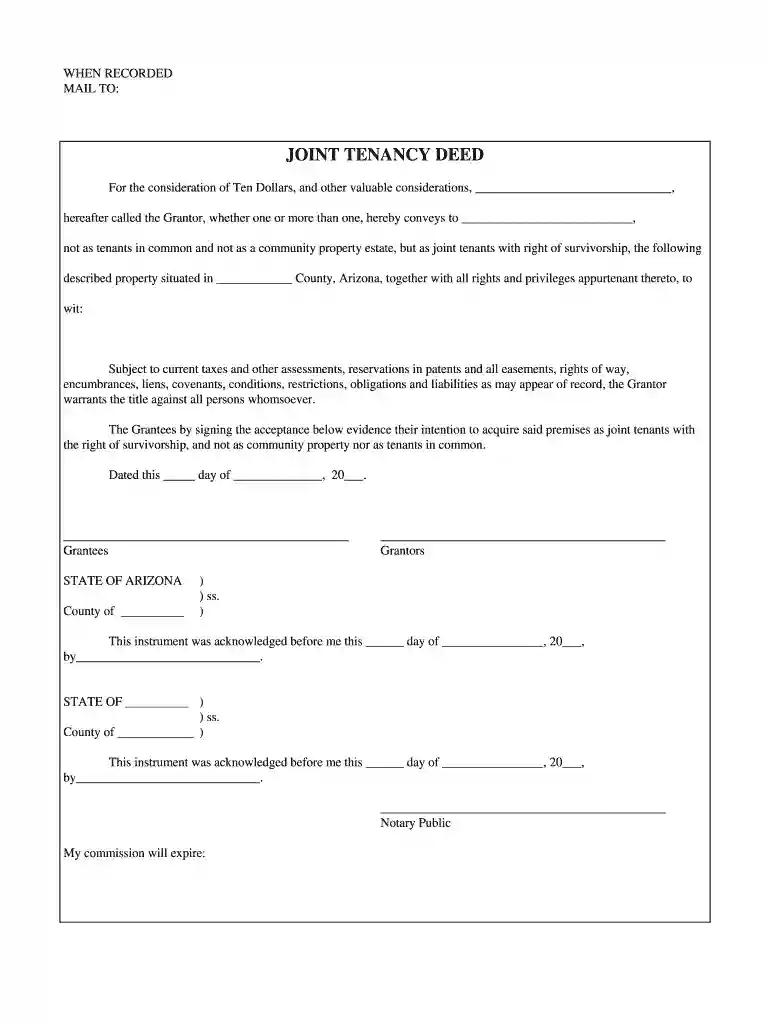
Arizona joint tenancy deed 2025

Get Form
joint tenancy with right of survivorship arizona form Preview on Page 1

Here's how it works

01. Edit your joint tenancy with right of survivorship arizona form online
Type text, add images, blackout confidential details, add comments, highlights and more.

02. Sign it in a few clicks
Draw your signature, type it, upload its image, or use your mobile device as a signature pad.

03. Share your form with others
Send joint tenancy deed arizona via email, link, or fax. You can also download it, export it or print it out.

Understanding the Arizona Joint Tenancy Deed

A joint tenancy deed in Arizona, often referred to as a survivorship deed, allows multiple individuals to hold property jointly. This form of ownership is characterized by the right of survivorship, meaning if one owner passes away, their share automatically transfers to the surviving owners. This deed format can be essential in estate planning, providing a straightforward method to transfer property without needing probate.

Key Features of the Arizona Joint Tenancy Deed

  • Right of Survivorship: Upon the death of one joint tenant, that tenant's interest in the property passes directly to the surviving joint tenants.
  • Equal Ownership: All tenants have equal rights to the property. Each owner has an undivided interest, meaning they cannot sell or transfer their part without the consent of the other owners.
  • Creation of the Deed: The deed must explicitly state the intent to create a joint tenancy with the right of survivorship. This intention is crucial for the legal recognition of the tenancy.
  • Restrictions on Use: Joint tenancy may not be suitable in all scenarios, such as where a party wishes to control property individually.

How to Complete an Arizona Joint Tenancy Deed Form

Completing an Arizona joint tenancy deed requires adherence to specific legal formats and local laws.

  1. Gather Necessary Information:

    • Full names and legal addresses of all joint tenants.
    • Legal description of the property involved, which can be found on the existing deed or local property records.
  2. Draft the Deed:

    • The document should state the intent to establish a joint tenancy.
    • Include a clause relating to the right of survivorship explicitly.
  3. Signatures and Notarization:

    • All joint tenants must sign the deed in the presence of a notary public. This formalizes the document, ensuring it meets legal standards.
  4. Record the Deed:

    • After notarization, the deed must be recorded with the county recorder’s office where the property is located. This step is vital as it updates public property records.

Legal Considerations and Requirements in Arizona

The Arizona joint tenancy deed is governed by state-specific laws, including ARS 33-431. Understanding these legal requirements can prevent future disputes and complications.

  • Statutory Compliance: Ensure that the deed complies with all relevant state statutes to maintain its validity.
  • Potential Issues: Disputes may arise if the intent of the joint tenancy is not clear, or if not all joint tenants are included in the deed.

Practical Examples of Joint Tenancy in Arizona

Joint tenancy is popularly used in various scenarios such as:

  • Married Couples: Often opt for joint tenancy to ensure that property automatically transfers to the surviving partner.
  • Family Members: Siblings may choose joint ownership of inherited property, allowing for straightforward transition upon the death of one sibling.
  • Business Partnerships: In some cases, business partners may hold property in joint tenancy to simplify asset management.

Understanding the Risks and Benefits of Joint Tenancy

Benefits of Joint Tenancy

  • Avoids Probate: One of the most significant advantages is avoiding the lengthy and often costly probate process upon an owner’s death.
  • Simplicity: This form of ownership simplifies property management and security since all tenants have equal shares and rights.

Risks of Joint Tenancy

  • Potential Conflicts: Disagreements among tenants regarding the property’s use or sale can lead to conflicts.
  • Impact on Control: All tenants must agree on any sale or encumbrance of the property, which can limit individual decision-making capabilities.

Conclusion

An Arizona joint tenancy deed is a valuable tool for property ownership and estate planning. Understanding its features, legal requirements, and implications is essential for anyone considering this form of property ownership. The joint tenancy deed promotes seamless transfer of ownership and simplifies management, providing significant advantages while requiring careful consideration of the potential risks involved.

be ready to get more

Complete this form in 5 minutes or less

Get form

Got questions?

We have answers to the most popular questions from our customers. If you can't find an answer to your question, please contact us.
Contact us
Lack of control: Each joint tenant has equal rights, which means one party can force a sale or take out loans against the property. Unintended tax consequences: In California, joint tenancy can lead to unfavorable property tax reassessments or lost step-up in basis benefits.
A joint tenancy is a concurrent property interest that permits two or more individuals or legal entities to hold title to real, personal, and intellectual property. Fundamentally, it is a way for two or more persons to be seized in property as if they were one person. Graham v. Allen, 11 Ariz. App.
Joint tenants own a property in tandem, and they can go anywhere onto the property without restriction. Under joint tenancy, all parties share ownership of the property equally. With joint tenancy, surviving tenant(s) take ownership of the shares held by another tenant upon their death.
A joint tenancy is a concurrent property interest that permits two or more individuals or legal entities to hold title to real, personal, and intellectual property. Fundamentally, it is a way for two or more persons to be seized in property as if they were one person. Graham v. Allen, 11 Ariz.
Four requirements must be present to allow individuals to hold the title as joint tenants with rights of survivorship in Arizona: Unity of time the joint tenants must take possession of the property at the same time. Unity of title the joint tenants must take the title by the same document (i.e., a deed or will).

People also ask

If you titled the house in joint names, it would pass automatically to you and your spouse upon your mothers death. Medicaid would not attempt to recover the home to pay for care.
Joint tenants must receive their interest in the property from the same source, such as a deed or title. Equal interest. Joint tenants must possess an equal share of the property.

joint tenancy deed example