




Here's how it works

01. Edit your form online
Type text, add images, blackout confidential details, add comments, highlights and more.

02. Sign it in a few clicks
Draw your signature, type it, upload its image, or use your mobile device as a signature pad.

03. Share your form with others
Send it via email, link, or fax. You can also download it, export it or print it out.
How to use or fill out 12 CFR Part 370 Recordkeeping for Timely Deposit with our platform

- Click ‘Get Form’ to open it in the editor.
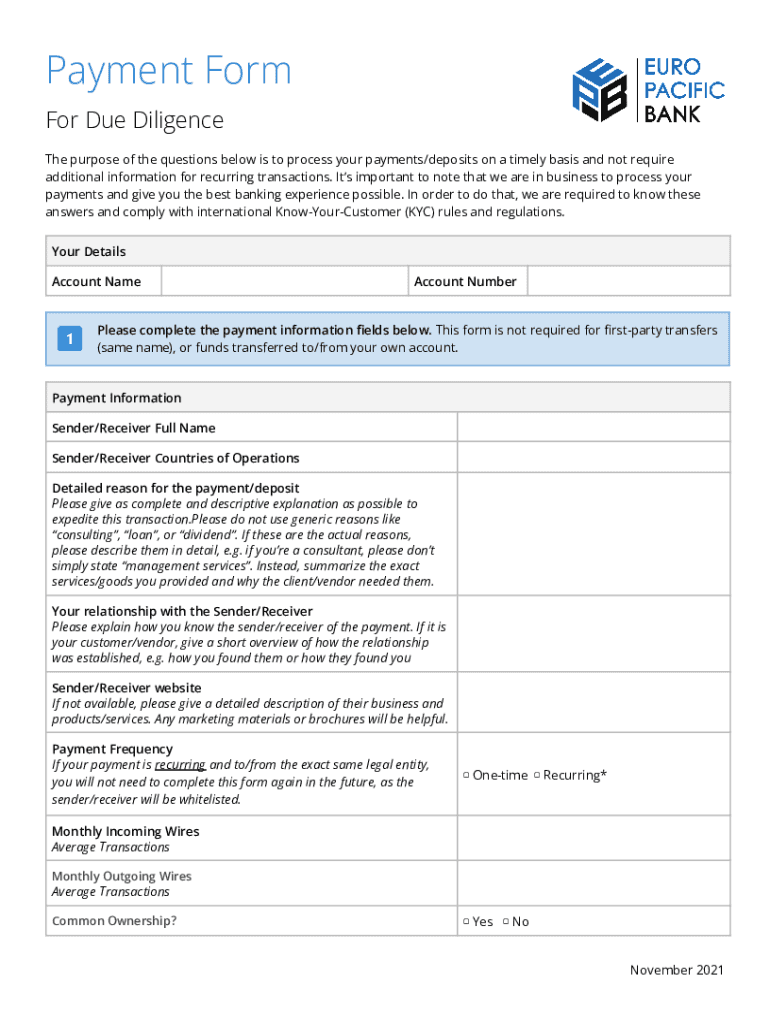
- Begin by entering your account details in the 'Your Details' section. Fill in your Account Name and Account Number accurately to ensure proper processing.
- In the 'Payment Information' section, provide the Sender/Receiver's Full Name and their Countries of Operations. Be specific about the reason for the payment/deposit; avoid generic terms and instead describe the services or goods provided.
- Detail your relationship with the Sender/Receiver. Explain how you know them, including any relevant background that establishes this connection.
- Indicate whether the payment is a one-time transaction or recurring. If it's recurring, note that you won't need to complete this form again for future transactions with the same entity.
- Attach any required documentation, such as invoices and supporting materials, ensuring they include all necessary business details.
- Once completed, review all entries for accuracy before submitting via eBanking secure message as instructed.
Start using our platform today to streamline your document editing and form completion process for free!
Fill out 12 CFR Part 370 Recordkeeping for Timely Deposit online
It's free
It's free
See more 12 CFR Part 370 Recordkeeping for Timely Deposit versions
We've got more versions of the 12 CFR Part 370 Recordkeeping for Timely Deposit form. Select the right 12 CFR Part 370 Recordkeeping for Timely Deposit version from the list and start editing it straight away!
Got questions?
We have answers to the most popular questions from our customers. If you can't find an answer to your question, please contact us.
Contact us
What is alternative recordkeeping FDIC?
A: The FDIC (Federal Deposit Insurance Corporation) is an independent agency of the United States government that protects bank depositors against the loss of their insured deposits in the event that an FDIC-insured bank or savings association fails.
What does FDIC mean?
This section describes the following FDIC ownership categories and the requirements a depositor must meet to qualify for insurance coverage above $250,000 at one insured bank. Single Accounts. Certain Retirement Accounts. Joint Accounts. Trust Accounts. Employee Benefit Plan Accounts.
What is 12 CFR Part 370 recordkeeping for timely deposit insurance determination?
The Recordkeeping for Timely Deposit Insurance Determination rule (12 CFR Part 370 of the FDICs Rules and Regulations) requires each insured depository institution that has two million or more deposit accounts (a Covered Institution as defined in 370.2(c) of the rule) to (1) configure its information technology
What is not a deposit account record for the purpose of calculating deposit insurance?
Alternative recordkeeping allows for the electronic submission of third party funds owner information in order to expedite the insurance determination. Files are only submitted in the event of failure and requirements are outlined in the FDIC Deposit Brokers Processing Guide.
What are the 6 types of accounts that the FDIC insures?
Wells Fargo, and its Bank and non-bank affiliates, also offers a range of products and investment accounts that do not qualify as deposits and are therefore not covered by FDIC insurance.
Security and compliance
At DocHub, your data security is our priority. We follow HIPAA, SOC2, GDPR, and other standards, so you can work on your documents with confidence.
Learn more


People also ask
Why is Wells Fargo not insured by the FDIC?
The FDIC (Federal Deposit Insurance Corporation) is an independent agency of the United States government. It protects depositors (bank customers) against the loss of their insured deposits (balances in savings accounts, checking accounts, etc.) in the unlikely event that an FDIC-insured bank fails.