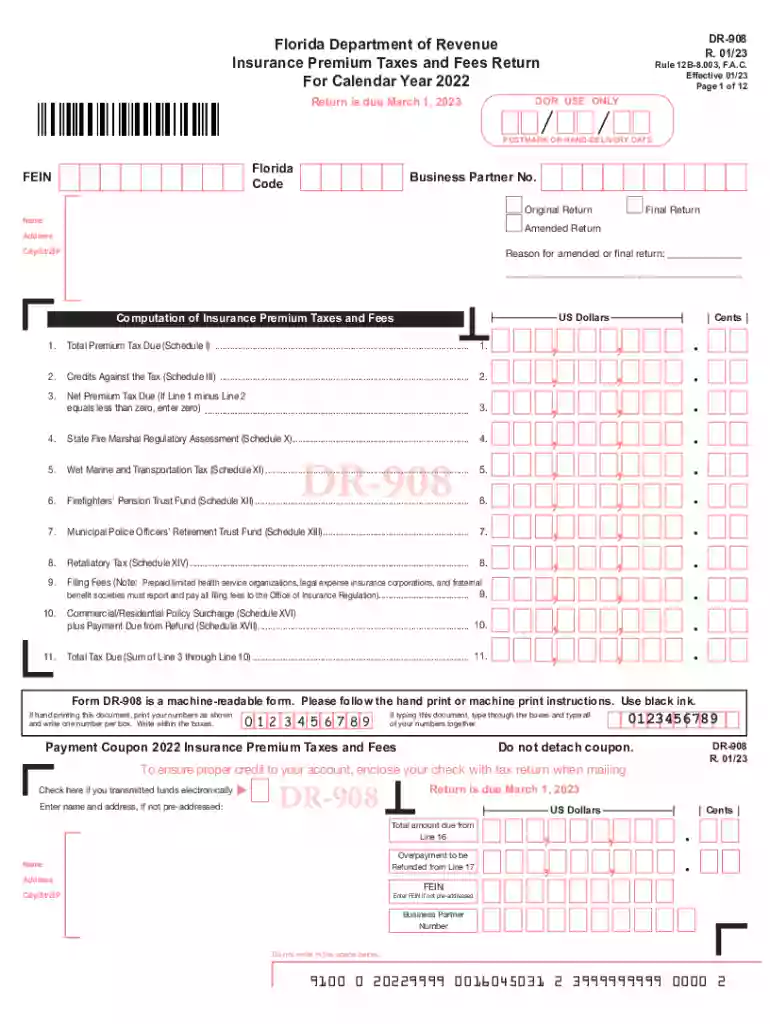
DR-908 Florida Insurance Premium Taxes and Fees Return 2026

Get Form
DR-908 Florida Insurance Premium Taxes and Fees Return Preview on Page 1

Here's how it works

01. Edit your form online
Type text, add images, blackout confidential details, add comments, highlights and more.

02. Sign it in a few clicks
Draw your signature, type it, upload its image, or use your mobile device as a signature pad.

03. Share your form with others
Send it via email, link, or fax. You can also download it, export it or print it out.

How to use or fill out DR-908 Florida Insurance Premium Taxes and Fees Return with DocHub

Form edit decoration
9.5
Ease of Setup
DocHub User Ratings on G2
9.0
Ease of Use
DocHub User Ratings on G2
  1. Click ‘Get Form’ to open the DR-908 in our editor.
  2. Begin by entering your FEIN and Business Partner Number at the top of the form. Ensure that you select whether this is an Original, Final, or Amended Return.
  3. Fill in your name and address details accurately. This information is crucial for processing your return.
  4. Proceed to the Computation of Insurance Premium Taxes section. Here, input the Total Premium Tax Due from Schedule I on Line 1, followed by any applicable credits on Line 2.
  5. Continue filling out each line as instructed, ensuring that calculations are accurate. Use our platform's features to easily navigate between sections and verify entries.
  6. Once completed, review all fields for accuracy before signing the document electronically within our editor.

Start using our platform today to simplify your DR-908 form completion process for free!

See more DR-908 Florida Insurance Premium Taxes and Fees Return versions

We've got more versions of the DR-908 Florida Insurance Premium Taxes and Fees Return form. Select the right DR-908 Florida Insurance Premium Taxes and Fees Return version from the list and start editing it straight away!
Versions Form popularity Fillable & printable
2024 4.2 Satisfied (30 Votes)
2023 4.1 Satisfied (39 Votes)
2022 4.8 Satisfied (35 Votes)
2021 4.2 Satisfied (70 Votes)
2020 4.4 Satisfied (80 Votes)
2019 4.3 Satisfied (135 Votes)
2018 4.4 Satisfied (175 Votes)
2015 4.4 Satisfied (118 Votes)
2013 4.4 Satisfied (482 Votes)
be ready to get more

Complete this form in 5 minutes or less

Get form

Got questions?

We have answers to the most popular questions from our customers. If you can't find an answer to your question, please contact us.
Contact us
Generally, you do not pay taxes on the return of premium received from a return of premium life insurance policy, as its considered a refund of your own money. However, consulting a tax professional for personalized advice regarding your situation is always advisable.
For individual market consumers who purchased their coverage with after‐tax dollars, a rebate is not taxable income. However, if an individual deducted the prior years premium payments on their Form 1040 Schedule A, then their MLR rebate is subject to federal income tax.
In general, rebates are taxable if you pay health insurance premiums with pre-tax dollars or you received tax benefits by deducting premiums you paid on your tax return. Talk with your tax preparer to determine if you need to report your rebate as income when you file your next tax return.
The Premium Tax Credit is a refundable tax credit designed to help eligible individuals and families with low or moderate income afford health insurance purchased through the Health Insurance Marketplace, also known as the Exchange. The size of your Premium Tax Credit is based on a sliding scale.
A premium tax credit is a form of financial assistance you can use toward the cost of your marketplace health insurance. The amount of credit you can get depends on the household income you estimate on your health insurance plan application.

Security and compliance

At DocHub, your data security is our priority. We follow HIPAA, SOC2, GDPR, and other standards, so you can work on your documents with confidence.

Learn more
ccpa2
pci-dss
gdpr-compliance
hipaa
soc-compliance

People also ask

as set forth in Section 624.509, F.S. (a) A tax at the rate of 1.75 percent of the gross amount of receipts for insurance premiums and assessments shall be applied to the following types of policies: 1. Life and health insurance policies covering Florida residents.
If an employer pays the cost of an accident or health insurance plan for his/her employees (including an employees spouse and dependents), then the employers payments are not wages and are not subject to social security, Medicare, and FUTA taxes, or federal income tax withholding.

Related links