
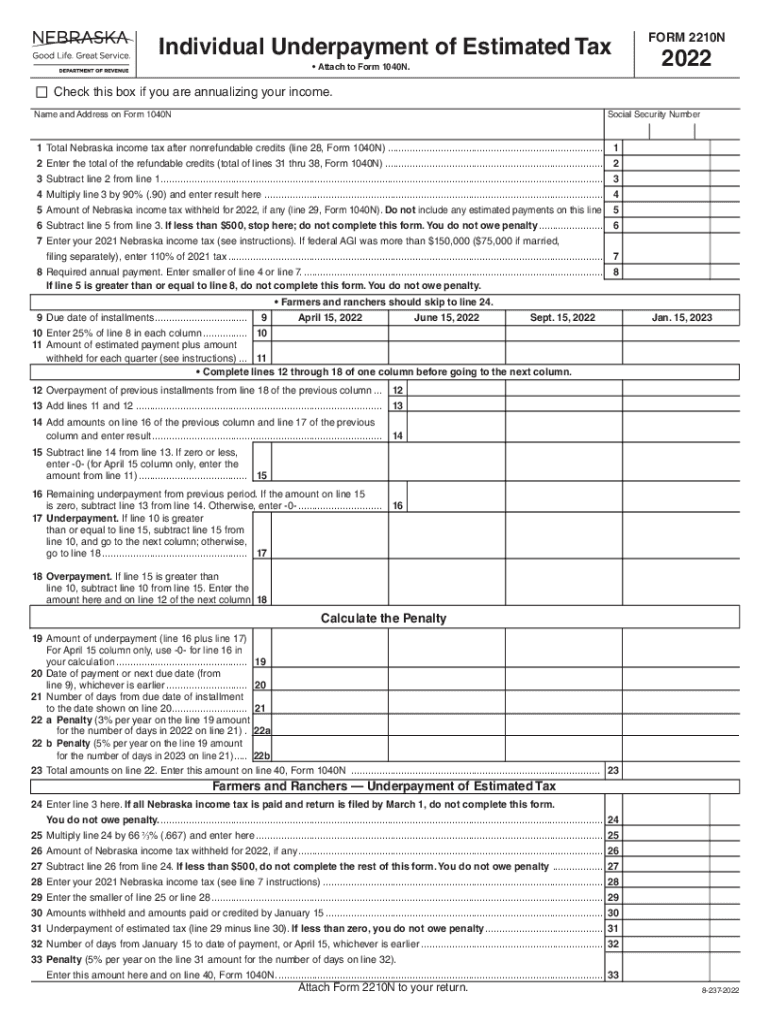



Individual Underpayment of Estimated Tax 2022-2026

Get Form
2210n Preview on Page 1

Here's how it works

01. Edit your 2210n online
Type text, add images, blackout confidential details, add comments, highlights and more.

02. Sign it in a few clicks
Draw your signature, type it, upload its image, or use your mobile device as a signature pad.

03. Share your form with others
Send it via email, link, or fax. You can also download it, export it or print it out.

How to use or fill out Individual Underpayment of Estimated Tax 2022 with our platform

Form edit decoration
9.5
Ease of Setup
DocHub User Ratings on G2
9.0
Ease of Use
DocHub User Ratings on G2
  1. Click ‘Get Form’ to open the Individual Underpayment of Estimated Tax 2022 in the editor.
  2. Begin by entering your name and address as it appears on Form 1040N, along with your Social Security Number.
  3. Complete line 1 by entering your total Nebraska income tax after nonrefundable credits from line 28 of Form 1040N.
  4. On line 2, input the total refundable credits from lines 31 through 38 of Form 1040N.
  5. Subtract line 2 from line 1 and enter the result on line 3. This is your adjusted tax amount.
  6. Multiply the amount on line 3 by 90% (0.90) and record this value on line 4.
  7. Enter any Nebraska income tax withheld for the year on line 5, excluding estimated payments.
  8. If the result from subtracting line 5 from line 3 is less than $500, you do not need to complete this form.

Start using our platform today to easily fill out your tax forms online for free!

See more Individual Underpayment of Estimated Tax 2022 versions

We've got more versions of the Individual Underpayment of Estimated Tax 2022 form. Select the right Individual Underpayment of Estimated Tax 2022 version from the list and start editing it straight away!
Versions Form popularity Fillable & printable
2022 4.7 Satisfied (47 Votes)
2021 4.8 Satisfied (118 Votes)
2020 4.3 Satisfied (75 Votes)
be ready to get more

Complete this form in 5 minutes or less

Get form

Got questions?

We have answers to the most popular questions from our customers. If you can't find an answer to your question, please contact us.
Contact us
An underpayment penalty is a charge the IRS imposes on taxpayers who did not pay all of their estimated income taxes for the year or paid their taxes late. Youll face an underpayment penalty if you: Didnt pay at least 90% of the tax on your current-year return or 100% of the tax shown on the prior years return.
You know you need to send the IRS a check every quarter, but the question is: should you pay extra just in case, or stick to the estimate? TL;DR: Paying a little extra can give you peace of mind and protect you from penalties, but overpaying means the IRS holds onto your money interest-free.
You could end up paying an underpayment penalty if you dont pay enough in estimated taxes, tax withholding, or taxes due. Check to see if you qualify for an exemption or reduced penalty if youre charged a penalty.
Youll face an underpayment penalty if you: Didnt pay at least 90% of the tax on your current-year return or 100% of the tax shown on the prior years return.
tax refund but with penalty? The IRS levies underpayment penalties if you dont withhold or pay enough tax on income received during each quarter. Even if you paid your tax bill in full by the April deadline or are getting a refund, you may still get an underpayment penalty.

Security and compliance

At DocHub, your data security is our priority. We follow HIPAA, SOC2, GDPR, and other standards, so you can work on your documents with confidence.

Learn more
ccpa2
pci-dss
gdpr-compliance
hipaa
soc-compliance

People also ask

To avoid this penalty, taxpayers generally need to pay at least 90% of their current years tax liability or 100% of the prior years tax, depending on adjusted gross income.
You will receive an IRS notice if you underpaid estimated taxes. They determine the tax underpayment penalty by calculating the amount based on the taxes accrued (total tax minus tax credits) on your original tax return or a more recent one you filed.
Generally, most taxpayers will avoid this penalty if they owe less than $1,000 in tax after subtracting their withholdings and credits, or if they paid at least 90% of the tax for the current year, or 100% of the tax shown on the return for the prior year, whichever is smaller.

Related links

