Equine Relinquishment 2026

Get Form
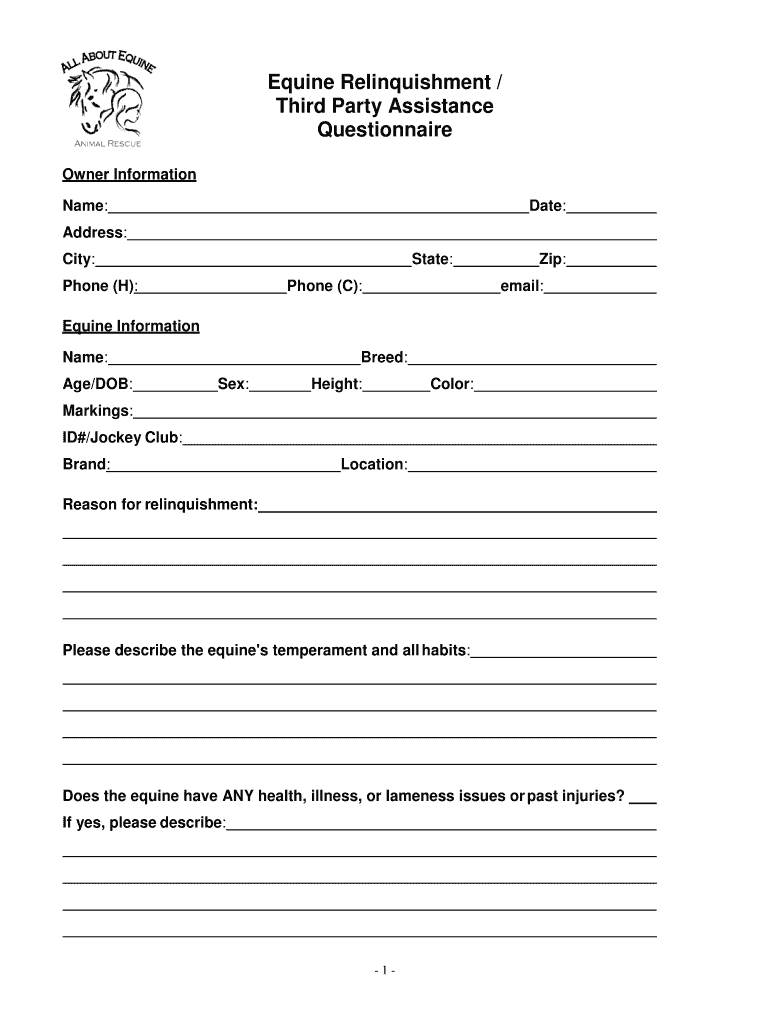
Equine Relinquishment Preview on Page 1

Here's how it works

01. Edit your form online
Type text, add images, blackout confidential details, add comments, highlights and more.
02. Sign it in a few clicks
Draw your signature, type it, upload its image, or use your mobile device as a signature pad.
03. Share your form with others
Send it via email, link, or fax. You can also download it, export it or print it out.

How to use or fill out Equine Relinquishment with our platform

Form edit decoration
9.5
Ease of Setup
DocHub User Ratings on G2
9.0
Ease of Use
DocHub User Ratings on G2
  1. Click ‘Get Form’ to open the Equine Relinquishment document in the editor.
  2. Begin by filling out the Owner Information section. Enter your name, date, address, city, state, phone numbers, zip code, and email. Ensure all details are accurate for effective communication.
  3. Next, move to the Equine Information section. Provide the equine's name, age or date of birth, breed, sex, height, color, markings, ID number or Jockey Club registration number, brand, and location.
  4. In the Reason for Relinquishment field, clearly describe why you are relinquishing the equine. Include details about its temperament and habits in the provided space.
  5. Complete the health history by detailing any health issues or past injuries. List recent veterinary care including exams and treatments in the designated fields.
  6. Finally, review all sections for completeness and accuracy before signing at the bottom of the form. Make sure to authorize any necessary information release regarding your equine.

Start using our platform today to streamline your Equine Relinquishment process for free!

See more Equine Relinquishment versions

We've got more versions of the Equine Relinquishment form. Select the right Equine Relinquishment version from the list and start editing it straight away!
Versions Form popularity Fillable & printable
2018 4.8 Satisfied (53 Votes)
be ready to get more

Complete this form in 5 minutes or less

Get form

Got questions?

We have answers to the most popular questions from our customers. If you can't find an answer to your question, please contact us.
Contact us
How to complete a change of ownership. To complete a change of ownership, you must submit the BHS issued/overstamped passport to the office along with the completed change of ownership form.
INCINERATION/CREMATION: While incineration/cremation of a horse carcass is very expensive, it is one of the most environmen- tally friendly solutions to body disposal. Cremating a 1,000-pound horse can cost between $600 and $2,000, depending on location and the current price of propane.
20% of the bet will be placed on the horse winning, while the other 80% of a stake will be placed on it finishing in another specific place, such as second or third. So many like to adopt this strategy because a lot can happen in a race at any one time.
The PROPORTIONAL HOOF BALANCE TOOL is based on the Golden Ratio, also known as Natural Proportions, and equates to the Ratio: 1:1.618. This ratio is often represented by the 1/3 - 2/3 Principle in many published articles. Natural Proportions work throughout the entire horse body, including the feet.
As horse owners, riders and keepers, it is our duty to provide the horses in our care with a species-appropriate life centred around their three essential needs: friends, forage, and freedom.

Security and compliance

At DocHub, your data security is our priority. We follow HIPAA, SOC2, GDPR, and other standards, so you can work on your documents with confidence.

Learn more
ccpa2
pci-dss
gdpr-compliance
hipaa
soc-compliance

People also ask

The 20 percent rule suggests that a horse should not carry more than 20 percent of its body weight, including the rider, saddle, and other equipment. This guideline, while not absolute, serves as a benchmark for preventing injuries and maintaining a horses physical health.
H-O-R-S-E is a game played by two people on a basketball court. The idea of the game involves matching baskets. The player who makes shots that the opponent does not duplicate, wins the game. Example: The second person shooting must duplicate the first persons shot, if it is made.

Related links