Asking About Pets Enhances Patient Communication and Care 2026

Get Form
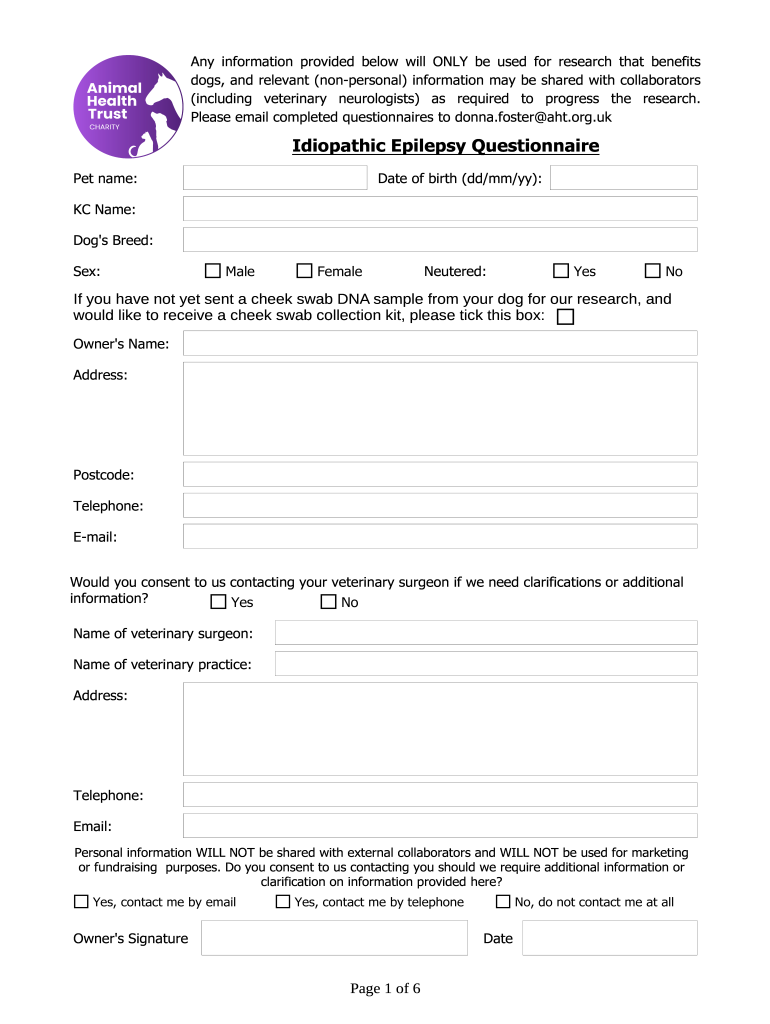
Asking About Pets Enhances Patient Communication and Care Preview on Page 1

Here's how it works

01. Edit your form online
Type text, add images, blackout confidential details, add comments, highlights and more.
02. Sign it in a few clicks
Draw your signature, type it, upload its image, or use your mobile device as a signature pad.
03. Share your form with others
Send it via email, link, or fax. You can also download it, export it or print it out.

How to use or fill out Asking About Pets Enhances Patient Communication and Care

Form edit decoration
9.5
Ease of Setup
DocHub User Ratings on G2
9.0
Ease of Use
DocHub User Ratings on G2
  1. Click ‘Get Form’ to open it in the editor.
  2. Begin by entering your pet's name, date of birth, KC name, breed, sex, and neuter status. This information is crucial for identifying your pet in the research.
  3. Fill in your contact details including owner's name, address, postcode, telephone number, and email. Ensure accuracy as this will be used for any follow-up communications.
  4. Indicate whether you consent to contact your veterinary surgeon for additional information. If yes, provide their name and practice details.
  5. Answer questions regarding your dog's seizures, including age at first seizure and any relevant medical history. Be as detailed as possible to aid the research.
  6. Complete the medication section if applicable and provide any additional comments about your dog's condition in the designated areas.

Start filling out the form today on our platform for free and contribute to vital research!

be ready to get more

Complete this form in 5 minutes or less

Get form

Got questions?

We have answers to the most popular questions from our customers. If you can't find an answer to your question, please contact us.
Contact us
Pet therapy is great, but it is not for everyone. Some people simply do not like animals and being around a pet may increase their stress level. Patients with weak immune systems also have to be very cautious about their contact with pets, in case of any asymptomatic infectious diseases the pet may be carrying.
Emotional Connection: Animals often evoke strong feelings of affection and empathy. Many people find joy and comfort in their companionship, as pets can provide unconditional love and support. Psychological Benefits: Interacting with animals has been shown to reduce stress, anxiety, and depression.
People may prefer pets over human relationships for several reasons: Unconditional Love: Pets often provide unconditional affection and companionship. Unlike humans, pets do not judge or hold grudges, which can create a sense of comfort and safety.
Nothing compares to the joy of coming home to a loyal companion. The unconditional love of a pet can do more than keep you company. Pets may also decrease stress, improve heart health, and even help children with their emotional and social skills. An estimated 68% of U.S. households have a pet.
Evidence suggests that attachment to pets is good for human health and even helps build a better community. Its no secret that pets can contribute to your happiness. Studies show that dogs reduce stress, anxiety and depression. They ease loneliness, encourage exercise and improve your overall health.

Security and compliance

At DocHub, your data security is our priority. We follow HIPAA, SOC2, GDPR, and other standards, so you can work on your documents with confidence.

Learn more
ccpa2
pci-dss
gdpr-compliance
hipaa
soc-compliance

People also ask

Companionship : Pets provide emotional support and companionship, helping to alleviate feelings of loneliness and isolation. Stress Relief : Interacting with pets has been shown to reduce stress and anxiety. Routine and Responsibility : Caring for a pet requires a routine, which can provide structure to a persons day.
Nothing compares to the joy of coming home to a loyal companion. The unconditional love of a pet can do more than keep you company. Pets may also decrease stress, improve heart health, and even help children with their emotional and social skills.
A good relationship with a pet can also help in developing non-verbal communication, compassion, and empathy. Pets can serve different purposes for children: They can be safe recipients of secrets and private thoughts--children often talk to their pets, like they do to their stuffed animals.

Related links