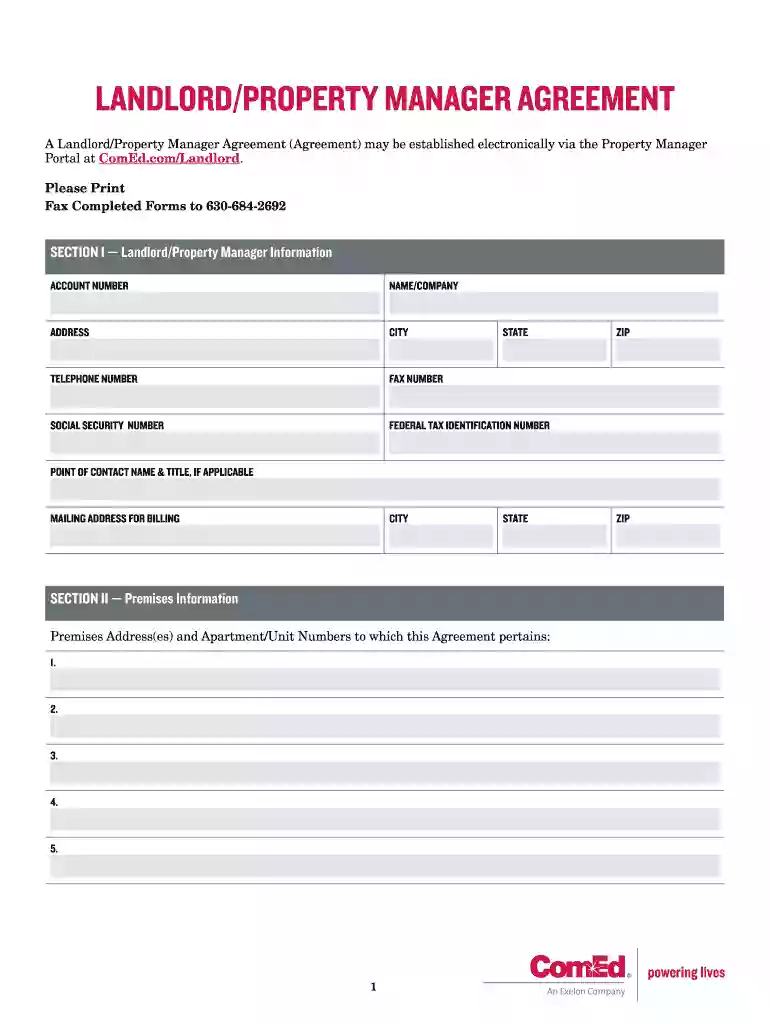
Definition and Meaning of the ComEd Landlord Agreement
The ComEd landlord agreement is a formal document that establishes the terms and conditions under which landlords and property managers manage electric service accounts associated with rental properties. This agreement outlines the responsibilities of both the landlord and ComEd regarding electric service, ensuring clarity and preventing disputes.
- Role of Landlords: Landlords are responsible for managing the electric accounts, which entails ensuring timely payment of electric bills, maintaining compliance with ComEd policies, and notifying ComEd of any tenant changes.
- Purpose: This agreement is designed to facilitate the management of service accounts and outline the authorization process for landlords and property managers when dealing with ComEd on behalf of tenants.
- Utility Management: By formalizing the relationship between ComEd and landlords, this agreement simplifies utility management, ensuring that electric services remain uninterrupted during tenant transitions.
Understanding the specifics of this agreement is crucial for landlords who wish to maintain efficient operations while adhering to ComEd's service guidelines.
Key Elements of the ComEd Landlord Agreement
Several critical components are incorporated in the ComEd landlord agreement, creating a comprehensive framework for electric service management. These key elements promote effective communication and establish responsibilities among involved parties.
- Landlord Information: This section captures the landlord's details, including name, contact information, and the residential address of the rental property, which is essential for proper identification and communication.
- Tenant Information: Landlords must provide information about tenants occupying the rental units to ensure accurate account management and service continuity.
- Authorization Clauses: Permissions granted to landlords for communicating with ComEd on behalf of tenants are outlined clearly. This allows landlords to handle account issues without tenant intervention, streamlining processes.
- Service Responsibility: The agreement specifies the landlord's responsibility to cover all charges during periods of vacancy, ensuring that the property remains in good standing concerning utility services.
- Notification Procedures: Detailed processes for landlords to notify ComEd about tenant changes, including move-ins and move-outs, are also included, which is vital for accurate account management.
Each of these elements is critical in ensuring that both landlords and ComEd clearly understand their roles, thereby enhancing the operational efficiency of electric service management.
Steps to Complete the ComEd Landlord Agreement
Completing the ComEd landlord agreement requires a series of organized steps that landlords must follow to ensure accuracy and compliance. Below is a detailed process to guide landlords through the completion of the agreement.
- Obtain the Agreement Form: Landlords can access the agreement via the ComEd website or contact ComEd customer service to receive a copy.
- Fill in Personal Information: Provide all necessary landlord details, including name, address, and contact information. It is essential to ensure all information is accurate to avoid delays in processing.
- Detail Tenant Information: Enter the names and contact details of current tenants, ensuring that all required tenant data is accurate for account management.
- Indicate Service Preferences: Specify how the landlord wishes to manage the electric account, including payment methods and any preferences for notifications from ComEd.
- Sign and Date the Agreement: Once all sections are accurately filled out, the landlord must sign and date the agreement to officially execute it.
- Submit the Agreement: The completed agreement can be submitted online through the ComEd landlord portal or via mail, depending on the preferred submission method.
Following these steps ensures that the agreement is accurately completed and submitted, which is critical for maintaining uninterrupted service.
Important Terms Related to the ComEd Landlord Agreement
The ComEd landlord agreement includes specific terminology that is crucial for understanding the nature of the agreement and the responsibilities of involved parties. Familiarity with these terms can help landlords manage their electric accounts more effectively.
- Landlord: An individual or entity that owns rental properties and is responsible for managing related utility accounts.
- Tenant: The individual or individuals leasing the rental property and utilizing the associated electric services.
- Vacancy Charges: Specific costs incurred by the landlord when a rental property is unoccupied, which the landlord is obligated to cover under the agreement.
- Authorization: The permissions granted to landlords to interact with ComEd on behalf of their tenants, enabling them to manage account issues without tenant involvement.
- Electric Service Account: The account associated with a specific address that tracks electric usage, payments, and communications between the landlord, tenants, and ComEd.
Understanding these terms enhances clarity throughout the agreement process and regular interactions with ComEd.
Examples of Using the ComEd Landlord Agreement
Various scenarios can illustrate the practical application of the ComEd landlord agreement, demonstrating its utility for landlords and property managers. Below are examples highlighting how the agreement functions in real-world situations.
- Property Transition: A landlord must notify ComEd of a tenant's move-out and a new tenant's move-in. Using the landlord agreement, the landlord communicates these changes effectively, allowing seamless service continuity without interruption in electric service.
- Managing Multiple Units: A property manager overseeing multiple rental properties can utilize the agreement to manage electric accounts for each unit efficiently. This involves submitting a single agreement that incorporates multiple tenant details, simplifying the management process across properties.
- Resolving Payment Issues: If a tenant misses a payment, the landlord can address the issue promptly using the authorization granted in the agreement, allowing them to negotiate payment arrangements directly with ComEd without requiring tenant involvement.
These examples illustrate the versatility and efficiency that the ComEd landlord agreement provides in managing electric services effectively.