




Here's how it works

01. Edit your form online
Type text, add images, blackout confidential details, add comments, highlights and more.

02. Sign it in a few clicks
Draw your signature, type it, upload its image, or use your mobile device as a signature pad.

03. Share your form with others
Send it via email, link, or fax. You can also download it, export it or print it out.
How to use or fill out exercise caution when using Free WiFi or Public Computers as these are not secure

- Click ‘Get Form’ to open it in the editor.
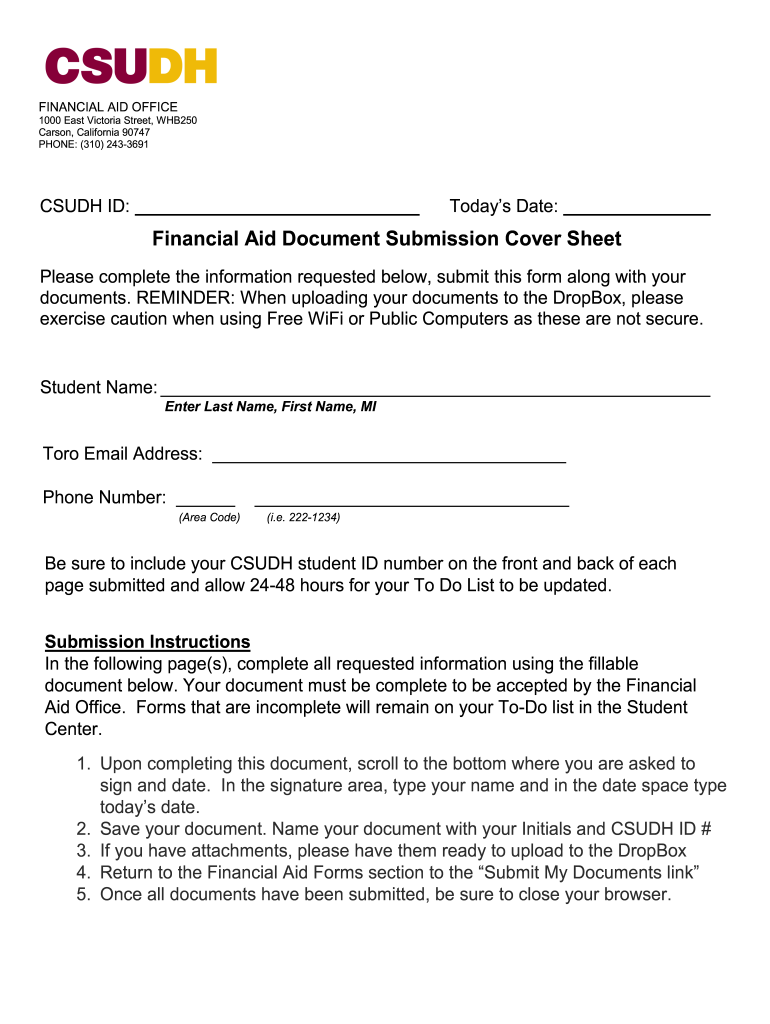
- Begin by entering your CSUDH ID number at the top of the form. This is essential for processing your submission.
- Fill in your name, Toro email address, and phone number accurately. Ensure that all information is legible and correct.
- In the signature area at the bottom, type your name and today's date to confirm your submission.
- Save your document with a clear naming convention that includes your initials and CSUDH ID # for easy identification.
- If you have any attachments, prepare them for upload to the DropBox as instructed.
- Return to the Financial Aid Forms section and click on the 'Submit My Documents' link to complete your submission.
- After submitting, ensure you close your browser to protect your personal information, especially when using public computers.
Start using our platform today for free to streamline your document editing and submission process!
Fill out exercise caution when using Free WiFi or Public Computers as these are not secure online
It's free
It's free
See more exercise caution when using Free WiFi or Public Computers as these are not secure versions
We've got more versions of the exercise caution when using Free WiFi or Public Computers as these are not secure form. Select the right exercise caution when using Free WiFi or Public Computers as these are not secure version from the list and start editing it straight away!
Got questions?
We have answers to the most popular questions from our customers. If you can't find an answer to your question, please contact us.
Contact us
Is it safe to use WhatsApp on public WiFi?
Encrypted Messaging Apps For basic web browsing, public Wi-Fi should be ok. But never use unsecured networks for activities like online banking, shopping or sending private messages. Apps like Signal, WhatsApp and Wire offer end-to-end encryption to keep your chats, calls and files private.
What is the main danger of connecting to public WiFi without precautions?
Attackers can exploit vulnerabilities in public Wi-Fi to inject malware into connected devices. This malware can steal data, damage your system, or even give hackers remote access.
What precautions should you take when using public WiFi?
Bad actors can take advantage of you online. Read below for some tips to consider if you need to use public Wi-Fi. Confirm you have the correct network. Turn off auto-connect. Turn off file sharing. Use a VPN. FBI warning about encrypted websites - HTTPS. Accessing sensitive information not recommended. Secured vs.
Which is the most important precaution to take if you have to connect to public WiFi?
Be aware of evil twin hotspots. Avoid shopping or banking online in public spaces. Learn to identify secure web pages. Dont visit sensitive websites on your phone. Turn off file sharing. Disable Wi-Fi when youre not using it. Set up your own personal hotspot. Take precautions to protect your information.
What is the safest practice for using free Wi-Fi?
When youre using free Wi-Fi, its not a good time to shop online, use social media or access your bank account or email. Youll want to avoid visiting websites that save and store your personal passwords or credit card numbers, which could inadvertently make it easy for someone to access your personal information.
Security and compliance
At DocHub, your data security is our priority. We follow HIPAA, SOC2, GDPR, and other standards, so you can work on your documents with confidence.
Learn more


People also ask
How risky is it to connect to public WiFi?
Public Wi-Fi networks, commonly found in places like airports, cafes, and hotels, are often unsecured and open to various security risks. Hackers may exploit these networks to intercept data, inject malware, or steal sensitive information.
What precautions should you take when using public Wi-Fi?
Confirm you have the correct network. Make sure you are connecting to the right network. Turn off auto-connect. Turn off file sharing. Use a VPN. FBI warning about encrypted websites - HTTPS. Accessing sensitive information not recommended. Secured vs. Keep your firewall enabled.


