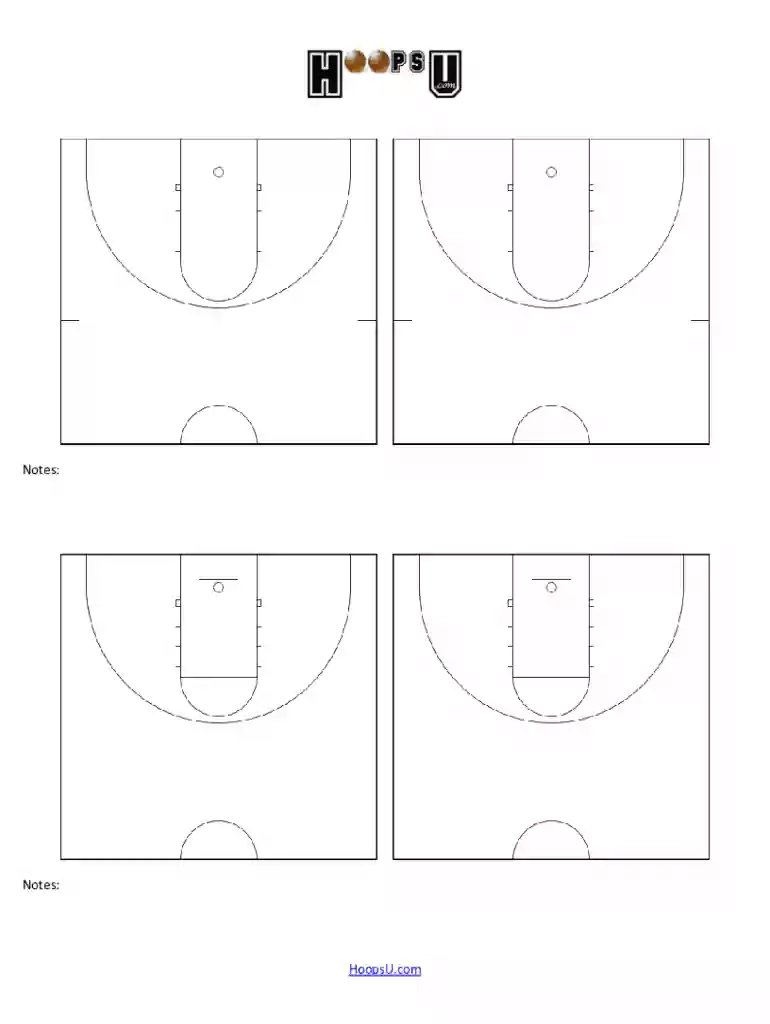
Basketball court diagram 2026

Get Form
basketball court diagram Preview on Page 1

Here's how it works

01. Edit your basketball court diagram online
Type text, add images, blackout confidential details, add comments, highlights and more.

02. Sign it in a few clicks
Draw your signature, type it, upload its image, or use your mobile device as a signature pad.

03. Share your form with others
Send basketball court pdf via email, link, or fax. You can also download it, export it or print it out.

Definition and Meaning of Basketball Court Diagrams

A basketball court diagram is a visual representation that outlines the specific layout and dimensions of a basketball court. This type of diagram serves various purposes, including play design, coaching strategies, and educational resources for players and enthusiasts. Understanding the layout of a basketball court is crucial for both strategizing plays and ensuring proper sportsmanship during games.

Key components of the basketball court include:

  • Three-Point Arc: The semi-circle located beyond which field goals are worth three points.
  • Key Area (Paint): The rectangular area under the basket, critical for post plays and rebounds.
  • Center Circle: Used for the jump ball at the start of game play.
  • Free-Throw Line: The line from which players shoot free throws.

Various types of basketball court diagrams exist, including those specific to different levels of play such as high school, NCAA, NBA, and international formats like FIBA.

How to Use Basketball Court Diagrams

Utilizing basketball court diagrams can enhance both gameplay and coaching effectiveness. Here are several practical applications:

  • Play Creation: Coaches and players can use diagrams to draw out plays, helping them visualize movements, positions, and strategies during practices or games.
  • Scouting: Teams analyze opponents’ basketball court diagrams to understand common strategies, formations, and weaknesses.
  • Teaching Tool: In educational settings, diagrams serve as visual aids to teach players about court dimensions, positioning, and the rules of the game.

When using these diagrams, it is beneficial to ensure that all team members comprehend the markings and their implications for gameplay. Incorporating player input during play design sessions using a basketball court diagram can generate engagement and ownership of strategies.

Key Elements of Basketball Court Diagrams

Basketball court diagrams are characterized by several vital elements, which vary slightly depending on the level of play but generally include:

  • Court Dimensions: Standard dimensions differ among leagues, with an NBA court measuring 94 feet by 50 feet, while a high school court typically measures 84 feet by 50 feet.
  • Markings: These include the three-point line, free throw line, and various boundaries that define areas like the key and center circle.
  • Player Positions: Diagrams often illustrate typical player positions during specific plays, aiding in strategic planning for both offense and defense.

Each element plays a critical role, influencing gameplay dynamics.

Examples of Using Basketball Court Diagrams

Basketball court diagrams can be utilized in various contexts. Examples include:

  1. Coaching Clinics: Coaches can present their playbooks with diagrams to other coaches to share strategies and styles.
  2. Player Development: Trainers can create individualized practice plans with diagrams outlining drills specific to improving players' understanding of court spacing and movement.
  3. Game Analysis: After games, teams can use court diagrams to dissect performance, visually aligning player positions with game outcomes to identify strengths and weaknesses.

Diagrams can also serve as a format for constructing baseline assessments of player movements and decisions, crucial for long-term development.

Legal Use of Basketball Court Diagrams

Using basketball court diagrams legally encompasses respecting intellectual property and adhering to established fair-use guidelines:

  • Attribution: When utilizing basketball court diagrams created by others, it is essential to provide proper credit to the source.
  • Commercial Use: If diagrams are used in commercial contexts (such as in instructional books or online platforms), obtaining permission from the creator may be necessary.

This ensures that creators maintain rights to their work while allowing users to effectively leverage these tools for instructional, coaching, or analytical purposes.

How to Obtain Basketball Court Diagrams

Acquiring basketball court diagrams can be achieved through several avenues:

  • Online Templates: Numerous websites offer free printable basketball court diagrams in various formats.
  • Educational Resources: Many coaching organizations and sports education platforms provide these diagrams as part of their training materials.
  • Custom Creations: Coaches and players may also choose to create their diagrams tailored to specific needs, utilizing tools like diagramming software or hand-drawing.

It is important to ensure that the diagrams employed adhere to the required specifications of the relevant league or organization.

Important Terms Related to Basketball Court Diagrams

Understanding key terms surrounding basketball court diagrams can enhance comprehension and usability:

  • Full Court: Refers to a basketball court used for games in which the entire length and width are available for play.
  • Half Court: This is a segment of the court used for specific drills or plays, such as during practice or for certain game situations.
  • Layup Area: Zones defined near the basket for executing layups, crucial for points in close proximity to the hoop.

Familiarity with these terms aids players and coaches in communicating more effectively about strategies and plays.

Diagrams of Basketball Courts

In addition to basic diagrams, various specialized versions exist that incorporate advanced strategies or player dynamics:

  • Play Diagrams: Designed to showcase specific plays in motion, marking player trajectories and ball movement on the court.
  • Statistical Diagrams: Used in analysis to visualize player performance metrics across different game scenarios.

These specialized diagrams not only assist in understanding gameplay but also contribute to data-driven decision-making in coaching and player development contexts.

be ready to get more

Complete this form in 5 minutes or less

Get form

Got questions?

We have answers to the most popular questions from our customers. If you can't find an answer to your question, please contact us.
Contact us

Signing paperwork on a mobile device is fast, straightforward, and doesn’t require software installation if you have an account with DocHub. Sign in from any browser, fill in your empty fields with your data, and click on Sign → Create your signature. You can draw your eSignature just as you usually do on paper, add its image to your basketball court layout printable, or type in your name and stylize its look. No matter what option you choose, your documentation will be valid.

Document editing with DocHub is equally convenient on desktop and mobile devices. You only need an internet browser to edit your free printable basketball court template on Android. Open our site and sign in to access the instruments you require. Add your file and introduce your intended modifications. Next, you can keep your form in your file storage or send it out instantly.

A regular 3x3 court playing surface is 15m wide x 11m long. The court has a regular basketball playing court sized zone, including a free throw line (5.80m), a two point line (6.75m) and a \u201cno-charge semi-circle\u201d area underneath the one basket. Half a traditional basketball court may be used.
Games are played in four quarters of 10 (FIBA) or 12 minutes (NBA). College men's games use two 20-minute halves, college women's games use 10-minute quarters, and most United States high school varsity games use 8-minute quarters; however, this varies from state to state.
Basketball Court Lines What are the lines on a basketball court? The Baselines (End Lines) The Sidelines. The Boundary Lines. The Free Throw Line (Foul Line) The Lane Lines (Paint or Key) The Midcourt Line (Half-Court Line) The Three Point Line (Three Point Arc)

Security and compliance

At DocHub, your data security is our priority. We follow HIPAA, SOC2, GDPR, and other standards, so you can work on your documents with confidence.

Learn more
ccpa2
pci-dss
gdpr-compliance
hipaa
soc-compliance

People also ask

Baseline is used for the offensive end of the court. Endline is used for the back court or defensive end of the court.
A regulation NBA or NCAA basketball court measures 94 feet long by 50 feet wide which is 28.7 meters long by 15.2 meters wide.
A basketball court is 91.86ft long and 49.21ft wide. The total playing area for a court is 4520.43 ft² and 7290.5ft² if run-offs and sidelines are required.
Typical backyard basketball court dimensions are 60 feet by 90 feet (for reference, a regulation NBA court is 50 feet by 94 feet).
A basketball court is 91.86ft long and 49.21ft wide. The total playing area for a court is 4520.43 ft² and 7290.5ft² if run-offs and sidelines are required.

editable basketball court diagram