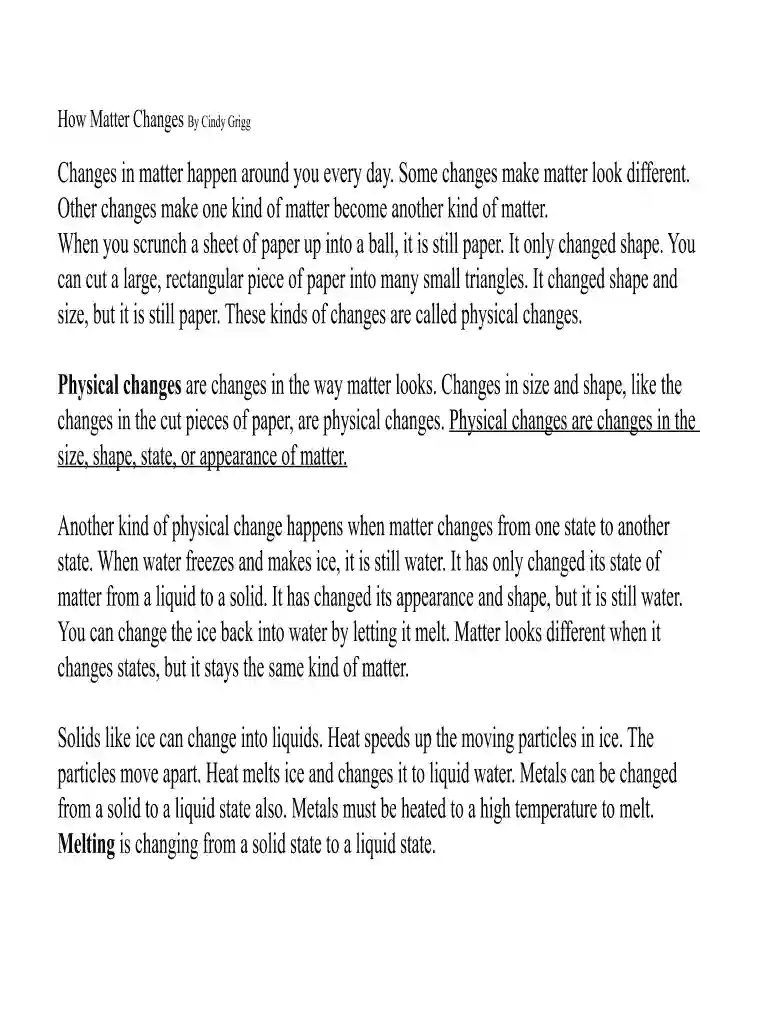
Matter changes form 2026

Get Form
how matter changes Preview on Page 1

Here's how it works

01. Edit your how matter changes online
Type text, add images, blackout confidential details, add comments, highlights and more.

02. Sign it in a few clicks
Draw your signature, type it, upload its image, or use your mobile device as a signature pad.

03. Share your form with others
Send matter changes via email, link, or fax. You can also download it, export it or print it out.

How to use or fill out the matter changes form

Form edit decoration
9.5
Ease of Setup
DocHub User Ratings on G2
9.0
Ease of Use
DocHub User Ratings on G2
  1. Click ‘Get Form’ to open it in the editor.
  2. Begin by entering your name at the top of the form. This identifies who is filling out the document.
  3. For questions 1 through 12, read each question carefully and select or write your answers in the provided fields. Ensure clarity and completeness in your responses.
  4. Use the Venn Diagram section to visually compare physical and chemical changes. Draw circles to represent each category and fill in examples accordingly.
  5. Review all entries for accuracy before finalizing. Make any necessary edits using our platform's editing tools.

Start using our platform today to effortlessly complete your matter changes form for free!

be ready to get more

Complete this form in 5 minutes or less

Get form

Got questions?

We have answers to the most popular questions from our customers. If you can't find an answer to your question, please contact us.
Contact us
The state or phase of a given set of matter can change depending on pressure and temperature conditions, transitioning to other phases as these conditions change to favor their existence; for example, solid transitions to liquid with an increase in temperature. Near absolute zero, a substance exists as a solid.
Matter can change form through physical and chemical changes, but through any of these changes matter is conserved. The same amount of matter exists before and after the changenone is created or destroyed. This concept is called the Law of Conservation of Mass.
Changes of state are physical changes in matter. They are reversible changes that do not involve changes in matters chemical makeup or chemical properties. Common changes of state include melting, freezing, sublimation, deposition, condensation, and vaporization. These changes are shown in Figure below.
Matter exists chiefly in four forms: solid, liquid, gas, and plasma. The conversion of matter from one state to another is called a phase change.
Physical changes are those in which the shape, size, or state of the matter changes, but the substance is still essentially the same. For example, chopping up a carrot or ice melting into water are both physical changes. Chemical changes are those where one or more substances are combined to produce a new substance.

Security and compliance

At DocHub, your data security is our priority. We follow HIPAA, SOC2, GDPR, and other standards, so you can work on your documents with confidence.

Learn more
ccpa2
pci-dss
gdpr-compliance
hipaa
soc-compliance
be ready to get more

Complete this form in 5 minutes or less

Get form

People also ask

In physics, chemistry, and other related fields like biology, a phase transition (or phase change) is the physical process of transition between one state of a medium and another. Commonly the term is used to refer to changes among the basic states of matter: solid, liquid, and gas, and in rare cases, plasma.
A change of state is a physical change in a matter. They are reversible changes and do not involve any changes in the chemical makeup of the matter. Common changes of the state include melting, freezing, sublimation, deposition, condensation, and vaporization. These changes are shown in the figure given below.

Related links