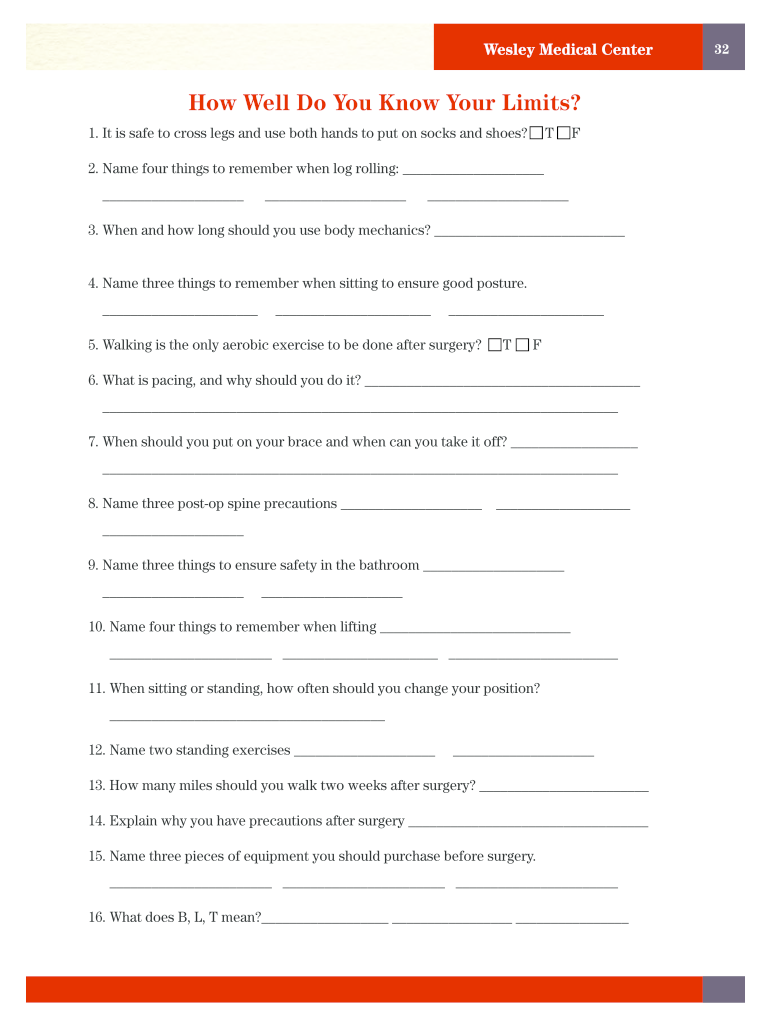
Spine patient education 2026

Get Form
spine patient education Preview on Page 1

Here's how it works

01. Edit your spine patient education online
Type text, add images, blackout confidential details, add comments, highlights and more.
02. Sign it in a few clicks
Draw your signature, type it, upload its image, or use your mobile device as a signature pad.
03. Share your form with others
Send spine patient education pdf via email, link, or fax. You can also download it, export it or print it out.

How to use or fill out spine patient education with our platform

Form edit decoration
9.5
Ease of Setup
DocHub User Ratings on G2
9.0
Ease of Use
DocHub User Ratings on G2
  1. Click ‘Get Form’ to open the spine patient education guide in the editor.
  2. Begin by reviewing the 'Your Spine Surgery Team' section. Fill in your personal details where prompted, ensuring you understand who will be part of your care team.
  3. Navigate to the 'Getting to Know Your Spine' section. Use the editor's tools to highlight key information about spinal anatomy that is relevant to your surgery.
  4. In the 'Consent and Risks of Spine Surgery' section, read through the risks carefully. You can add notes or questions directly in the document for discussion with your healthcare provider.
  5. Complete the 'Packing for the Hospital' checklist by checking off items you plan to bring. This ensures you are prepared for your hospital stay.
  6. Review sections on post-operative care and pain management. Use text boxes to jot down any specific instructions or reminders from your doctor.

Start using our platform today for free and take control of your spine surgery preparation!

be ready to get more

Complete this form in 5 minutes or less

Get form

Got questions?

We have answers to the most popular questions from our customers. If you can't find an answer to your question, please contact us.
Contact us
Plan to rest for the first 24-48 hours following discharge from the hospital. Avoid excessive bending, twisting, pushing, pulling, or lifting more than 5 pounds. Walk twice a day for 30 minutes using a walker or cane as needed. A void sitting or standing for more than 30 minutes at a time for the first two weeks.
The spine itself has three main segments: the cervical spine, the thoracic spine, and the lumbar spine. The cervical is the upper part of the spine, made up of seven vertebrae (bones). The thoracic is the center portion of the spine, consisting of 12 vertebrae. The lower portion of the spine is called the lumbar spine.
Your spine is an important bone structure that supports your body and helps you walk, twist and move. Your spine is made up of vertebrae (bones), disks, joints, soft tissues, nerves and your spinal cord. Exercises can strengthen the core muscles that support your spine and prevent back injuries and pain.
The spine is our bodys central support structure. It keeps us upright and connects different parts of our skeleton to each other, including the head, ribcage, pelvis, shoulders, arms and legs. Although the spine is made up of a chain of bones, it is flexible due to elastic spinal discs and ligaments.
You can use a meal-related mnemonic to remember them imagine a crunchy breakfast at 7 am (7 cervical vertebrae), a tasty lunch at 12 noon (12 thoracic vertebrae), and a light dinner at 5 pm (5 lumbar vertebrae).

Security and compliance

At DocHub, your data security is our priority. We follow HIPAA, SOC2, GDPR, and other standards, so you can work on your documents with confidence.

Learn more
ccpa2
pci-dss
gdpr-compliance
hipaa
soc-compliance
be ready to get more

Complete this form in 5 minutes or less

Get form

People also ask

Your spine is made up of 24 small bones (vertebrae) that are stacked on top of each other to create the spinal column. Between each vertebra is a soft, gel-like cushion called a disc that helps absorb pressure and keeps the bones from rubbing against each other.
The backbone encloses the spinal cord and the fluid surrounding the spinal cord. Also called spinal column, spine, and vertebral column.

Related links