
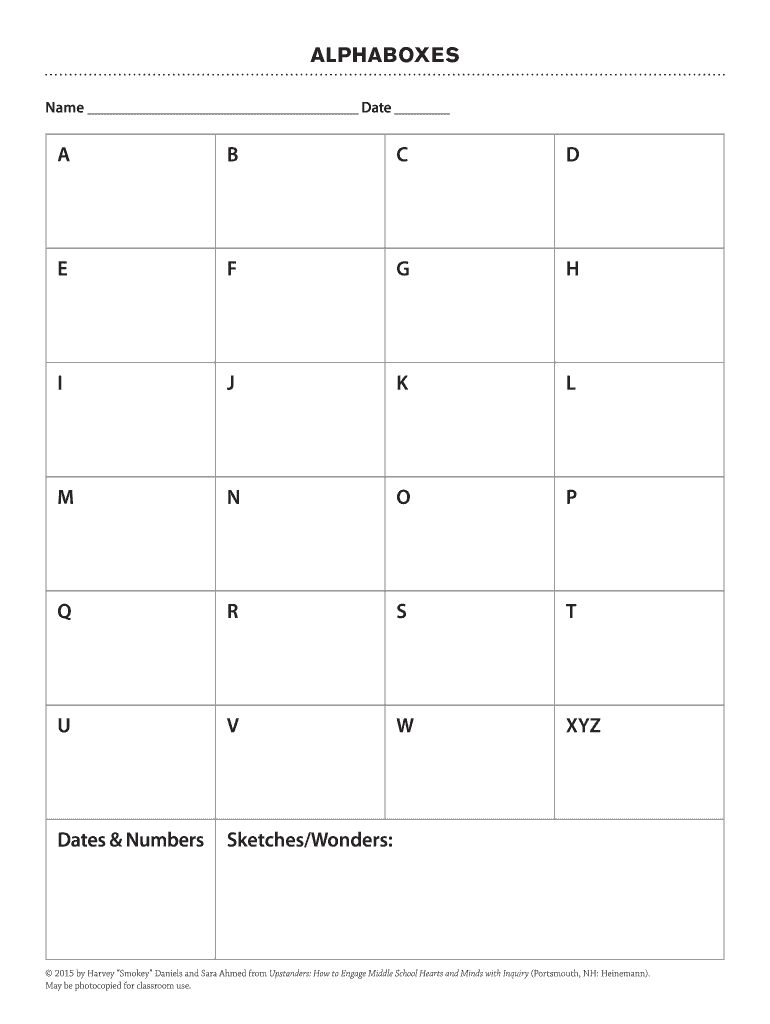







Definition and Meaning of the Alphaboxes Template
The alphaboxes template is an educational tool used primarily in middle school settings to facilitate inquiry-based learning and creative thinking among students. This structured resource allows students to explore topics through the lens of the alphabet, making learning interactive and engaging. Each section of the alphabox provides designated spaces for students to write letters, dates, numbers, and illustrations associated with chosen subjects. This not only promotes creativity but also reinforces organizational skills and categorization as students think critically about how their ideas relate to different alphabetical prompts.
In this template, each letter serves as a prompt. For example, under the letter "A," students might write about "adventure," associating that concept with various dates or numbers that are significant, followed by sketches that illustrate their thoughts. The alphaboxes template nurtures an environment that fosters discourse, collaboration, and personalized learning experiences, appealing to diverse learning styles.
How to Use the Alphaboxes Template
Utilizing the alphaboxes template involves a straightforward yet thoughtful approach. Here are the steps to effectively incorporate it into a lesson plan:
-
Select a Topic: Choose a subject matter relevant to the students' curriculum. This could be a historical event, a scientific concept, or a literary theme.
-
Distribute the Template: Provide each student with a printed alphaboxes template. Ensure students understand the layout and purpose of each section.
-
Guide the Exploration: Encourage students to think critically about their chosen topic. They should fill out each box with pertinent information, such as:
- A for “Aspect” – what unique angle or perspective can be explored?
- B for “Benefit” – how does this affect individuals or society?
- C for “Cause” – what led to this subject becoming significant?
-
Facilitate Discussion: After students complete their templates, hold a class discussion where they share their findings and experience with the alphaboxes format.
-
Revise and Reflect: Encourage students to review their work after the discussion, incorporating feedback and additional insights.
This process not only enhances comprehension of the topic but also encourages students to engage in deeper analysis and reflection.
Steps to Complete the Alphaboxes Template
Completing the alphaboxes template is a methodical process that can be broken down into clear steps:
-
Research the Topic: Begin by gathering information related to the subject. This may involve reading articles, watching educational videos, or discussing in groups.
-
Brainstorm Ideas: Use brainstorming techniques such as mind mapping to generate thoughts and concepts that can be associated with each letter of the alphabet.
-
Fill Out the Template: As you consider each letter, write down your ideas in the corresponding box. Ensure that each entry is relevant to the topic explored.
-
Use Visuals: When appropriate, incorporate drawings or images that represent your ideas. This visual component enhances learning and comprehension.
-
Share and Collaborate: Once each student completes their alphaboxes, collaborate with peers to share ideas and receive diverse perspectives. This peer interaction is vital for knowledge sharing and community building.
These steps facilitate a holistic approach to learning, allowing students to adopt various viewpoints and consolidate their understanding of the material being studied.
Important Terms Related to the Alphaboxes Template
Understanding the terminology associated with the alphaboxes template is essential for effective communication and implementation in educational settings. Some key terms include:
-
Inquiry-Based Learning: An educational method where students learn by engaging in exploration and asking questions instead of receiving direct instruction. This encourages a deeper understanding of material.
-
Critical Thinking: The ability to analyze information and draw reasoned conclusions. The alphaboxes template fosters this essential skill by prompting students to consider multiple aspects of a topic.
-
Template Structure: The specific design of the alphaboxes, including sections designated for letters, illustrations, and explanatory text. A well-organized template facilitates easier navigation and comprehension.
-
Interactive Learning: A teaching approach focused on engaging students actively in their learning process. The alphaboxes promote this by allowing students to express creativity and generate discussion around their work.
-
Collaboration: Working jointly with others to produce or create something. The alphaboxes template encourages collaboration through group discussions and peer-driven input.
These terms provide foundational clarity for educators as they implement the alphaboxes template and guide students through a rich learning experience.
Examples of Using the Alphaboxes Template
The alphaboxes template can be utilized in various educational contexts, each providing unique opportunities for student engagement:
-
Historical Events: In a history class, students could explore a significant event such as the American Revolution. Each box could prompt consideration of notable figures, causes, outcomes, and associated dates. For instance:
- A - "Advisors to Congress"
- B - "Battles fought"
-
Literary Themes: During literature studies, students might analyze a novel's themes using the alphaboxes. A classic like "To Kill a Mockingbird" could lead students to explore themes of justice, empathy, and societal roles:
- C - "Courage as a theme"
-
Scientific Concepts: In science, the template may be used to examine ecosystems. Students can discuss components such as producers and consumers:
- E - "Energy flow in ecosystems"
These examples illustrate the flexibility of the alphaboxes template, demonstrating its applicability across various subjects and areas of learning while promoting engagement and critical thinking.
Who Typically Uses the Alphaboxes Template
The alphaboxes template is typically utilized by:
-
Educators: Teachers across subjects use this resource to promote interactive and inquiry-based learning in classrooms, making complex content more accessible and engaging for students.
-
Students: Middle school students are the primary users. They employ the template to organize their thoughts, enhance comprehension of curriculum material, and develop critical thinking skills.
-
Educational Administrators: School curricula planners may endorse the use of alphaboxes as part of their strategy to enhance student engagement and learning outcomes in various disciplines.
-
Curriculum Developers: They leverage the structure of the alphaboxes template to design instructional materials that facilitate deeper learning experiences through creativity and exploration.
This diverse user base underscores the value of the alphaboxes template as a versatile educational tool conducive to various learning environments.






