Illinois form exemption 2013-2025

Get Form
illinois form exemption 2013 Preview on Page 1

Here's how it works

01. Edit your form online
Type text, add images, blackout confidential details, add comments, highlights and more.
02. Sign it in a few clicks
Draw your signature, type it, upload its image, or use your mobile device as a signature pad.
03. Share your form with others
Send it via email, link, or fax. You can also download it, export it or print it out.

How to use or fill out Illinois Form Exemption 2013 with our platform

Form edit decoration
9.5
Ease of Setup
DocHub User Ratings on G2
9.0
Ease of Use
DocHub User Ratings on G2
  1. Click ‘Get Form’ to open it in the editor.
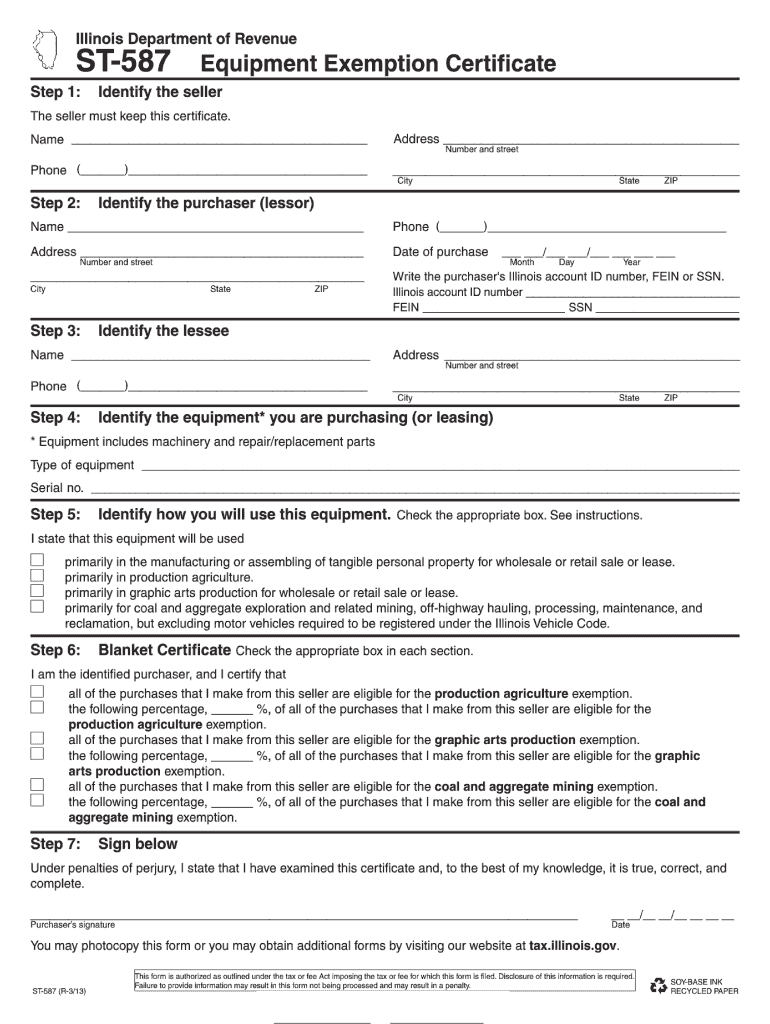
  2. Begin by identifying the seller. Fill in the seller's name, address, and phone number in the designated fields.
  3. Next, identify the purchaser (lessor). Enter their name, address, phone number, and date of purchase. Don’t forget to include the Illinois account ID number or FEIN/SSN.
  4. If applicable, provide details for the lessee by filling in their name, address, and phone number.
  5. Identify the equipment being purchased or leased. Specify the type of equipment and its serial number.
  6. Indicate how you will use this equipment by checking the appropriate box based on its primary use.
  7. Complete the blanket certificate section if necessary by checking relevant boxes regarding exemptions.
  8. Finally, sign and date the form under penalties of perjury to confirm accuracy.

Start using our platform today for free to streamline your document editing and form completion!

See more illinois form exemption 2013 versions

We've got more versions of the illinois form exemption 2013 form. Select the right illinois form exemption 2013 version from the list and start editing it straight away!
Versions Form popularity Fillable & printable
2019 4.8 Satisfied (70 Votes)
2019 4.3 Satisfied (216 Votes)
2014 4.4 Satisfied (562 Votes)
2013 4 Satisfied (55 Votes)
2010 4.1 Satisfied (37 Votes)
1996 4.5 Satisfied (24 Votes)
be ready to get more

Complete this form in 5 minutes or less

Get form

Got questions?

We have answers to the most popular questions from our customers. If you can't find an answer to your question, please contact us.
Contact us
Your Illinois Sales Tax Exemption Certificate is an important tax document that authorizes you under the Retailers Occupation Tax Act to purchase tangible personal property for use or consumption tax-free.
For the 2024 tax year, Illinois offers a personal exemption allowance of $2,775 per individual, totaling $5,550 for married couples filing jointly. Taxpayers 65 or older and those who are legally blind receive an extra exemption of $1,000 each.
A single filer with no children should claim a maximum of 1 allowance, while a married couple with one source of income should file a joint return with 2 allowances. You can also claim your children as dependents if you support them financially and theyre not past the age of 19.
The due date for filing IL-1040 and paying any tax owed is April 15, 2025. The Illinois income tax rate is 4.95 percent. The personal exemption amount for tax year 2024 is $2,775.
IL‑W‑4 Employees Illinois Withholding Allowance Certificate Check the box if you are exempt from federal and Illinois Income Tax withholding and sign and date the certificate. If you have more than one job or your spouse works, you should figure the total number of allowances you are entitled to claim.

People also ask

Enter $11,080 if married filing joint with two or more allowances, unmarried head of household, or qualifying widow(er) with dependent(s) or $5,540 if single or married filing separately, dual income married, or married with multiple employers 2.
This is different from a standard deduction, which is a fixed amount that reduces taxable income, available to all taxpayers regardless of dependents. For the 2024 tax year, Illinois offers a personal exemption allowance of $2,775 per individual, totaling $5,550 for married couples filing jointly.
In summary, if you prefer a larger refund and can afford to have less take-home pay, claim 0. If you want more immediate cash flow and are comfortable managing your tax liability, claim 1.

Related links