



Guide to judiciary policy 2026

Get Form
guide to judiciary policy Preview on Page 1

Here's how it works

01. Edit your form online
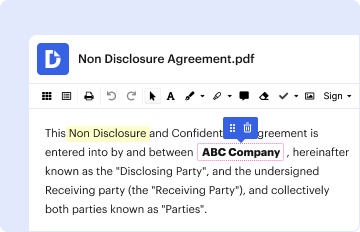
Type text, add images, blackout confidential details, add comments, highlights and more.
02. Sign it in a few clicks
Draw your signature, type it, upload its image, or use your mobile device as a signature pad.
03. Share your form with others
Send it via email, link, or fax. You can also download it, export it or print it out.

How to use or fill out guide to judiciary policy with our platform

Form edit decoration
9.5
Ease of Setup
DocHub User Ratings on G2
9.0
Ease of Use
DocHub User Ratings on G2
  1. Click ‘Get Form’ to open the guide to judiciary policy in the editor.
  2. Begin by reviewing the 'Overview' section, which outlines the scope and applicability of the code of conduct. Ensure you understand who it applies to and any exceptions.
  3. Proceed to fill in the required fields, such as [Name of CDO] and [Name Abbreviation], where indicated. This personalizes the document for your organization.
  4. Navigate through each canon listed in the document. For each canon, reflect on how it applies to your role and responsibilities within your community defender organization.
  5. Utilize our platform's commenting feature to add notes or questions regarding specific canons that may require further clarification or discussion with colleagues.
  6. Once completed, review all entries for accuracy and completeness before saving or sharing the document with relevant stakeholders.

Start using our platform today for free to streamline your document editing and ensure compliance with judiciary policies!

be ready to get more

Complete this form in 5 minutes or less

Get form

Got questions?

We have answers to the most popular questions from our customers. If you can't find an answer to your question, please contact us.
Contact us

Yes, you can use DocHub for signing any business and personal paperwork, including your guide to judiciary policy. All electronic signatures you create with our tool are legally binding and court-admissible, as DocHub complies with standards required by ESIGN and UETA. Save your accomplished form with a detailed Audit Trail if necessary.

If you are looking for a state-specific guide to judiciary policy sample, you will find it in our DocHub Forms & Templates catalog. Use the search field, key in your form’s name, and search through the results for your state. You can also filter out irrelevant results while browsing our catalog by categories.


The federal court system has three main levels: district courts (the trial court), circuit courts which are the first level of appeal, and the Supreme Court of the United States, the final level of appeal in the federal system.
Enforcing the Spirit of Constitutionalism: The judiciary can play an important role in improving the lawmaking process and securing democratic ideals. A straightforward way of doing this is by enforcing the text and spirit of the constitutional provisions governing legislative procedures.
1. : of or relating to courts or judges. 2. : ordered or enforced by a court. a judicial decision.

People also ask

The judicial branch decides the constitutionality of federal laws and resolves other disputes about federal laws. However, judges depend on our governments executive branch to enforce court decisions.
The principles state: Judicial independence is a prerequisite to the rule of law and a fundamental guarantee of a fair trial. A judge shall therefore uphold and exemplify judicial independence in both its individual and institutional aspects. Impartiality is essential to the proper discharge of the judicial office.
The functions of the Judiciary are to interpret laws and settle disputes. It is also called the watchdog of democracy. As the guardian of the constitution, it takes care of justice. There are three types of Judiciary in India, namely Supreme Courts, High Courts, and District Courts.
What is the basic purpose of the Federal Judicial System? To interpret laws and actions of the government against the Constitution (Judicial Review) and apply them to court cases.
At times, the judiciary issues directions for formulating a particular policy or changing the existing policy to suit a particular purpose. It may also determine certain guidelines for the legislature and/or the executive that ought to be followed in the process of public policy making.

Related links

