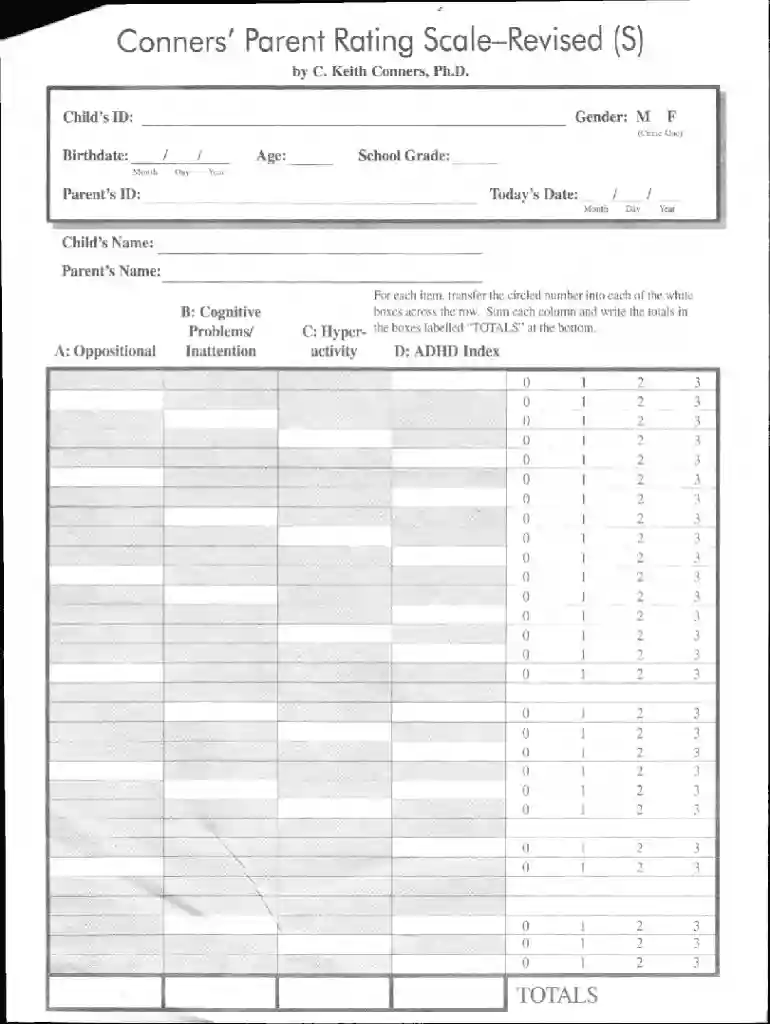
Definition of the Conners Parent Rating Scale
The Conners Parent Rating Scale (CPRS) is a comprehensive tool utilized for assessing behavioral issues in children, particularly focusing on symptoms associated with Attention Deficit Hyperactivity Disorder (ADHD). The scale enables parents to report their observations regarding their child's behavior across various contexts, thus helping clinicians in diagnosing emotional and behavioral disorders. The CPRS is pivotal for determining areas such as inattention, hyperactivity, oppositional behavior, and various cognitive issues. The tool is made available in a structured PDF format, allowing easy scoring and interpretation.
Components of the Conners Parent Rating Scale
- Sections: The CPRS includes various sections designed to collect multifaceted behavioral information. These sections typically address:
- Attention-related problems
- Hyperactivity/impulsivity
- Oppositional behaviors
- Rating Scales: Parents are instructed to rate behaviors on a scale from "not true" to "very much true," enabling a standardized measure of frequency or intensity.
- Identification Information: Each form includes identification sections for both the parent and child to ensure clarity in evaluation and follow-up recommendations.
Steps to Complete the Conners Parent Rating Scale PDF Scoring
Completing the CPRS involves a series of straightforward steps designed to yield accurate and insightful results:
- Download the Scale: Access the Conners Parent Rating Scale PDF from a reliable source, ensuring it is the most current version.
- Fill Out Identification Information: Complete the identification section of the form, accurately entering the child's name, age, and date of evaluation.
- Rate Behaviors: Using the provided scale, parents should rate their child’s behaviors by marking their observations accordingly. It is crucial to answer all items based on the past month to maintain consistency.
- Score Calculation: Once the ratings are completed, use the included scoring guide to calculate total scores for each behavioral category.
- Interpret Results: Analyze the scores against standardized norms to identify areas of concern, which can inform further assessment or intervention strategies.
Usage in Clinical and Educational Settings
- In clinical settings, the CPRS is administered alongside other assessments as part of a comprehensive evaluation.
- In educational environments, findings from the scale may inform individualized education programs (IEPs) or behavioral interventions.
Important Terms Related to the Conners Parent Rating Scale
Understanding the specific terminology used in the CPRS can enhance comprehension and scoring accuracy:
- ADHD (Attention Deficit Hyperactivity Disorder): A chronic condition marked by persistent inattention, hyperactivity, and impulsivity.
- Behavioral Symptoms: Observable actions or sequences of actions that indicate underlying psychological conditions.
- Norm-Referenced Scores: Scoring that compares an individual's result against a norm group, helping to identify significant behavioral concerns.
Scoring Terminology
- T-scores: Standardized scores used to compare a child's behavior against normative data, where a score above 65 typically indicates concern.
Key Elements of the Conners Parent Rating Scale PDF Scoring
The CPRS scoring process consists of several critical elements that facilitate accurate interpretation and utilization of results:
- Total Score Calculation: Summing individual items within each behavioral domain to form total scores for better context for clinicians and parents.
- Subscale Scores: The scale includes various behavioral subscales, such as inattention or hyperactivity, offering a nuanced view of specific behaviors.
- Interpretive Guidelines: Instructions provide recommended actions based on score ranges, enabling effective follow-ups and interventions.
Practical Recommendations for Scoring
- Use the Conners assessment PDF free download to obtain the latest version of the scale for accurate scoring.
- Always refer to the Conners rating scale manual for guidance when interpreting detailed results.
Steps to Obtain the Conners Parent Rating Scale PDF Scoring
Obtaining the CPRS PDF scoring form is essential for effective assessment and intervention:
- Visit Authorized Websites: Access educational or clinical websites that offer valid downloads of the CPRS.
- Check for Availability: Ensure the selected site provides the most recent version of the scale, typically labeled with the current revision date.
- Download and Save: Save the PDF to your device for easy access, ensuring it is readily available for use during assessments.
Alternative Access Options
- Some clinics may provide printed versions directly during assessments, ensuring convenience for parents and caregivers.
Examples of Using the Conners Parent Rating Scale PDF Scoring
Practical applications of the Conners Parent Rating Scale are observed across various scenarios:
- Identifying ADHD Symptoms: A pediatrician using the CPRS to assess whether a child meets the diagnostic criteria for ADHD.
- Monitoring Treatment Effectiveness: Parents may periodically fill out the scale to determine if behavioral interventions are yielding positive changes.
- Collaboration Among Professionals: School counselors can use data from the CPRS to develop tailored strategies suitable for a child in the classroom setting.
Scenarios for Interpretative Guidance
- If a child's scores indicate high levels of hyperactivity, clinicians may recommend additional evaluations or targeted behavioral therapies, ensuring that interventions are based on comprehensive data.