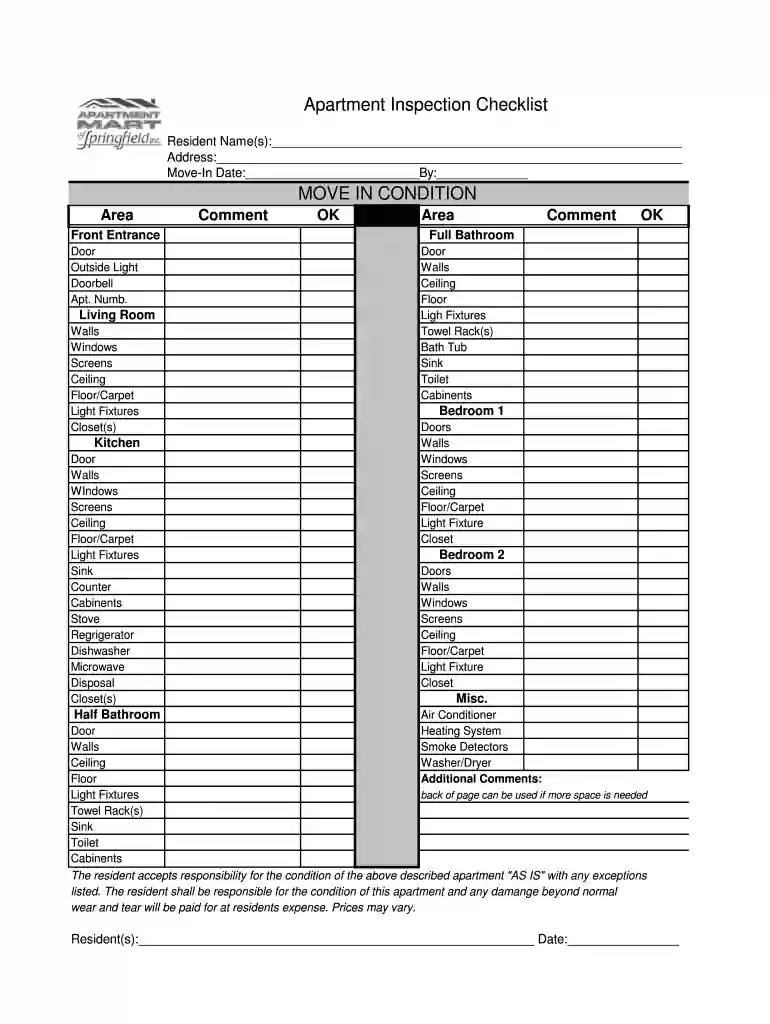
Apartment Inspection bChecklist MOVEb IN CONDITION 2026

Get Form
Apartment Inspection bChecklist MOVEb IN CONDITION Preview on Page 1

Here's how it works

01. Edit your form online
Type text, add images, blackout confidential details, add comments, highlights and more.

02. Sign it in a few clicks
Draw your signature, type it, upload its image, or use your mobile device as a signature pad.

03. Share your form with others
Send it via email, link, or fax. You can also download it, export it or print it out.

How to use or fill out Apartment Inspection Checklist MOVE IN CONDITION

Form edit decoration
9.5
Ease of Setup
DocHub User Ratings on G2
9.0
Ease of Use
DocHub User Ratings on G2
  1. Click ‘Get Form’ to open it in the editor.
  2. Begin by entering your Resident Name(s) and Address at the top of the form. This information is essential for identifying your inspection record.
  3. Fill in the Move-In Date and sign off with your name in the designated fields to confirm your acceptance of the apartment's condition.
  4. Proceed to each area listed under 'MOVE IN CONDITION'. For each section, such as Living Room, Kitchen, and Bathrooms, carefully inspect and note any issues in the Comments field next to each item.
  5. Mark 'OK' next to items that are satisfactory. If there are any concerns, detail them in the Comments section provided.
  6. Utilize the back of the page if additional space is needed for comments or notes regarding any areas not covered.
  7. Finally, ensure all residents sign and date at the bottom of the form to acknowledge responsibility for the apartment's condition 'AS IS'.

Start using our platform today for free to streamline your apartment inspection process!

See more Apartment Inspection bChecklist MOVEb IN CONDITION versions

We've got more versions of the Apartment Inspection bChecklist MOVEb IN CONDITION form. Select the right Apartment Inspection bChecklist MOVEb IN CONDITION version from the list and start editing it straight away!
Versions Form popularity Fillable & printable
2009 4.3 Satisfied (41 Votes)
2006 4.7 Satisfied (22 Votes)
be ready to get more

Complete this form in 5 minutes or less

Get form

Got questions?

We have answers to the most popular questions from our customers. If you can't find an answer to your question, please contact us.
Contact us
Take the time to make notes about the condition of everything in the rental, from the condition of the carpet to marks on the wall or cracked bathroom tiles; you want to show you didnt cause the damage. You can add additional notes about each room in the comments section.
Before your tenants settle into their new home, its essential to complete a move-in checklist. Doing so will let both landlords and tenants avoid any confusion or miscommunication surrounding the condition of the rental unit.
While landlords may ask tenants to move belongings temporarily for inspection, they cannot forcibly remove items without consent. Communication is key; tenants should clarify inspection scope and timing. Document all notices and interactions to protect tenant rights during such inspections.
Aspects of the overall condition include checking if the walls, floors, and ceilings are in good condition, as well as conducting a mold inspection to verify that the property is free from harmful mold growth. Safety hazards: Landlords can inspect for issues that pose a threat to the health and safety of their tenants.
Generally, landlords cannot move a tenants belongings without proper notice or legal eviction. Without a formal eviction notice or agreement, removing possessions may violate tenant rights.

Security and compliance

At DocHub, your data security is our priority. We follow HIPAA, SOC2, GDPR, and other standards, so you can work on your documents with confidence.

Learn more
ccpa2
pci-dss
gdpr-compliance
hipaa
soc-compliance

People also ask

Tenant Privacy Rights Even though you own the property, its the tenants home. You cant just walk in, open closets, or go through personal belongings. Your inspection should focus on areas that impact health, safety, and the structure of the property, like plumbing, walls, windows, and shared spaces.
You should review not only the basic structural features but also areas of the apartment such as heating, light and ventilation, electricity, plumbing, trash and garbage disposal, and security and safety issues, such as locks, smoke detectors, and fire extinguishers.

Related links