Anatomy prefixes and suffixes list 2026

Get Form
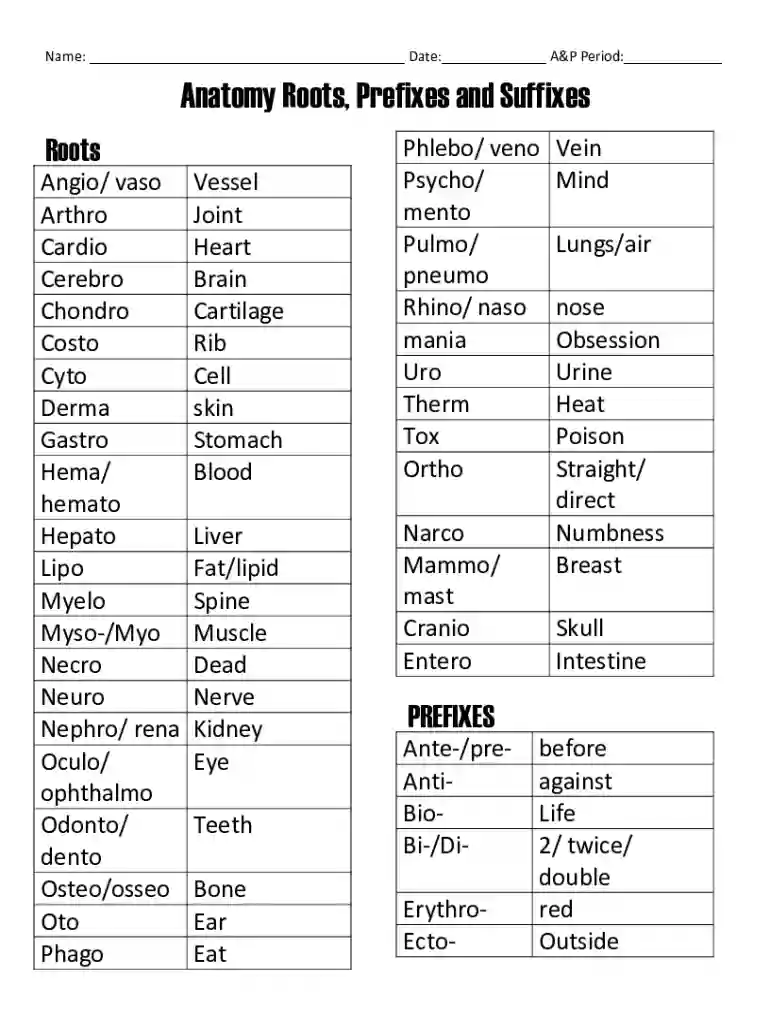
anatomy prefixes and suffixes list Preview on Page 1

Here's how it works

01. Edit your anatomy prefixes and suffixes list online
Type text, add images, blackout confidential details, add comments, highlights and more.

02. Sign it in a few clicks
Draw your signature, type it, upload its image, or use your mobile device as a signature pad.

03. Share your form with others
Send anatomy prefixes via email, link, or fax. You can also download it, export it or print it out.

Definition and Meaning of Anatomy Prefixes and Suffixes

Anatomy prefixes and suffixes are essential linguistic components in medical terminology that enhance understanding of anatomical terms. These linguistic elements modify root words and provide specific meanings, making it easier to describe various body parts, functions, and conditions. For instance, the prefix "hypo-" means "below normal," while the suffix "-itis" refers to inflammation. Understanding these components allows healthcare professionals to communicate effectively regarding diagnoses and treatments.

  • Prefixes: These are elements added to the front of a root word, altering its meaning. Common prefixes in anatomy include:

    • "Hyper-": Excessive or above normal (e.g., hypertension)
    • "Sub-": Under or below (e.g., subcutaneous)
    • "Inter-": Between (e.g., intercostal)
  • Suffixes: These are elements added to the end of a root word. They provide a variety of meanings, often indicating conditions or procedures. Examples include:

    • "-ectomy": Surgical removal (e.g., appendectomy)
    • "-ology": The study of (e.g., cardiology)
    • "-osis": Abnormal condition (e.g., fibrosis)

Understanding the implications of these prefixes and suffixes can greatly aid in deciphering medical jargon.

How to Use the Anatomy Prefixes and Suffixes List

Utilizing an anatomy prefixes and suffixes list effectively involves several steps. Familiarity with common prefixes and suffixes enhances one's medical vocabulary, making the interpretation of complex terms more manageable.

  1. Referencing Terms: When encountering a new anatomical term, break it down into its components using the list. Identify the root word and then apply the meaning of any prefixes and suffixes. For instance, "cardiomyopathy" can be dissected into "cardio-" (heart) + "myo-" (muscle) + "-pathy" (disease).
  2. Creating Terminology: Construct new terms for specific conditions or anatomical references by combining suitable prefixes and suffixes with root words. This technique is especially useful in research and professional communication.
  3. Improving Communication: Use the list to enhance clarity when discussing complex medical concepts with peers or patients. Accurate terminology can significantly improve the efficiency of information exchange.

By mastering this list, healthcare professionals and students can navigate anatomical terminology with greater ease and confidence.

Examples of Using the Anatomy Prefixes and Suffixes List

Real-world examples demonstrate the practical application of anatomy prefixes and suffixes in medical settings.

  • Prefix Examples:

    • "Ante-": Meaning "before." In the term "antepartum," it refers to the period before childbirth.
    • "Trans-": Meaning "across." In "transdermal," it refers to the passage of medication through the skin.
  • Suffix Examples:

    • "-ology": Meaning "the study of." For example, "neurology" is the branch of medicine dealing with the nervous system.
    • "-pathy": Indicating disease. "Neuropathy" refers to disease or dysfunction of one or more peripheral nerves.

Such examples illustrate how prefixes and suffixes provide clarity in describing medical conditions, ensuring accurate and effective communication.

Important Terms Related to Anatomy Prefixes and Suffixes List

Familiarity with additional terms related to anatomy prefixes and suffixes can enhance understanding of medical terminology.

  • Root Words: These form the core of anatomical terms, conveying the primary meaning. Examples include "cardi-" (heart), "hepat-" (liver), and "nephr-" (kidney).
  • Medical Terminology: This encompasses the language used within the healthcare field. Comprehension of prefixes and suffixes is crucial for mastering this vocabulary.
  • Anatomical Position: A standard position of the body used as a reference point for anatomical terminology, where the person stands upright, facing forward, with arms at the sides and palms facing forward.

Understanding these terms establishes a solid foundation for anyone navigating the field of anatomy and physiology.

Key Elements of Anatomy Prefixes and Suffixes List

The anatomy prefixes and suffixes list consists of several key elements that contribute to its effectiveness and utility.

  • Comprehensive Coverage: The list includes a wide array of prefixes and suffixes used in various medical specialties, ensuring that users have access to relevant terms across disciplines.
  • Definitions: Each term in the list typically includes a clear definition, allowing users to quickly grasp its meaning and applications.
  • Example Terms: Many lists provide examples of terms utilizing specific prefixes or suffixes, facilitating learning through practical application.

These elements collectively create a valuable resource for medical professionals, students, and anyone interested in enhancing their understanding of anatomy-related terminology.

be ready to get more

Complete this form in 5 minutes or less

Get form

Got questions?

We have answers to the most popular questions from our customers. If you can't find an answer to your question, please contact us.
Contact us
List of Words with a Prefix and a Suffix PrefixBase WordSuffix Im-Mortal-ity Un- Fortunate -ly Mis- Calculate -tion Pre- Arrange -ment24 more rows
Prefixes are located at the beginning of a medical term. The prefix alters the meaning of the medical term. It is important to spell and pronounce prefixes correctly. Many prefixes that you find in medical terms are common to English language prefixes.
Using Prefixes and Suffixes unhappy (prefix un- added to happy) rewrite (prefix re- added to write) disagree (prefix dis- added to agree) misspell (prefix mis- added to spell) overeat (prefix over- added to eat) teacher (suffix -er added to teach) development (suffix -ment added to develop)
Anti- Against. Antisocial. De- Opposite. Demotivated. Un- Not. Unhappy. Dis- Not, opposite of. Disagree. Im- Not. Impolite. Mid- Middle. Midday. Mis- Wrongly. Misunderstand. Over- Over. Overenthusiastic.
List of Commonly-Used Prefixes and Suffixes with Examples A- (abiotic, atypical) Un- (undo, unfold) Im- (impolite, immature) In- (intolerant, indisciplined) Il- (illogical, illegible) Ir- (irregular, irresponsible) De- (decode, destress) Re- (redo, reappear)

Security and compliance

At DocHub, your data security is our priority. We follow HIPAA, SOC2, GDPR, and other standards, so you can work on your documents with confidence.

Learn more
ccpa2
pci-dss
gdpr-compliance
hipaa
soc-compliance

People also ask

List of Suffixes Prefixes List of Prefix in English Prefix WordMeaningsPrefix Examples fore before Forecast, forelimb, hyper too much hyperactive, hypersensitive il, im, in, ir not, opposite of illogical, impossible, indistinct, irrational51 more rows

anatomy prefixes and suffixes worksheet