Liability waiver 2026

Get Form
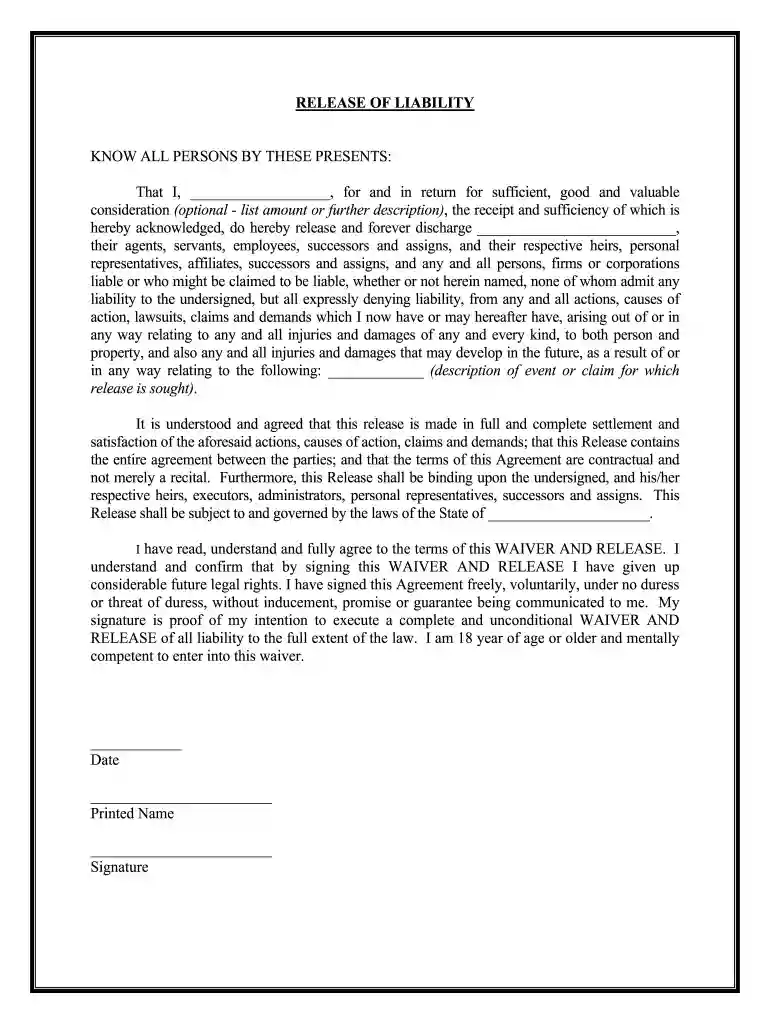
liability waiver Preview on Page 1

Here's how it works

01. Edit your form online
Type text, add images, blackout confidential details, add comments, highlights and more.

02. Sign it in a few clicks
Draw your signature, type it, upload its image, or use your mobile device as a signature pad.

03. Share your form with others
Send it via email, link, or fax. You can also download it, export it or print it out.

How to use or fill out liability waiver with our platform

Form edit decoration
9.5
Ease of Setup
DocHub User Ratings on G2
9.0
Ease of Use
DocHub User Ratings on G2
  1. Click ‘Get Form’ to open the liability waiver in the editor.
  2. Begin by filling in your name in the first blank space provided. This identifies you as the individual releasing liability.
  3. In the next section, specify the consideration amount or description if applicable. This is optional but can clarify what you are receiving in return for signing.
  4. Describe the event or claim related to this release in the designated area. Be specific to ensure clarity regarding what you are waiving rights for.
  5. Review the terms of the waiver carefully. Ensure you understand that by signing, you are giving up certain legal rights.
  6. Enter today’s date in the provided space, followed by your printed name and signature at the bottom of the form.

Start using our platform today to easily complete your liability waiver online for free!

be ready to get more

Complete this form in 5 minutes or less

Get form

Got questions?

We have answers to the most popular questions from our customers. If you can't find an answer to your question, please contact us.
Contact us
Yes, liability waivers can be legally binding documents. Its, therefore, advisable to seek legal or professional guidance to ensure your waiver is well-drafted and legally valid for your location. Other relevant factors that determine the enforceability of liability waivers include: The terms and language used.
Some examples of times when organizations might use a waiver include: A river tubing company requiring participants to sign an activity waiver before they hop in a tube and float down the river. A school asking parents to agree to an activity waiver before allowing students to take part in its annual field day event.
A liability waiver is a contract that protects your business from claims and lawsuits for damages suffered due to the inherent hazards of your services. Think of it as a warning label with a legal protection feature. It tells your customers three key things: Your service carries inherent risks.
Allowing employees to intimidate or coerce participants or customers into signing your liability waivers. A mistake that many businesses make is pressuring employees to get liability waivers signed.
Generally, a liability waiver should include the following provisions: Risks. First and foremost, it should include a list of the representative inherent risks and any special risks of a trip and/or core activities in an itinerary. Liability Waiver Release. Assumption of Risk. Indemnification. Forum/Venue Selection.