




01. Edit your form online
Type text, add images, blackout confidential details, add comments, highlights and more.

Type text, add images, blackout confidential details, add comments, highlights and more.

Draw your signature, type it, upload its image, or use your mobile device as a signature pad.

Send it via email, link, or fax. You can also download it, export it or print it out.
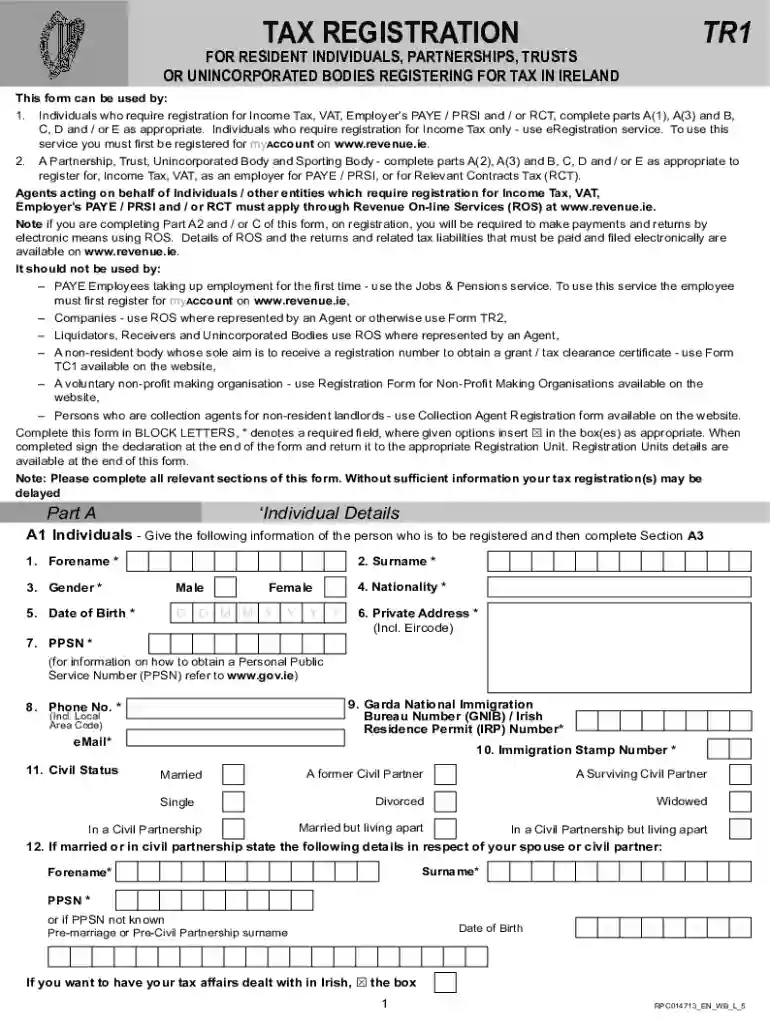
Tax registration is a critical process for individuals and entities required to report earnings and remit taxes to governmental authorities. This form is primarily used to register for different types of taxes, including Income Tax, VAT, PAYE/PRSI, and Relevant Contracts Tax (RCT). By completing this form, taxpayers ensure compliance with tax laws, avoid potential penalties, and maintain good financial standing.
Providing accurate information in tax registration is essential for preventing processing delays and ensuring the correct calculation of tax liabilities. Details such as personal and business information, tax residency, and business activities must be verified. Errors or omissions could lead to penalties, audit triggers, or in extreme cases, legal consequences.
The form is designed to guide the user through the tax registration process. When using the form, follow these general steps:
Understanding key terms ensures clarity while completing the tax registration form.
This form is commonly used by a variety of taxpayers, each with specific needs and goals.
Timely and accurate completion of the tax registration form is essential for legal compliance.
By examining practical examples, users can gain a clearer understanding of how to properly complete and submit the form.
A small business owner who starts a consultancy firm needs to register for State Income Tax and Sales Tax.
A self-employed individual needing to register for federal and state income taxes, ensuring accurate self-reporting for freelance work.
Staying aware of critical dates is vital for avoiding late fees and ensuring compliance.
We've got more versions of the revenue ieregistering-for-taxindexRegistering for tax - Revenue form. Select the right revenue ieregistering-for-taxindexRegistering for tax - Revenue version from the list and start editing it straight away!
At DocHub, your data security is our priority. We follow HIPAA, SOC2, GDPR, and other standards, so you can work on your documents with confidence.
You must register with the Illinois Department of Revenue (IDOR) if you conduct business in Illinois or with Illinois customers.Read more
We examine the impact of recent tax reforms in Ireland on private car transport and its greenhouse gas emissions. A carbon tax was introduced on fuels,
The Internal Revenue Service (IRS) collects the revenue that funds the government and administers the nations tax laws. The IRS collected $2.415 trillion inRead more


