
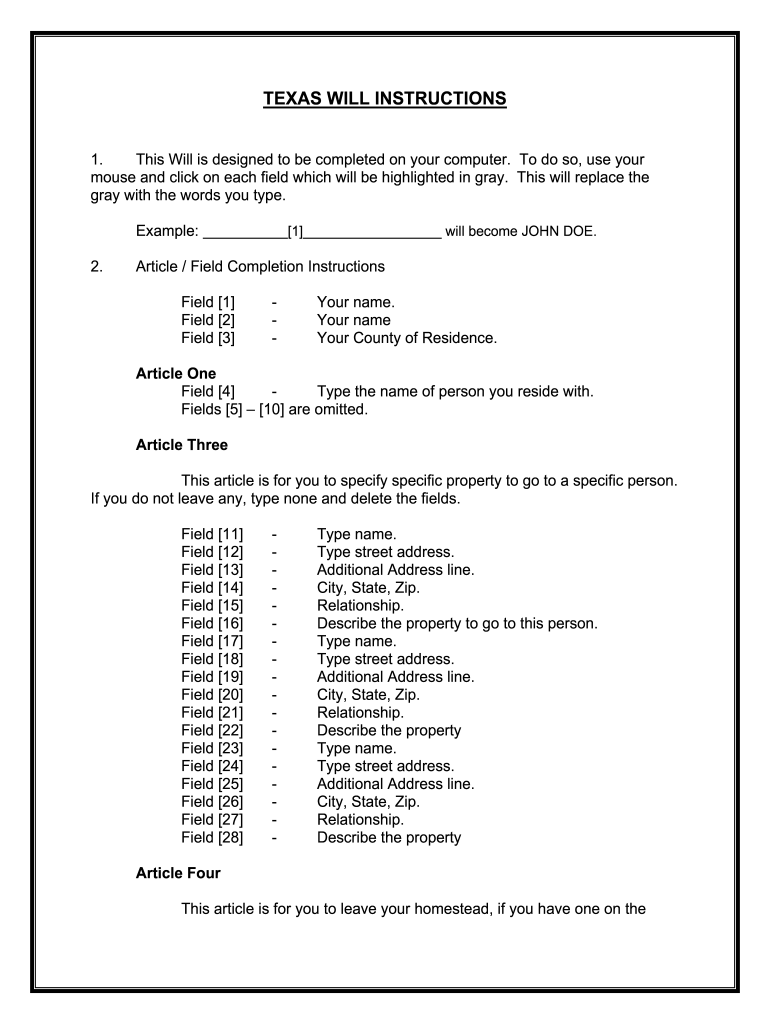







Defining a Texas Last Will and Testament
A Texas Last Will and Testament is a legal document that outlines the wishes of an individual, referred to as the testator, regarding the distribution of their property and the care of any minor children after their death. This document is essential in the probate process, as it guides the court in ensuring that the testator's intentions are honored. In Texas, the will must comply with specific state laws to be considered valid. These laws determine the necessary formalities, such as the testator's legal capacity and the will's execution requirements.
Key Elements of a Texas Will
- Personal Information: The will must include detailed personal information about the testator, such as their full name and address, to establish identity.
- Bequests of Property: Specific assets must be listed, along with instructions on how they are to be distributed among beneficiaries.
- Appointment of Executors: The testator should designate a personal representative responsible for executing the will's terms.
- Provisions for Debts and Expenses: Directions for settling any outstanding debts or expenses upon the testator's death should be included.
Obtaining and Using a Texas Will
To obtain a Texas will, an individual can either draft it themselves or employ the services of an attorney specializing in estate planning. Templates are available online but should be used with caution to ensure compliance with Texas laws. Once drafted, the will needs to be signed by the testator in the presence of at least two witnesses who are not beneficiaries. A notary public can be present to add an extra layer of legality, although this is not mandatory in Texas.
Steps to Complete the Will
- Compile Personal and Asset Information: Gather all necessary details about the testator and their assets.
- Select Beneficiaries and Executors: Decide who will receive the assets and who will manage the estate's execution.
- Draft the Will: Include all elements such as asset distribution, executor appointment, and guardian designation for minors.
- Sign the Document: Execute the will with required witnesses and possibly a notary.
Reasons to Create a Texas Will
Creating a will in Texas ensures that a person's assets are distributed according to their desires, avoiding potential disputes among heirs. It also allows individuals to appoint guardians for minor children rather than leaving it to the court's discretion. A well-structured will saves beneficiaries from unnecessary legal expenses and delays during probate.
Potential Users of a Texas Will
- Homeowners: People who own real estate can use a will to dictate property management posthumously.
- Parents with Minor Children: Individuals with young children can specify guardianship arrangements.
- Business Owners: Entrepreneurs can designate who inherits ownership or control of their business.
Legal Usage and State-Specific Rules
The Texas Estates Code governs how wills are drafted, executed, and probated in Texas. It is essential to comply with state laws to ensure the will is enforceable in court. Specific Texas rules include requirements for witnesses, who must be at least 14 years old, and the type of will format accepted, such as holographic wills being valid if wholly in the testator's handwriting.
Important Related Terms
- Codicil: A legal document that modifies an existing will, which must be executed with the same formalities.
- Intestate: The condition of dying without a valid will, leading to a distribution under Texas intestacy laws.
- Probate: The legal process through which a will is validated in court and executed.
Examples and Scenarios
A recent widower with substantial assets, including a house, investments, and personal property, may draft a will to ensure his children inherit the estate according to his wishes. Another example includes a young couple with two small children, they may create a joint will with provisions for guardianship.
Steps to Execute the Will
- File for Probate: The appointed executor must file the will with the local probate court.
- Notify Beneficiaries: Ensure heirs are aware of their entitlements.
- Settle Debts and Taxes: Pay any outstanding debts and necessary taxes before distribution.
- Distribute Assets: Follow the will's instructions under the court's supervision.
Penalties for Non-Compliance
Failing to follow Texas-specific requirements can render a will invalid, leading the estate to be distributed according to intestacy laws. This can result in undesired outcomes and potential legal challenges from disinherited family members.
Compliance and Execution
Ensuring compliance involves meeting all legal requirements such as witness qualifications, obtaining notarization when necessary, and accurately conveying the testator's wishes. Non-compliance risks delaying probate and increasing costs for the estate.




