Affidavit for Search Warrant - Forms 2026

Get Form
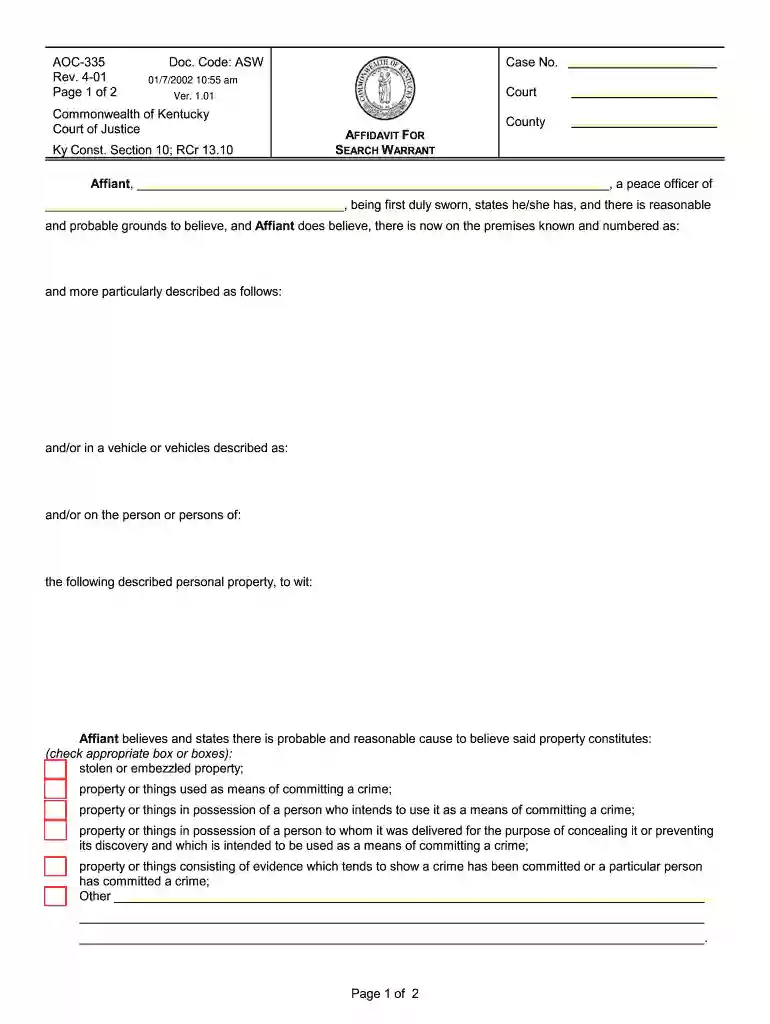
Affidavit for Search Warrant - Forms Preview on Page 1

Here's how it works

01. Edit your form online
Type text, add images, blackout confidential details, add comments, highlights and more.

02. Sign it in a few clicks
Draw your signature, type it, upload its image, or use your mobile device as a signature pad.

03. Share your form with others
Send it via email, link, or fax. You can also download it, export it or print it out.

How to use or fill out Affidavit for Search Warrant - Forms with our platform

Form edit decoration
9.5
Ease of Setup
DocHub User Ratings on G2
9.0
Ease of Use
DocHub User Ratings on G2
  1. Click ‘Get Form’ to open the Affidavit for Search Warrant in the editor.
  2. Begin by filling in the 'Affiant' section with your name and title as a peace officer, along with your agency's name.
  3. Provide the address of the premises where the search is to be conducted, ensuring accuracy in the description.
  4. Indicate any vehicles involved by describing them clearly in the designated section.
  5. List any persons involved, if applicable, and detail the personal property you believe is present at the location.
  6. Check all relevant boxes that describe why you believe this property is connected to criminal activity.
  7. Complete your tenure details as an officer and summarize any information or observations that led to this affidavit.
  8. Finally, sign and date the document before a notary public to finalize your affidavit.

Start using our platform today for free to streamline your document editing and signing process!

See more Affidavit for Search Warrant - Forms versions

We've got more versions of the Affidavit for Search Warrant - Forms form. Select the right Affidavit for Search Warrant - Forms version from the list and start editing it straight away!
Versions Form popularity Fillable & printable
2019 4.8 Satisfied (85 Votes)
2003 4.4 Satisfied (330 Votes)
2001 4.3 Satisfied (48 Votes)
be ready to get more

Complete this form in 5 minutes or less

Get form

Got questions?

We have answers to the most popular questions from our customers. If you can't find an answer to your question, please contact us.
Contact us
A probable cause affidavit is a legal document completed by law enforcement officers to make a case to a judge for issuing a warrant. It details incidents, supporting evidence, and witness testimonies, establishing a reasonable belief or probable cause of a crimes occurrence.
Affidavits can occur any time a formal promise is made, and they are often used as a form of documentation tied to a specific person in the proceedings. They are often used in court to serve as evidence toward a singular side in a dispute, or to affirm a claim that someone is making.
Writing a probable cause affidavit requires clarity and meticulousness. It should include date, time, location of incidents, involved officers, detailed description of the event, references to evidence, and witness statements. The affidavit should also state the degree of offense and relevant penal code.
A valid search warrant must meet four requirements: (1) the warrant must be filed in good faith by a law enforcement officer; (2) the warrant must be based on reliable information showing probable cause to search; (3) the warrant must be issued by a neutral and detached magistrate; and (4) the warrant must state
Quick Overview of a Search Warrant Affidavit: Caption. Include the proper title of the court that will issue the warrant. Affiant resume (hero statement). Describe your training and experience and tell the court about your prior search warrant experience (if any). Description. Probable cause. Notice. Time.

Security and compliance

At DocHub, your data security is our priority. We follow HIPAA, SOC2, GDPR, and other standards, so you can work on your documents with confidence.

Learn more
ccpa2
pci-dss
gdpr-compliance
hipaa
soc-compliance

People also ask

After filing, an affidavit is examined for its accuracy and adherence to legal requirements. It then becomes part of official court records and is accessible to relevant parties. Attorneys may use the affidavit to understand the merit of a case, cross-examine witnesses, and challenge or prove claims.
The completed affidavit is submitted to a judge and they determine if probable cause exists. If the judge agrees that probable cause exists, then they will sign and authorize the search warrant which is filed with the court along with the warrant.

Related links