Customs isf 10 2 form 2026

Get Form
isf form Preview on Page 1

Here's how it works

01. Edit your isf form online
Type text, add images, blackout confidential details, add comments, highlights and more.

02. Sign it in a few clicks
Draw your signature, type it, upload its image, or use your mobile device as a signature pad.

03. Share your form with others
Send isf 10 2 form pdf via email, link, or fax. You can also download it, export it or print it out.

How to use or fill out customs isf 10 2 form with our platform

Form edit decoration
9.5
Ease of Setup
DocHub User Ratings on G2
9.0
Ease of Use
DocHub User Ratings on G2
  1. Click ‘Get Form’ to open the customs ISF 10+2 form in the editor.
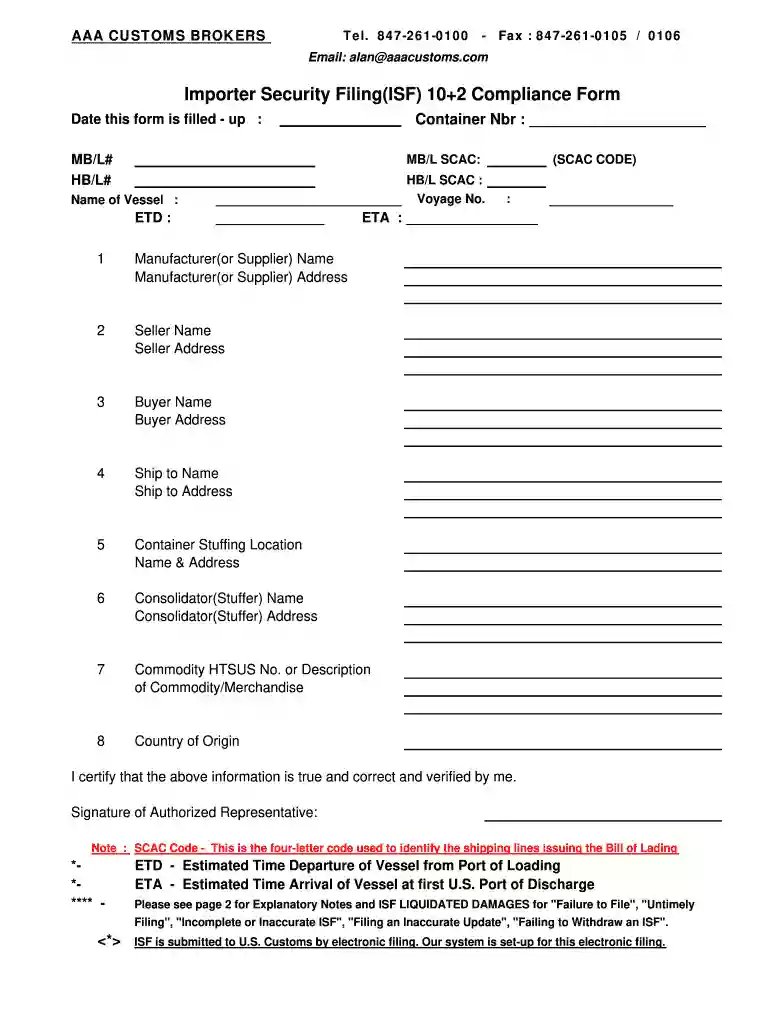
  2. Begin by entering the Container Number and the date this form is filled out. Ensure these details are accurate as they are crucial for tracking your shipment.
  3. Fill in the Master Bill of Lading (MB/L) number and House Bill of Lading (HB/L) number, along with their respective SCAC codes. This information identifies your shipping lines.
  4. Complete the vessel details including Name of Vessel, Estimated Time of Departure (ETD), and Estimated Time of Arrival (ETA). These timestamps help in scheduling and logistics.
  5. Provide detailed information for each party involved: Manufacturer, Seller, Buyer, and Ship To. Include names and addresses to ensure compliance with U.S. Customs requirements.
  6. Input the Container Stuffing Location and Consolidator's details. This is essential for tracking where goods are packed before shipment.
  7. Lastly, enter the Commodity HTSUS number or a description of the merchandise along with its Country of Origin. This data is vital for tariff classification.
  8. Review all entered information for accuracy before signing as an Authorized Representative to certify that all details are true and correct.

Start using our platform today to streamline your customs ISF filing process for free!

be ready to get more

Complete this form in 5 minutes or less

Get form

Got questions?

We have answers to the most popular questions from our customers. If you can't find an answer to your question, please contact us.
Contact us
Who is Responsible for the Filing? The ISF Importer is required to submit the Importer Security Filing. The ISF Importer is the party causing the goods to arrive within the limits of a port in the United States by vessel.
ISF 5 vs. Failure to an ISF 5 filing can result in exam fees and storage costs. However, an ISF 10 is used for the goods that are designed for the United States. Importers must file it 24 hours before loading the cargo. Failure to ISF 10 filing can result in a minimum of $5,000 fine.
ISF is called 10+2 since there are 10 data items required from the importer or their agent, and 2 data elements required from the carrier.
The Importer Security Filing (ISF) also referred to as 10+2, is a customs import requirement of the United States Customs and Border Protection (CBP); which requires containerized cargo information, for security purposes, to be transmitted to the agency at least 24 hours (19 CFR section 149.2(b) before goods are loaded
All ISFs must be filed electronically through either the Automated Broker Interface (ABI) or the Automated Commercial Environment (ACE). This means that you will need to use the services of a licensed U.S. customs broker or another third-party software vendor to successfully file your ISF.

Security and compliance

At DocHub, your data security is our priority. We follow HIPAA, SOC2, GDPR, and other standards, so you can work on your documents with confidence.

Learn more