




01. Edit your nationwide accountants certificate online
Type text, add images, blackout confidential details, add comments, highlights and more.

Type text, add images, blackout confidential details, add comments, highlights and more.

Draw your signature, type it, upload its image, or use your mobile device as a signature pad.

Send it via email, link, or fax. You can also download it, export it or print it out.
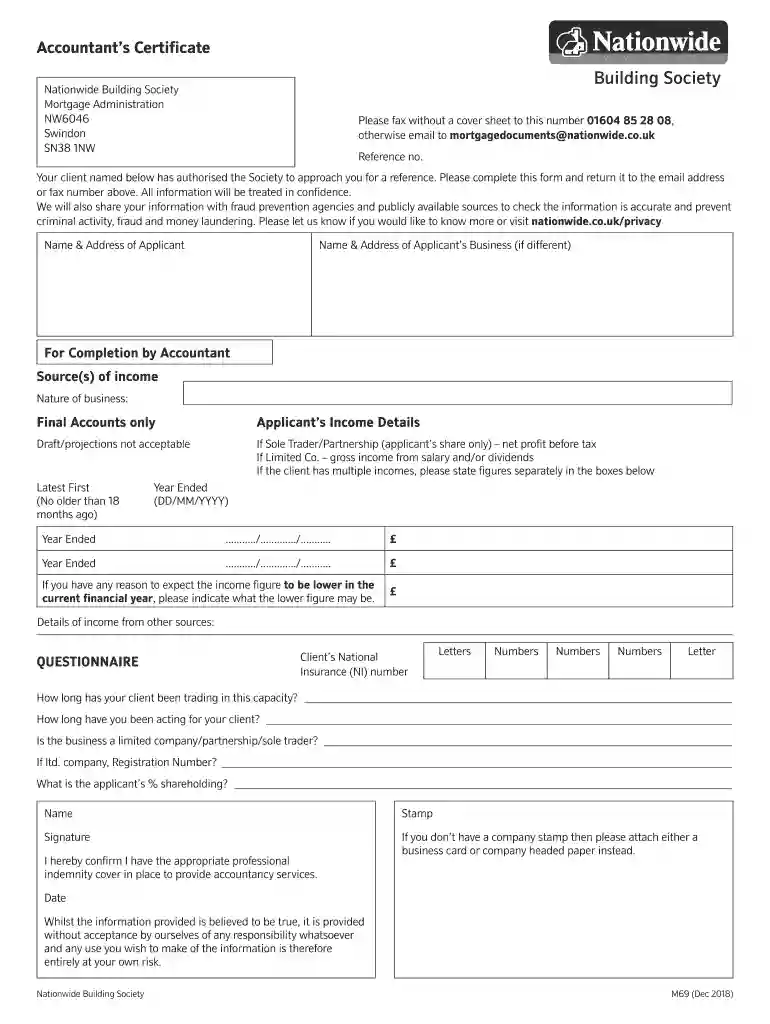
The Nationwide Accountant's Certificate is a formal document issued by Nationwide Building Society, used to verify an individual's income and business details for various financial assessments. Typically, this certificate is filled out by a certified accountant who provides an authoritative reference about the client’s financial standing. The document includes essential data like income sources, business structure, and the duration of trading, serving as a confidential tool that ensures all submitted information is accurate and reliable. The certificate is critical in maintaining transparency and trust between the client, their financial institution, and potentially other parties such as fraud prevention agencies.
Completing the Nationwide Accountant's Certificate involves several structured steps to ensure all necessary information is accurately captured:
Initial Verification: Confirm the client's legitimacy and gather preliminary details about their financial background.
Income Documentation: List all sources of the client's income, including professional fees, investments, and any other relevant income streams.
Business Structure Analysis: Detail the client’s business structure, such as sole proprietorship, LLC, or corporation, including any partners or shareholders if applicable.
Trading Duration Recording: Specify how long the client has been operating their business to provide context for their financial history.
Authenticate Information: Verify all provided information for accuracy and completeness.
Confidentiality Assurance: Ensure that the data compiled is treated with strict confidentiality.
Submission: Once complete, sign the document and submit it to the relevant parties as specified by the instructions.
Each Nationwide Accountant's Certificate contains several crucial elements that must be comprehensively completed to fulfill its purpose:
Client Identification: Complete details about the client's identity, including name, address, and contact information.
Accountant's Details: Information about the accountant responsible for the completion of the certificate, including professional credentials.
Financial Overview: A summary of the client's financial status, highlighting income, expenses, liabilities, and assets.
Confidentiality Clause: Statement ensuring the confidential handling of all information, with a mention that it might be shared with fraud prevention agencies.
The Nationwide Accountant's Certificate is primarily used by individuals and business entities that require a validated proof of income and business structure for financial evaluations:
Individual Clients: These are clients seeking loans, mortgages, or other financial products that require proof of income and financial stability.
Financial Institutions: Banks and lending organizations use these certificates as part of their due diligence processes.
Accountants: Professionals who provide financial verification and assurance services to their clients.
Regulatory Bodies: Agencies that may require detailed financial documentation for compliance and verification purposes.


Understanding specific terms related to the Nationwide Accountant's Certificate is vital for accurate completion and interpretation:
Income Verification: The process of confirming an individual's or business’s earnings.
Financial Assessment: Evaluation of the client’s financial health and risk profile.
Trading Duration: The length of time the business has been operational, impacting credit evaluations.
Confidentiality: The assurance of private handling of sensitive information provided through the certificate.
Opting for a Nationwide Accountant's Certificate offers various benefits, especially when engaging in financial transactions:
Credibility: It provides an official and credible source of financial verification, strengthening the client’s position in financial applications.
Transparency: Enhances transparency between clients and financial institutions, reducing potential fraud.
Compliance: Meets the legal and compliance requirements of many financial institutions and regulatory bodies.
Efficiency: Streamlines financial evaluations by providing a standardized form of data presentation and verification.
Real-world scenarios highlight the application of the Nationwide Accountant's Certificate:
Mortgage Application: A self-employed individual uses the certificate to prove income stability when applying for a mortgage.
Business Loan Processing: A business owner submits the certificate to support their application for a business loan, providing verified income and business details.
Financial Audits: Companies may require the certificate during audits for verified financial information about stakeholders or partners.
Eligibility for obtaining a Nationwide Accountant's Certificate depends on certain criteria, ensuring that only qualified individuals and businesses can utilize it:
Registered Business Entity: Must have an officially recognized business operation, like an LLC or corporation.
Professional Accountant: Requires a certified accountant to complete and authenticate the document.
Positive Financial Standing: Demonstrated by steady income streams and a stable financial history.
Compliance with Legal Requirements: Adherence to laws governing financial reporting and confidentiality, pertinent to the document’s usage.

We've got more versions of the nationwide accountants certificate form. Select the right nationwide accountants certificate version from the list and start editing it straight away!
| Versions | Form popularity | Fillable & printable |
|---|---|---|
| 2018 | 4.5 Satisfied (46 Votes) |
At DocHub, your data security is our priority. We follow HIPAA, SOC2, GDPR, and other standards, so you can work on your documents with confidence.
An Accounting Post-baccalaureate Certificate prepares individuals for careers in accounting and finance across various industries. Certificate holders mayRead more
The forums offer enrolled agents, certified public accountants, Annual Filing Season Program (AFSP) participants, and other tax professionals the opportunity toRead more


