




01. Edit your form online
Type text, add images, blackout confidential details, add comments, highlights and more.

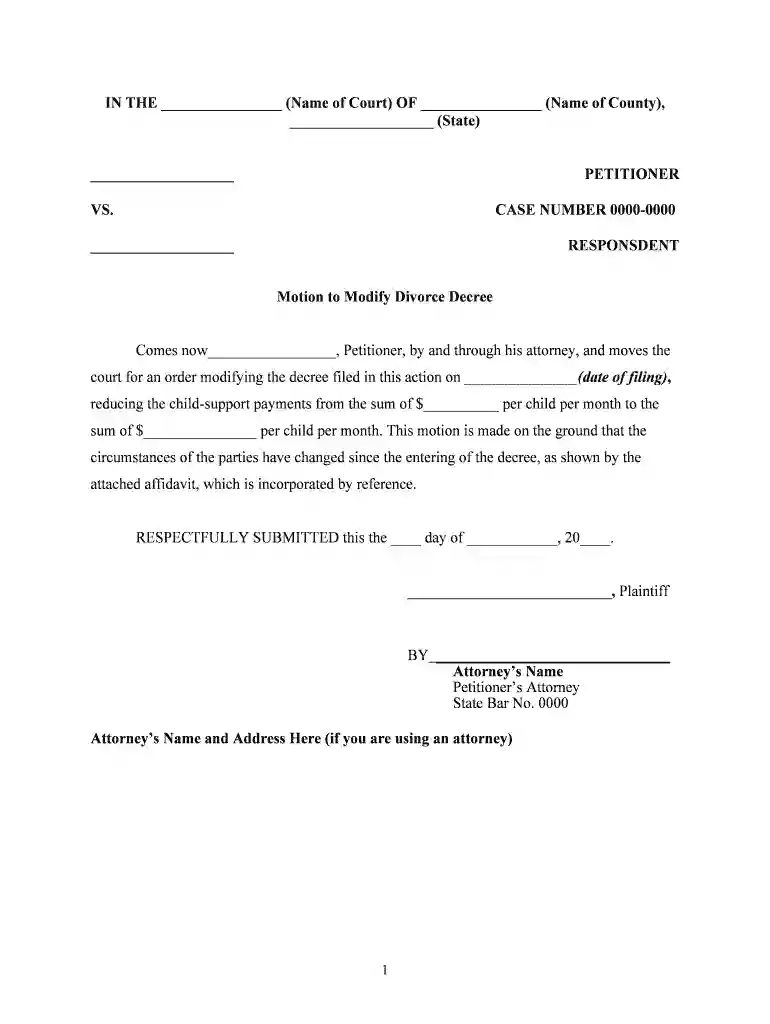
Type text, add images, blackout confidential details, add comments, highlights and more.

Draw your signature, type it, upload its image, or use your mobile device as a signature pad.

Send it via email, link, or fax. You can also download it, export it or print it out.
The "motion modify decree" is a legal document filed by a petitioner aiming to alter an existing court order, typically in the context of family law matters such as divorce. The decree modifies terms of an original judgment or court order, like adjusting child-support payments or changing custody arrangements. Its purpose is to adapt the conditions set by the court to reflect current circumstances, addressing changes that have occurred since the initial order was issued. This document serves as a formal request for judicial consideration of these changes, ensuring the arrangements remain fair and applicable.
To effectively utilize a motion modify decree, the petitioner must follow these steps:
Identify the Need for Modification: Determine the changes in circumstances necessitating the modification, such as financial changes or shifts in child custody needs.
Prepare the Motion: Draft the motion by detailing the original decree's terms and clarifying the requested modifications. Be specific about how circumstances have changed and justify why the adjustments are essential.
File the Motion: Submit the completed motion to the appropriate court, ensuring all relevant parties receive a copy.
Attend the Hearing: Be prepared to present your case if required by the court, providing evidence and possibly witness testimony to support your request.
This document is crucial in legal proceedings when maintaining the original decree's terms is no longer viable due to new developments.
A well-prepared motion modify decree should include several critical components:
Case Information: Detail the current case number, court jurisdiction, and identities of involved parties.
Description of Modification: Clearly outline the specific changes requested to the original decree, including any new terms or conditions.
Rationale for Change: Provide a thorough explanation of the changed circumstances that justify the modification, supported by evidence like financial records or witness statements.
Certification of Service: Verify that all parties have been formally notified of the motion, ensuring compliance with legal procedures.
These elements help ensure the motion is adequately presented and considered by the court.
Filing a motion modify decree involves several methodical steps:
Review the Original Decree: Examine the existing court order to clearly understand the terms you are requesting to modify.
Draft the Motion: Write the motion, ensuring it is comprehensive and includes all necessary details mentioned in the key elements section.
Complete Supporting Forms: Depending on the jurisdiction, additional forms may be required for submission alongside the motion.
Submit to the Court: File the motion with the court clerk, paying close attention to submission guidelines and providing a copy to all relevant parties.
Attend Required Court Proceedings: If the court schedules a hearing, prepare to present your case and answer any questions the judge may have.
If done meticulously, these steps can streamline the process and improve the chances of a successful decree modification.
The motion modify decree is crucial in ensuring court orders remain equitable and reflective of current realities. Legally, it provides a structured approach to requesting changes to court orders, applicable primarily in family law but extendable to other legal areas requiring decree modifications. Legal standards require the petitioner to demonstrate significant changes in circumstances, such as altered financial status or shifts in caregiving responsibilities, warranting a decree adjustment. Filing this motion preserves not just legal rights but ensures continued adherence to court-directed responsibilities amidst evolving personal circumstances.
Individuals commonly using the motion modify decree include:
Divorced Parents: Seeking adjustments in child support or custody based on new life circumstances or financial status changes.
Former Spouses: Modifying alimony payments owing to income alterations or changes in need.
Guardians and Conservators: Adjusting arrangements for minors or dependents if their needs or the caretaker's ability to provide care changes.
These users require the decree to achieve current and fair conditions reflecting their present realities.


While the motion modify decree is a universal legal procedure, requirements can vary by state:
Filing Procedures: Methods and forms for filing may differ, with some states requiring additional documentation or specific forms.
Hearing Necessities: Some jurisdictions necessitate a hearing, while others might resolve the motion through documentation review.
Supporting Documentation: Different states have unique rules concerning the types of evidence or proof required to support the motion.
Understanding specific regional requirements ensures compliance and optimizes the chances of successful decree modification.
Familiarity with certain legal terms aids understanding and processing motions:
Petitioner: The individual or party filing the motion requesting the modification.
Respondent: The opposing party who receives notification of the motion and may rebut the claims made.
Legal Precedent: Past court decisions that influence considerations on whether requested modifications are likely to be granted.
Discovery: The process by which parties gather additional evidence or information necessary to support their motion or response.
Recognizing these terms helps navigate the legal complexities often associated with filing a motion modify decree effectively.
Yes, you can utilize DocHub for signing any business and private documentation, including your motion modify decree. All electronic signatures you create with our tool are legally binding and court-admissible, as DocHub complies with standards required by ESIGN and UETA. Save your completed document with a detailed Audit Trail if necessary.
You can complete and eSign your motion modify decree online, even on a tight deadline. All you need to access high quality editing instruments on any device is a DocHub account, that you can register in a few moments. Once you sign up, upload your file or find what you are searching for in our catalog, complete it using the editing instruments you want, and place your electronic signature on it at the end.
At DocHub, your data security is our priority. We follow HIPAA, SOC2, GDPR, and other standards, so you can work on your documents with confidence.
The courts have applied Bergeron to a parents motion to modify a considered decree of permanent custody to a non-parent. Bergeron does not apply to aRead more
The purpose of this report is to provide a summary of. Technical Impracticability (TI) waivers that have been issued by U.S. Environmental Protection Agency.Read more
To file a motion for Modification you have to fill out the following 2 forms. If you want to modify child support, custody or visitation, you will also need an:Read more


