







Definition & Meaning
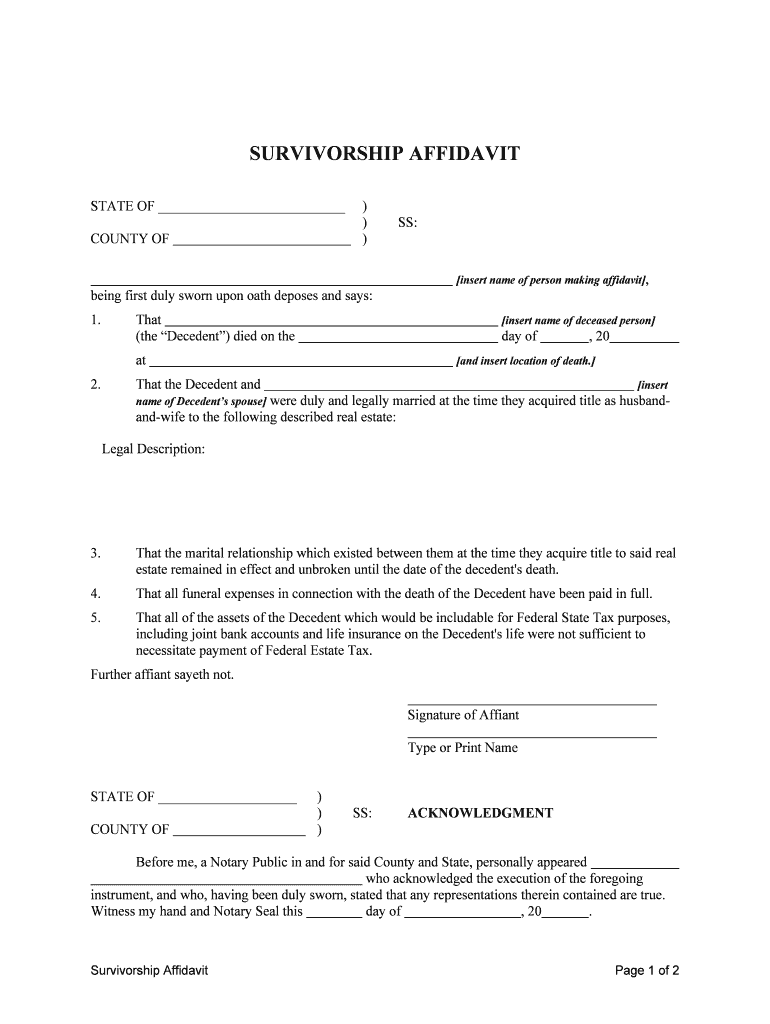
The Idaho affidavit of survivorship is a legal document used primarily by spouses who own property jointly in Idaho. This affidavit serves as evidence that the surviving spouse has rights to the property following the death of the other spouse, the Decedent. It verifies that both parties were married at the time of acquiring the property, and it confirms that all associated funeral expenses have been settled. This form often asserts that the Decedent's estate doesn't require Federal Estate Tax payments, simplifying the transition of property rights to the surviving spouse.
An affidavit of survivorship is crucial in ensuring that property transfer happens smoothly without the need for probate court intervention. By documenting the arrangement, it helps protect the surviving spouse’s legal rights and provides a clear record for title changes in official land records.
Key Elements of the Idaho Affidavit of Survivorship
The Idaho affidavit of survivorship comprises several essential sections that legally define the transfer of property rights. Key elements include:
-
Declarations: Includes statements affirming the marriage status at the time of property acquisition and the death of the Decedent.
-
Property Description: A detailed section specifying the real estate's address or legal description to ensure clarity and precision.
-
Financial Statements: Affirms the clearance of the Decedent’s funeral expenses and lack of necessity for Federal Estate Tax.
-
Notarization Section: The affidavit must be signed in the presence of a notary public to validate its authenticity.
-
Affirmation of Accuracy: The surviving spouse avows the truthfulness of the provided information, adding credibility to the document.
These components work together to ensure that the affidavit is legally sound, aiding in the swift resolution of property rights.
How to Obtain the Idaho Affidavit of Survivorship
Acquiring an Idaho affidavit of survivorship involves a straightforward process:
-
Downloading the Form: You can often access the form online via legal or government websites that provide downloadable templates. Platforms like DocHub allow easy editing and filling out of forms.
-
Consulting an Attorney: Due to its legal implications, consulting with a law professional can ensure that all nuances are appropriately addressed.
-
Supplies & Materials: Ensure you have all necessary documentation related to the property and proof of marriage when completing the form.
Combining proper resources with legal advice facilitates the completion of the affidavit accurately and effectively.
Steps to Complete the Idaho Affidavit of Survivorship
Filling out the Idaho affidavit of survivorship can be completed through a series of structured steps:
-
Gather Essential Documents: Start with the marriage certificate, the deceased's death certificate, and proof of property ownership.
-
Fill Out Personal Details: Enter the full legal names of both spouses and pertinent dates, such as the date of death.
-
Provide Property Information: Carefully input details about the joint property, including address and any existing mortgage or liens.
-
Notarization: Sign the form in the presence of a notary public who will witness the authenticity of your signature.
-
Submit the Affidavit: Often filed with the county recorder's office, this step ensures official recognition of property transfer.
-
Keep Copies: Retain copies for personal records and potential future reference.
Thoroughly understanding each step minimizes mistakes and ensures compliance with all legal requirements.
State-Specific Rules for the Idaho Affidavit of Survivorship
Idaho has specific provisions regarding affidavits of survivorship, distinct from other states:
-
Community Property State: Idaho often recognizes joint property as community property, impacting how assets are distributed.
-
Property Title Types: Differentiating between joint tenants with the right of survivorship versus tenants in common is important for legal clarity.
-
Local Filing Requirements: Each county in Idaho might have additional rules for submission, such as specific offices or additional supporting documents.
Adhering to state-specific rules prevents legal disputes and ensures the proper transfer of ownership rights.
Legal Use of the Idaho Affidavit of Survivorship
This affidavit has key legal functions in Idaho, particularly around estate management:
-
Probate Avoidance: By legally transferring property rights, it often circumvents the lengthy probate process.
-
Property Title Updates: Ensures that land records reflect the surviving spouse as the new sole owner, facilitating future real estate transactions.
-
Estate Plan Integration: As part of larger estate planning efforts, the affidavit can complement a will or trust.
These uses underscore the document's importance in safeguarding property rights and simplifying legal transitions upon the death of a spouse.
Examples of Using the Idaho Affidavit of Survivorship
The document finds practical application in various real-world scenarios:
-
Real Estate Transactions: When selling the jointly-owned property, buyers and financial institutions often require this affidavit to confirm legitimate ownership rights.
-
Home Improvement or Financing: The surviving spouse may need to present the affidavit when applying for mortgages or home equity lines.
-
Property Tax Adjustments: It can be used to adjust property tax records, reflecting the updated ownership structure.
Analyzing these examples provides clarity on when and how this form ensures legal adherence and property rights protection.
Important Terms Related to Idaho Affidavit of Survivorship
Understanding specific terminology is crucial for effectively using this form:
-
Decedent: The deceased individual whose property rights are being transferred.
-
Joint Tenancy: A form of property co-ownership with inherent survivorship rights, unlike tenants in common.
-
Notary Public: An official authorized to legally witness the signing of documents, essential for the affidavit's validity.
Familiarity with these terms helps individuals and professionals correctly interpret application guidelines and legal stipulations within the affidavit of survivorship context.




