




01. Edit your form online
Type text, add images, blackout confidential details, add comments, highlights and more.

Type text, add images, blackout confidential details, add comments, highlights and more.

Draw your signature, type it, upload its image, or use your mobile device as a signature pad.

Send it via email, link, or fax. You can also download it, export it or print it out.
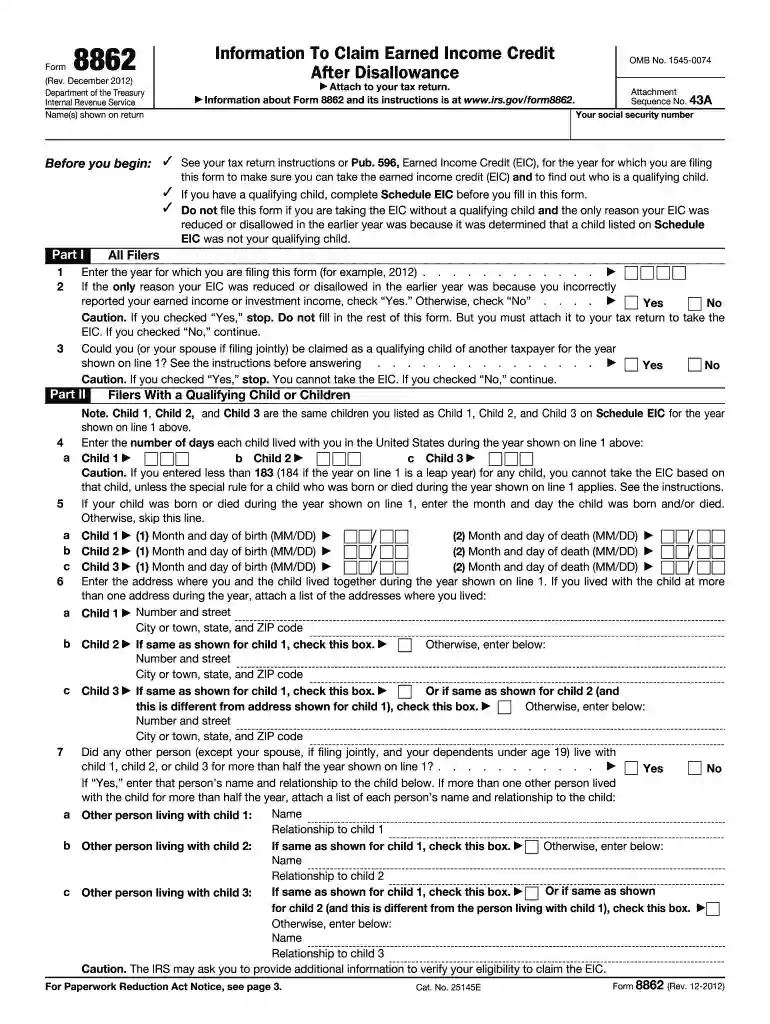
Form 8862, Information to Claim Certain Credits After Disallowance, is required by taxpayers looking to claim the Earned Income Credit (EIC) after it has been previously denied. This form serves to demonstrate eligibility for the credit and ensure compliance with IRS standards. In 2012, making sure this form was correctly completed meant a taxpayer could attempt to reclaim the EIC, provided they met all eligibility criteria and could verify the necessary details regarding qualifying children and living arrangements.
Filling out Form 8862 for 2012 requires attention to several details.
Form 8862 for the year 2012 can be retrieved through several methods:
This access ensures that taxpayers can swiftly acquire the necessary documentation to proceed with their EIC claims.
To successfully file Form 8862 in 2012, taxpayers need to ensure they fit the eligibility parameters:
Taxpayers should consult the IRS guidelines for comprehensive details on qualifying factors.


The IRS outlines specific directives regarding the submission and use of Form 8862:
These guidelines help maintain clarity and accuracy in the filing process.
Understanding the relevant terminology can assist in completing Form 8862:
Grasping these terms ensures precise completion of the form and adherence to IRS standards.
Failure to comply with requirements for filing Form 8862 may lead to significant penalties:
Understanding compliance dictates and potential repercussions emphasizes the importance of meticulous form handling.
Taxpayers have multiple options for submitting Form 8862:
Options allow for flexibility depending on personal preferences and access to technology, contributing to a tailored filing experience.
At DocHub, your data security is our priority. We follow HIPAA, SOC2, GDPR, and other standards, so you can work on your documents with confidence.
The Earned Income Tax Credit (EITC) is a refundable tax credit American citizens or permanent residents can receive if they have earned any income in a fiscalRead more
this form to make sure you can take the earned income credit (EIC) and to find out who is a qualifying child. ✓ If you have a qualifying child, completeRead more


