




01. Edit your this british prime minister for most of world war ii said we will never surrender whatever the cost may be online
Type text, add images, blackout confidential details, add comments, highlights and more.

Type text, add images, blackout confidential details, add comments, highlights and more.

Draw your signature, type it, upload its image, or use your mobile device as a signature pad.

Send it via email, link, or fax. You can also download it, export it or print it out.
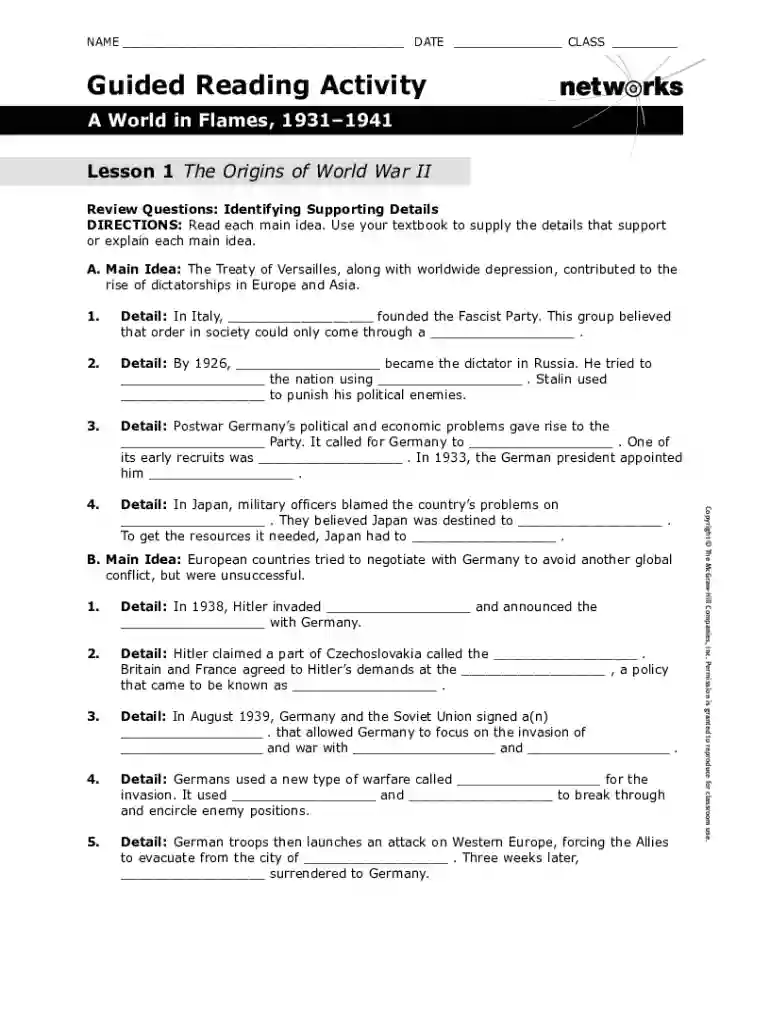
"A World in Flames Lesson 1" serves as an educational tool designed to explore the major causes and early events leading up to World War II, particularly focusing on the years 1931 to 1941. The lesson highlights the impact of the Treaty of Versailles and the global depression, explaining how these factors contributed to the rise of totalitarian regimes in Europe and Asia. Students can gain a deeper understanding of how these dictatorships, including Mussolini's Fascist regime in Italy, Stalin's control in Russia, and Hitler’s rise in Germany, set the stage for a global conflict.
The text outlines pivotal events that marked the beginning of increased tensions worldwide. Hitler’s aggressive invasions of various European countries, coupled with the policy of appeasement adopted by other nations, are crucial components of the lesson. This section provides essential context for understanding the mistakes and strategic decisions made by European countries, aiming to prevent conflict but inadvertently enabling further aggression by Germany.
Students will explore the personalities and political strategies of key figures such as Mussolini, Stalin, and Hitler. Understanding their ideologies and methods of consolidating power helps explain how these leaders managed to galvanize their nations towards war. Analyzing these figures provides insights into the drastic societal changes that occurred during this period, illustrating how individual leadership can alter the course of history.
Using "A World in Flames Lesson 1" involves a structured approach to unravel the complex history of pre-World War II Europe and Asia. It's designed for educational settings, allowing educators to guide discussions and analyses. The lesson can be used to facilitate interactive class debates, encouraging students to critically evaluate decisions made by nations during this volatile period.
Educators can maximize the value of this lesson through group discussions, engaging students with interactive timelines, and analyzing primary source documents. These activities encourage critical thinking and help students draw parallels between historical events and modern geopolitical issues.
Using supplementary resources such as maps, video documentaries, and articles can enrich the learning experience. This multi-faceted approach ensures students receive a comprehensive view, allowing them to piece together how interconnected events contributed to the outbreak of World War II.
Successful completion of "A World in Flames Lesson 1" involves a series of coordinated steps:
Preparation: Gather relevant resources, such as textbooks, documentaries, and primary source documents. These materials help provide a full spectrum of historical perspectives.
Introduction: Begin with an overview of the global landscape after World War I and introduce the socio-economic factors contributing to political instability.
Detailed Analysis: Delve into each key event and figure, exploring their significance and the broader impact on international relations during this time.
Discussion and Debate: Facilitate group activities and discussions to encourage analysis of diplomatic strategies and military decisions made during this period.
Assessment: Use quizzes or short essays to assess understanding, ensuring students can articulate the causes and consequences of early World War II events.
Incorporating interactive timelines can help students visualize the sequence and overlap of key events, enhancing their ability to connect causes and outcomes.
"A World in Flames Lesson 1" features several critical components essential for a comprehensive understanding of this historic period:
Students should engage in comparative analysis to understand how different countries responded to threats, examining what strategies succeeded or failed and why.
Educators choose "A World in Flames Lesson 1" for its comprehensive coverage of a crucial historical period, offering students a chance to understand the complexities of political decision-making and its long-term consequences. The lesson aligns with educational standards, ensuring it meets curriculum needs for teaching 20th-century history.
The lesson aids in developing critical thinking, analytical skills, and historical empathy as students examine differing perspectives and motivations of the figures involved in these historic events.
"A World in Flames Lesson 1" can be used in various educational settings:
Analyzing case studies, such as the Munich Agreement or the Spanish Civil War, within the lesson helps illustrate the practical applications of historical theory and decision-making.
By offering a structured yet flexible framework, "A World in Flames Lesson 1" serves as an essential resource for educators aiming to impart a thorough understanding of the events that paved the way for the Second World War.
We've got more versions of the this british prime minister for most of world war ii said we will never surrender whatever the cost may be form. Select the right this british prime minister for most of world war ii said we will never surrender whatever the cost may be version from the list and start editing it straight away!
| Versions | Form popularity | Fillable & printable |
|---|---|---|
| 2012 | 4.4 Satisfied (51 Votes) |
As outlined by eSignature regulations, documents signed digitally have the same validity as those approved with pen and paper. You can eSign almost any business and personal paperwork. Four types of paperwork still call for handwritten signatures only - wills and testamentary trusts, court orders and other court papers, state statutes governing divorce, adoption, or other family law, and notice of cancellation of utility services. If you follow the guidelines and utilize a trustworthy and compliant software solution, like DocHub, you can eSign your a world in flames lesson 1 without printing it.
If you use Chrome, there are two simple ways to modify your a world in flames lesson 1 online. First, visit the DocHub site, add your file, and modify it utilizing our toolbar. You may also set up our Chrome extension and modify any document by dragging and dropping it in your web browser window.
At DocHub, your data security is our priority. We follow HIPAA, SOC2, GDPR, and other standards, so you can work on your documents with confidence.
Apr 20, 2024 Requirements for main events usually include being past a certain day, but also frequently include having seen other main and character events.Read more
Aug 23, 2024 Selected resources contribute to learners understandings of multiple perspectives of the use and impact of the atomic bomb in World War II.Read more


