




01. Edit your form online
Type text, add images, blackout confidential details, add comments, highlights and more.

Type text, add images, blackout confidential details, add comments, highlights and more.

Draw your signature, type it, upload its image, or use your mobile device as a signature pad.

Send it via email, link, or fax. You can also download it, export it or print it out.
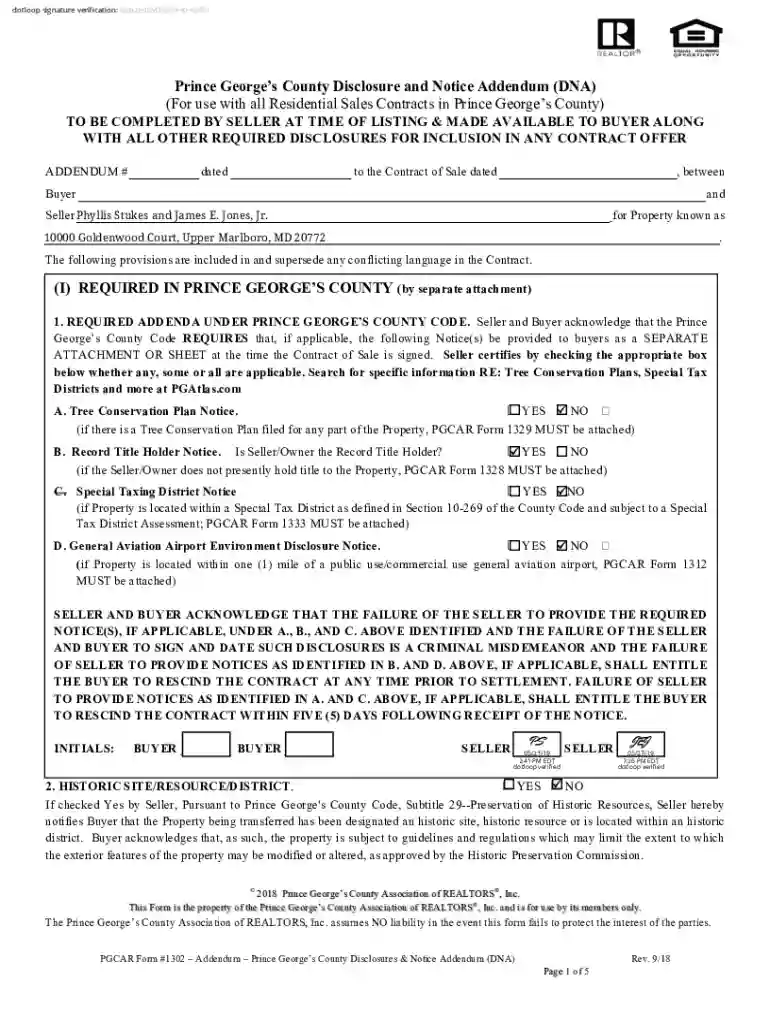
The Prince George's County Disclosure and Notice Addendum (DNA), commonly referred to as the pgcar, is an integral part of residential real estate transactions in Prince George's County, Maryland. It is a mandatory document that sellers must present to prospective buyers during the listing stage. By including the pgcar in sales contracts, both parties are better informed of specific property conditions, legal obligations, and county-specific regulations that might influence the sale.
The pgcar plays a crucial role in preventing potential disputes by obligating sellers to share pertinent information about the property.
When included in a real estate transaction, the pgcar serves as a disclosure tool, detailing any known issues or conditions that could affect the property's value or habitability.
Using the pgcar ensures transparency and helps mitigate risks associated with undisclosed property conditions.
Completing the pgcar effectively requires attention to detail and honesty from the seller to ensure compliance with legal requirements.
Completing the pgcar thoughtfully can prevent future legal complications by ensuring all parties have a clear understanding of property specifics.
The pgcar contains several key terms that facilitate clear understanding between buyers and sellers. Familiarity with these terms can assist in filling out the document correctly.
Grasping these terms enhances the capability to accurately complete and comprehend the pgcar, ensuring both parties have shared expectations.
The pgcar serves a pivotal legal function by ensuring that sellers disclose relevant property information honestly, which can affect buying decisions and legal outcomes.
Failure to comply with legalities when using the pgcar can result in rescinded contracts or lawsuits for nondisclosure, underscoring its necessity in real estate transactions.
The structure of the pgcar ensures comprehensive and organized disclosure of property details, which are mandatory for a legally binding sale.
Understanding these sections helps ensure that all parties are aligned on their responsibilities and the property's state, leading to a smoother transaction process.
While the pgcar applies specifically to Prince George's County, Maryland, its implementation occurs within the broader context of state regulations governing real estate transactions.
Navigating these rules ensures compliance and facilitates a legal and smooth real estate transaction in Maryland.
Non-compliance with the pgcar can lead to serious repercussions, affecting both ethical and legal standings in real estate dealings.
Understanding the gravity of these penalties encourages diligence in completing the pgcar, thereby safeguarding against legal challenges.
Most eSignature solutions require users to have a paid subscription. With DocHub, there are two ways for you to create an electronic signature to your pgcar without being charged:
The second option, though, has limitations on the number of signatures, sign requests, emails, and documents for editing available per month. You can check for full information here.
If you edit your pgcar with DocHub, you only require a steady internet connection and virtually any web browser installed on your device. No need to install any third-party software or study tutorials. Just open a tab with DocHub, drag and drop your file, and edit it immediately.
At DocHub, your data security is our priority. We follow HIPAA, SOC2, GDPR, and other standards, so you can work on your documents with confidence.
Brenda is an accomplished administrative leader with over 20 years of experience. She began her career at Howard University over a decade ago.Read more
The Prince Georges County Association of REALTORS (PGCAR) represents over 4000 REALTORS and industry-related professionals in Prince Georges County,


