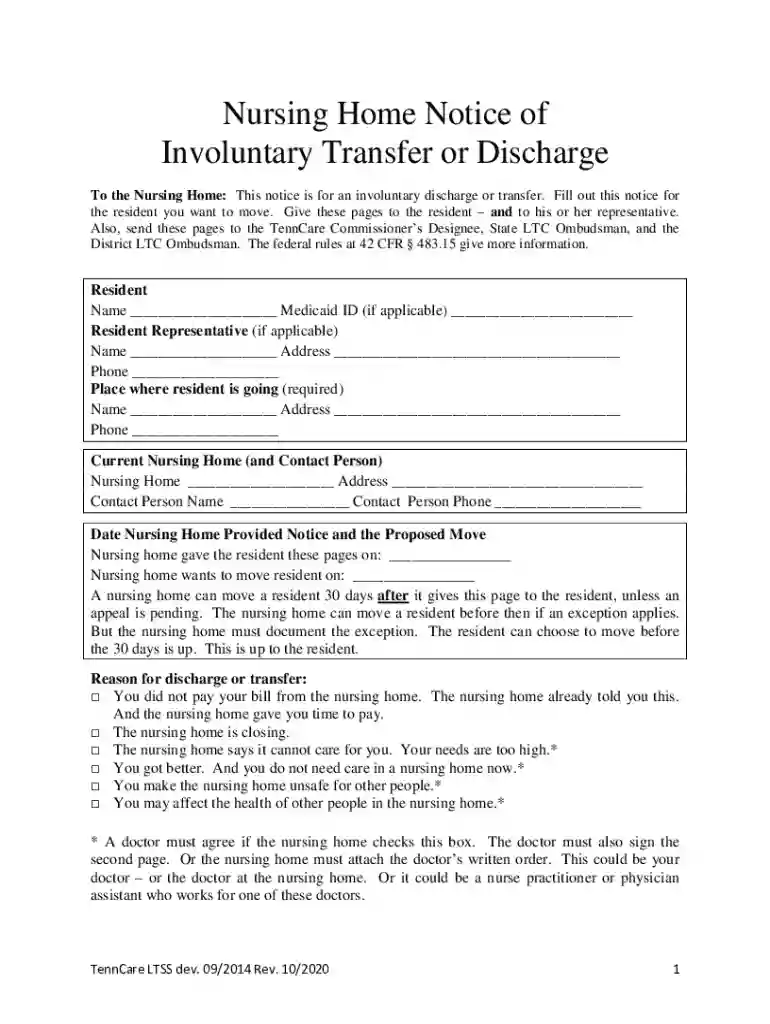
Nursing Home Notice of Involuntary Transfer or Discharge 2026

Get Form
30 day discharge notice nursing home template Preview on Page 1

Here's how it works

01. Edit your 30 day discharge notice nursing home template online
Type text, add images, blackout confidential details, add comments, highlights and more.

02. Sign it in a few clicks
Draw your signature, type it, upload its image, or use your mobile device as a signature pad.

03. Share your form with others
Send 30 day discharge notice nursing home form via email, link, or fax. You can also download it, export it or print it out.

Definition and Meaning of the Nursing Home Notice of Involuntary Transfer or Discharge

The Nursing Home Notice of Involuntary Transfer or Discharge is a formal document issued to residents of nursing homes when a transfer or discharge is deemed necessary by the facility. This notice outlines the reasons for the involuntary action, the specific circumstances surrounding it, and the resident's rights and options following the decision. It is designed to ensure transparency in the care process and to inform residents and their families about their legal rights to contest such decisions.

Key aspects include:

  • Legal Framework: This notice is grounded in federal and state regulations governing the operations of nursing homes, specifically under the requirements set forth in the Omnibus Budget Reconciliation Act (OBRA).
  • Importance of Rights: Residents have the right to be informed about their transfer or discharge and to appeal the decision within a specified time frame, often within 30 days.
  • Components of the Notice: Typically, it includes the resident's information, reasons for transfer or discharge, details about the appeal process, and contact information for advocacy organizations that can offer support.

Steps to Complete the Nursing Home Notice of Involuntary Transfer or Discharge

Completing the Nursing Home Notice of Involuntary Transfer or Discharge involves several critical steps to ensure compliance with legal requirements and to protect the rights of the residents involved.

  1. Gather Required Information:

    • Collect all necessary personal and medical information about the resident.
    • Identify the specific reasons for the transfer or discharge, including health-related, safety, or facility-related factors.
  2. Draft the Notice:

    • Clearly outline the reasons for the involuntary action.
    • Include a section detailing the rights of the resident, including the time frame for appeal.
  3. Review Legal Guidelines:

    • Ensure the notice complies with state and federal regulations regarding care facilities.
    • Consult with legal counsel if unsure about specific provisions.
  4. Distribute the Notice:

    • Send a copy of the completed notice to the resident and their designated representative.
    • Keep a record of the distribution for compliance purposes.
  5. Track Responses:

    • Monitor any appeals or responses from the resident and their family.
    • Provide assistance as needed if the resident seeks to contest the decision.

Important Terms Related to the Nursing Home Notice of Involuntary Transfer or Discharge

Understanding the key terms associated with the Nursing Home Notice of Involuntary Transfer or Discharge can aid in better navigating the implications of such notices and their legal frameworks.

  • Involuntary Transfer: A mandatory relocation of a resident to another facility or room, often due to safety concerns or service inadequacies.
  • Discharge: The termination of a resident's stay at the nursing home, which may be due to medical necessity or failure to pay.
  • Right to Appeal: The resident's legal entitlement to contest the decision within a specified period, typically 30 days.
  • Advocacy Organizations: Groups or entities that assist individuals in understanding their rights and provide support in navigating the appeal process.

Legal Use of the Nursing Home Notice of Involuntary Transfer or Discharge

The legal framework surrounding the Nursing Home Notice of Involuntary Transfer or Discharge is designed to protect both the rights of residents and the obligations of facilities. This section outlines the critical legal aspects.

  • Federal Regulations: The Omnibus Budget Reconciliation Act specifies the conditions under which a resident can be involuntarily transferred or discharged. Facilities must adhere to these regulations to ensure both compliance and the protection of residents' rights.
  • State-Specific Laws: Many states have additional laws that may impose stricter guidelines regarding notification periods or the appeal process.
  • Documentation Requirements: It is crucial to maintain detailed records of all notices issued, including the reasoning and supporting evidence for the transfer or discharge, to prevent potential legal challenges.

Examples of Using the Nursing Home Notice of Involuntary Transfer or Discharge

Understanding practical applications of the Nursing Home Notice of Involuntary Transfer or Discharge can illuminate its significance in a real-world context.

  • Case Scenario 1: A resident with increasing health care needs may require transfer to a facility with specialized services. The nursing home must issue a notice that explains the necessity of this move, the available options for the resident, and the timeline for the transfer.
  • Case Scenario 2: A resident exhibiting behavioral issues that jeopardize their safety or that of others may be involuntarily discharged. The notice would need to clearly outline the reasons for the discharge, provide details on the appeal process, and inform the resident of their rights and potential next steps.
  • Appeal Example: If a family contests the discharge within the 30-day window, the nursing home is obligated to review the case. The notice must guide them through any additional documentation or steps required for the appeal.

This comprehensive exploration of the Nursing Home Notice of Involuntary Transfer or Discharge showcases its critical role in the nursing home discharge process, emphasizing the importance of clarity, legal compliance, and the protection of resident rights.

be ready to get more

Complete this form in 5 minutes or less

Get form

Got questions?

We have answers to the most popular questions from our customers. If you can't find an answer to your question, please contact us.
Contact us

Yes, you’ll find many different applications for this on the web. However, if you need to eSign your nursing home transfer and discharge notice form without installing additional software, DocHub is the best choice you can make. This powerful editor works on mobile devices just like on desktops. Open our editor in any internet browser, register or log in to your account, and start processing your forms.

With a swift editing system like DocHub, you do not need anything but a web browser and internet connection to edit your 30 day discharge notice nursing home online swiftly. Add your document or get the relevant form in DocHub’s catalog, open our editor with one click, and complete it electronically. To revise your forms at any time, sign up a free profile with DocHub.

A transfer/discharge is considered involuntary, or facility initiated, if it does not originate through the residents verbal or written request, and/or is not in alignment with the residents preferences and stated goals for care. An involuntary discharge is also called an eviction.
A transfer is when a patient moves from one area of the hospital to another � for example, from AE to a ward. Discharge happens when a patient leaves the hospital � because they are transferring to another type of care such as going home or moving into a hospice.
Lawful reasons for a nursing home eviction include: Nonpayment for services after appropriate notice. Nursing home care is no longer needed. The facility cannot meet the residents needs. The resident poses a threat to themselves or others.

Security and compliance

At DocHub, your data security is our priority. We follow HIPAA, SOC2, GDPR, and other standards, so you can work on your documents with confidence.

Learn more
ccpa2
pci-dss
gdpr-compliance
hipaa
soc-compliance
be ready to get more

Complete this form in 5 minutes or less

Get form