
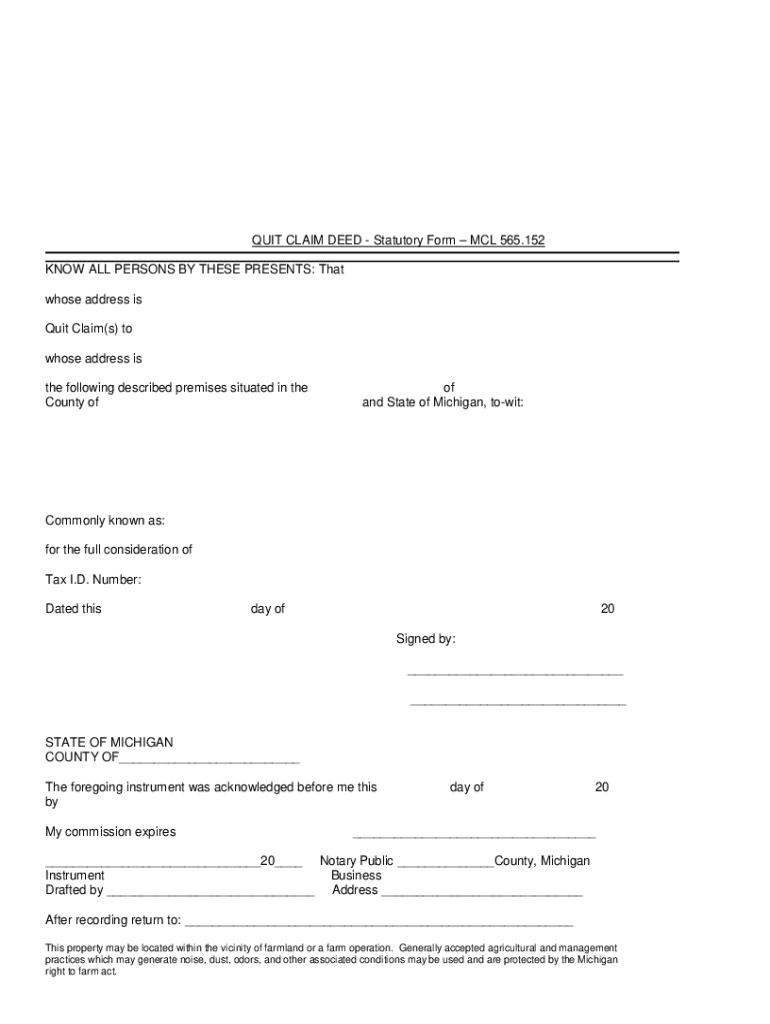







Definition & Meaning
The "mcl 565 152" refers to a specific legal document, likely related to property transactions in Michigan, given the reference to a Quit Claim Deed. This type of form is critical in conveying property rights, serving as an official record of a transfer of interest in real estate without warranties of ownership. It is commonly used when the transfer is between trusted parties, such as family members, to clarify property rights for tax or estate purposes.
How to Use the MCL 565 152
To properly use the MCL 565-152 form, you'll need to gather pertinent details such as the names of the granter and grantee, the address and legal description of the property, and any specific terms of the agreement. The form must be accurately completed to reflect the intended transfer of rights. Note that both parties typically need to sign the document in the presence of a notary public to ensure its legal validity.
Steps to Complete the MCL 565 152
-
Obtain the form: Ensure you have the correct and most current version of the MCL 565-152.
-
Fill in personal information: Enter the name and contact details of both the granter and grantee.
-
Describe the property: Provide a clear legal description of the property, including address and parcel number if applicable.
-
Specify terms: Outline any specific terms or conditions related to the transfer.
-
Notarization: Both involved parties should sign the form in the presence of a notary, who will then notarize the document.
-
File the form: Submit the completed form to the county register of deeds where the property is located, along with any required fees.
Legal Use of the MCL 565 152
Legally, the MCL 565-152 is used to transfer property rights without title warranties. This means the granter is not guaranteeing clear ownership of the property, which can carry risks for the grantee if there are undisclosed issues with the title. Therefore, it’s crucial to conduct thorough due diligence or obtain title insurance prior to the completion of the transaction.
Key Elements of the MCL 565 152
- Parties involved: Clear identification of both the granter and grantee.
- Property description: An exact legal description of the property in question.
- Signatures: All parties must sign, often alongside a notary for validation.
- Effective date: The date the transfer is intended to take place.
State-Specific Rules for the MCL 565 152
In Michigan, specific rules govern the use of a Quit Claim Deed form such as MCL 565-152. These rules often include requirements for notary acknowledgment, particular language to be used on the form, and the filing process with the local county. Different counties may also have their own variations in standard procedures or fees.
Who Issues the MCL 565 152
The MCL 565-152 form is typically issued by the Michigan Department of Licensing and Regulatory Affairs (LARA) or the local county register of deeds. As it forms part of the state’s regulatory documentation for real estate transactions, ensuring you utilize the official form is crucial for maintaining legal compliance.
Required Documents
To successfully complete and file the MCL 565-152 form, several key documents are required:
- Identification: Government-issued IDs for both parties involved.
- Proof of ownership: Documents showing the granter's ownership of the property.
- Property tax information: Latest tax receipts or assessments.
- Notarization: Evidence of the notary’s seal and signature where applicable.
Form Submission Methods (Online/Mail/In-Person)
There are several ways to submit the MCL 565-152 form:
- Online: Some counties may offer e-filing services through their websites.
- Mail: You can mail the completed and notarized form, along with any applicable fees, to the county registrar.
- In-person: Submit directly at the county register of deeds office, which may provide immediate processing.




