
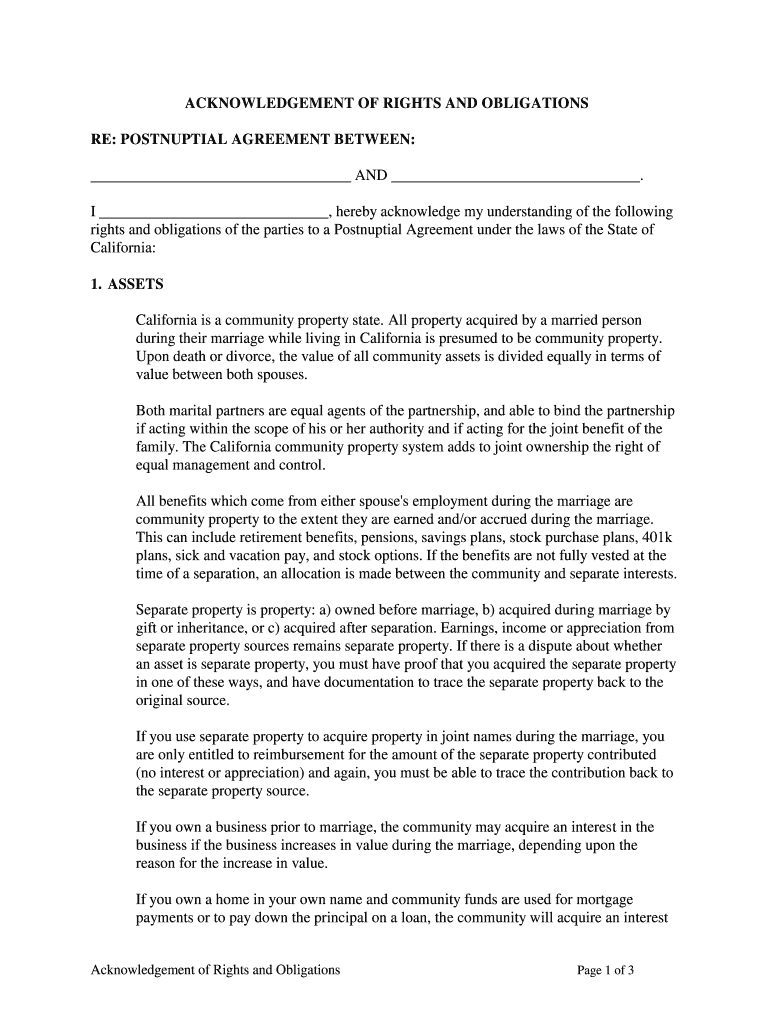







Definition & Meaning
The "California Agreement" typically refers to a legal document that outlines the rights and responsibilities of parties within specific situations that are governed under California law. Commonly, it is associated with postnuptial agreements, detailing how assets, debts, support, and child custody will be handled in the event of divorce or death. These agreements are crafted under California's community property laws that dictate the division of property and debts upon separation. A significant focus of such agreements is to ensure fairness and clarity, which is why many parties opt for independent legal counsel to navigate these legal complexities efficiently.
Key Elements of the California Agreement
A comprehensive California Agreement typically includes several critical elements to ensure clarity and legal enforceability.
- Asset and Debt Division: Addresses the treatment of shared and individual assets and debts, detailing the division process under California's community property rules.
- Spousal Support: Specifies terms relating to alimony, outlining either waiver or stipulation of support in case of separation.
- Child Custody and Support: Involves agreements on custody arrangements and support obligations, prioritizing the best interests of the child.
- Waiving Marital Rights: Parties often agree to waive certain rights that would otherwise automatically apply under California law.
Each element is framed to provide clear expectations and responsibilities for each party involved in the agreement.
Important Terms Related to California Agreement
Understanding key terms is essential when drafting or reviewing a California Agreement:
- Community Property: Refers to the principle that all assets and debts acquired during the marriage are joint property.
- Separate Property: Assets or debts owned by one spouse prior to the marriage, which can remain individual assets if designated.
- Postnuptial Agreement: A legal contract executed after marriage, detailing the division of finances and responsibilities between spouses.
- Alimony: Financial support provided by one spouse to another post-separation or divorce.
These terms form the legal foundation of most California Agreements and help interpret the document's stipulations accurately.
How to Obtain the California Agreement
To legally obtain a California Agreement, parties usually engage in a few key steps:
- Consult Legal Experts: Seek advice from qualified family law attorneys who understand California's specific legal landscape.
- Draft Agreement: Use templates or have a lawyer draft an agreement that meets the specific needs of the parties involved. Ensure it aligns with California law.
- Review and Amend: Parties should thoroughly review the document with their counsel, making amendments as needed to protect their interests.
- Sign and Notarize: Finalize the agreement with signatures from all parties involved, typically in the presence of a notary to enhance its enforceability.
By following these steps, parties can ensure their agreement is both legally sound and tailored to their situation.
Steps to Complete the California Agreement
Completing a California Agreement involves several meticulous steps to ensure it is comprehensive and legally binding:
- Identify Goals: Discuss and document the objectives of each party regarding asset division, custody, and support.
- Gather Documentation: Collect relevant documentation such as financial records, asset titles, and other pertinent information.
- Draft Agreement: Outline terms in a draft; include details on the division of community property and other obligations.
- Legal Review: Have the document reviewed by each party's legal counsel to ensure compliance with California law and mutual understanding.
- Finalize and Sign: Both parties sign the agreement, often facilitated by legal counsel, ensuring all necessary formalities such as notarization are observed.
These steps assist in creating a valid and enforceable agreement.
Legal Use of the California Agreement
The legal application of a California Agreement extends into various scenarios where delineation of financial and custodial responsibilities is essential.
- Marriage Dissolution: Utilized primarily in divorce proceedings to help courts enact an agreed-upon division of assets and custody arrangements.
- Estate Planning: Secures provisions for asset distribution to heirs or beneficiaries while protecting individual financial interests.
- Debt Liability Clarification: Differentiates between joint and separate debt liabilities, preventing unwarranted liability impositions on one party.
Each application underlines the agreement's role in simplifying legal processes by pre-establishing consented terms.
State-Specific Rules for the California Agreement
California has distinctive rules which can impact how agreements like the California Agreement are drafted and enforced:
- Community Property Law: As a community property state, California agreements must adhere to laws that typically divide marital assets evenly unless otherwise specified.
- Legal Counsel: Both parties are encouraged, if not required, to seek legal counsel to ensure the agreement's enforceability.
- Fairness Doctrine: Judges retain the discretion to alter the terms if they find them grossly unfair or unjustly favoring one party.
Understanding these state-specific nuances is integral to ensuring such agreements withstand legal scrutiny.
Examples of Using the California Agreement
In real-world scenarios, a California Agreement can manifest in various forms:
- Post-Marriage Financial Reorganization: Couples use it to redefine financial responsibilities post-marriage, accommodating changes like new investments or business endeavors.
- Preemptive Divorce Planning: Before a potential separation, spouses create agreements to avoid prolonged litigation.
- Inheritance Protection: An agreement may specify the protection of individual inheritances as separate from community assets.
These examples illustrate the agreement’s flexibility in addressing diverse personal circumstances within a legal framework.




