
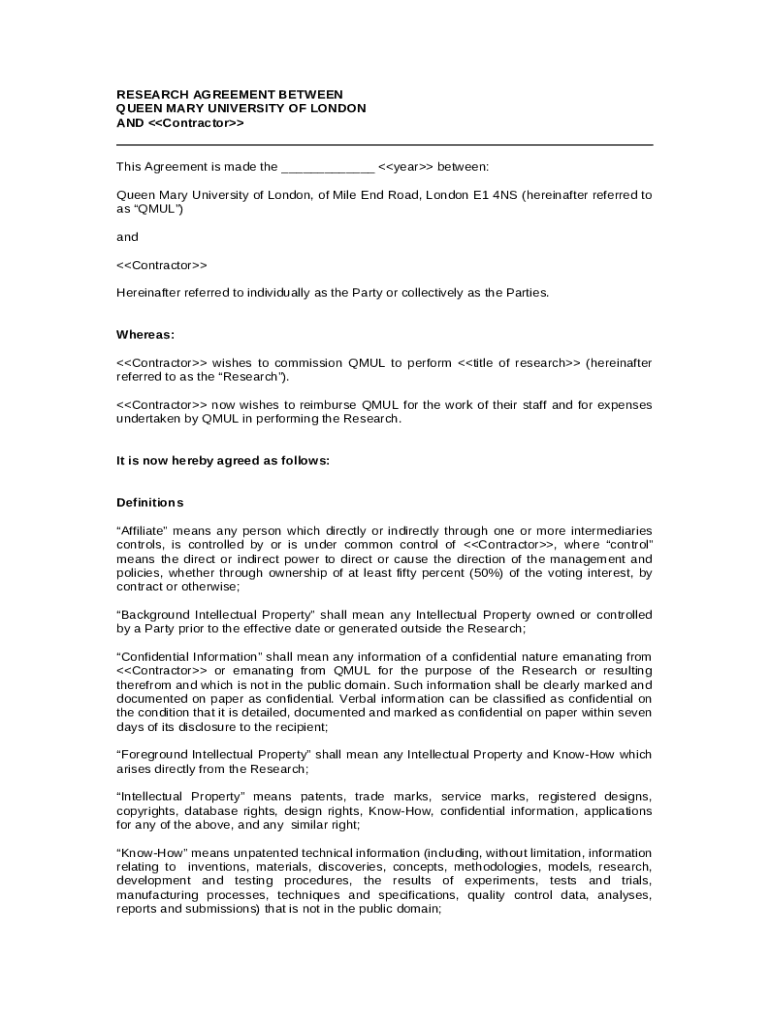







Definition and Meaning
The Standard Research Contract is a formal agreement between two or more parties, typically a research institution and a contractor, detailing the terms and conditions for conducting a specific research project. This contract outlines critical components such as project scope, financial arrangements, intellectual property rights, and confidentiality requirements. By establishing a clear framework, it helps safeguard the interests of all parties involved.
It is important to note that while the term "Standard Research Contract" implies a level of uniformity, the specifics can vary significantly depending on the nature of the research, the institutions involved, and any relevant legal requirements.
Key Elements of the Standard Research Contract
Understanding the essential components of a Standard Research Contract is crucial for effectively managing a research collaboration. Some of the key elements typically included are:
- Project Scope and Objectives: Clearly defines the goals and deliverables of the research, providing participants with a roadmap of expected outcomes.
- Payment Structure: Details how and when the contractor will be compensated, often specifying milestones linked to payment schedules.
- Intellectual Property (IP) Rights: Establishes who will own any IP developed during the research and how it can be used or licensed by the involved parties.
- Confidentiality Obligations: Protects sensitive information disclosed during the project, detailing the measures required to maintain its confidentiality.
- Liability Limitations: Describes the extent of liability for each party in case of issues arising during or after the project.
- Termination Clauses: Outlines conditions under which the contract can be terminated, including breaches or mutual agreement.
How to Use the Standard Research Contract
To effectively utilize a Standard Research Contract, several steps and best practices should be followed:
- Initial Drafting: Collaborate with legal experts or contract professionals to draft an initial version tailored to the specific research context.
- Review and Negotiation: Engage all parties in a review process to discuss and negotiate terms, ensuring that the contract reflects a mutually beneficial agreement.
- Finalization and Approval: Once terms are agreed upon, each party's representative should formally approve the contract to ensure legal validity.
- Ongoing Monitoring: Throughout the project, monitor contract compliance and maintain open communication with involved parties for any required amendments or clarifications.
These steps ensure that the contract is a reliable tool for guiding the research project to a successful conclusion.
Who Typically Uses the Standard Research Contract
Typically, a Standard Research Contract is used by entities engaged in collaborative research projects. These include:
- Universities and Academic Institutions: Often collaborate with private companies, government agencies, or other educational entities.
- Private Corporations: Engage with academic or independent researchers to advance R&D initiatives, innovation, and product development.
- Government Agencies: Partner with universities and private companies to leverage expertise for public interest research endeavors.
- Non-Profit Organizations: May seek research collaborations to support mission-driven projects requiring specialized study.
The contract facilitates clear communication of expectations and obligations, enabling efficient collaboration among diverse stakeholders.


Important Terms Related to the Standard Research Contract
A Standard Research Contract involves several key legal and technical terms that participants should be familiar with:
- Principal Investigator (PI): The lead researcher responsible for overseeing project management and execution.
- Subcontracting: The practice of partnering with other entities or individuals to perform specific tasks within the research project.
- Indemnification: A clause typically included to protect one party from potential losses or claims arising from the other party's actions.
- Material Transfer Agreement (MTA): Governs the transfer of proprietary materials between institutions for research purposes.
Understanding these terms is critical for all parties involved to ensure a transparent and informed execution of the contract.
Legal Use of the Standard Research Contract
The legal aspects of a Standard Research Contract are essential for ensuring that the agreement is enforceable and compliant with applicable laws. Key considerations include:
- Contract Law and Jurisdiction: Ensuring that the contract adheres to relevant legal frameworks and specifying the jurisdiction in case of disputes.
- Compliance with Regulations: Adhering to scientific research regulations, especially if human or animal subjects, are involved.
- Data Protection Laws: Following regulations like GDPR or HIPAA, depending on the data type and location of research, to secure personal information.
- Ethical Considerations: Establishing ethical standards consonant with institutional and professional guidelines.
Careful legal review and adherence to these considerations help protect both the project's integrity and the research participants' rights.
Steps to Complete the Standard Research Contract
Completing a Standard Research Contract involves several procedural steps to ensure clarity and commitment from all parties:
- Identify Stakeholders: Determine all parties actively involved in or impacted by the research project, including contractors, academic partners, and funding bodies.
- Develop Contract Draft: Create an initial draft outlining the terms, conditions, roles, and responsibilities of each party. Utilize legal counsel for precise language.
- Negotiate Terms: Facilitate discussions among stakeholders to address concerns, make amendments, and reach consensus on contentious issues.
- Approve and Sign: Collect signatures from authorized representatives of all parties to formalize the agreement.
- Distribute Final Copies: Ensure that signed copies are distributed to all parties, and stored securely for reference throughout the project duration.
This structured process helps in creating a robust contract that serves as an effective governance tool for the research project.
Examples of Using the Standard Research Contract
Real-world examples illustrate the practical application and benefits of using a Standard Research Contract:
- University-Industry Partnership: A university collaborates with a pharmaceutical company to develop a new drug, with IP rights predefined in the contract to clarify ownership and commercialization rights.
- Cross-Institutional Research Projects: Multiple universities collaborate on climate change research, using a standardized contract to harmonize contributions and resource sharing.
- Government-Funded Initiatives: A government agency commissions a private research firm to study public health issues, with clear guidelines for data confidentiality and reporting.
These examples demonstrate how contracts facilitate structured, equitable research collaborations across diverse domains.




