





Definition and Legal Framework of Summary Judgment
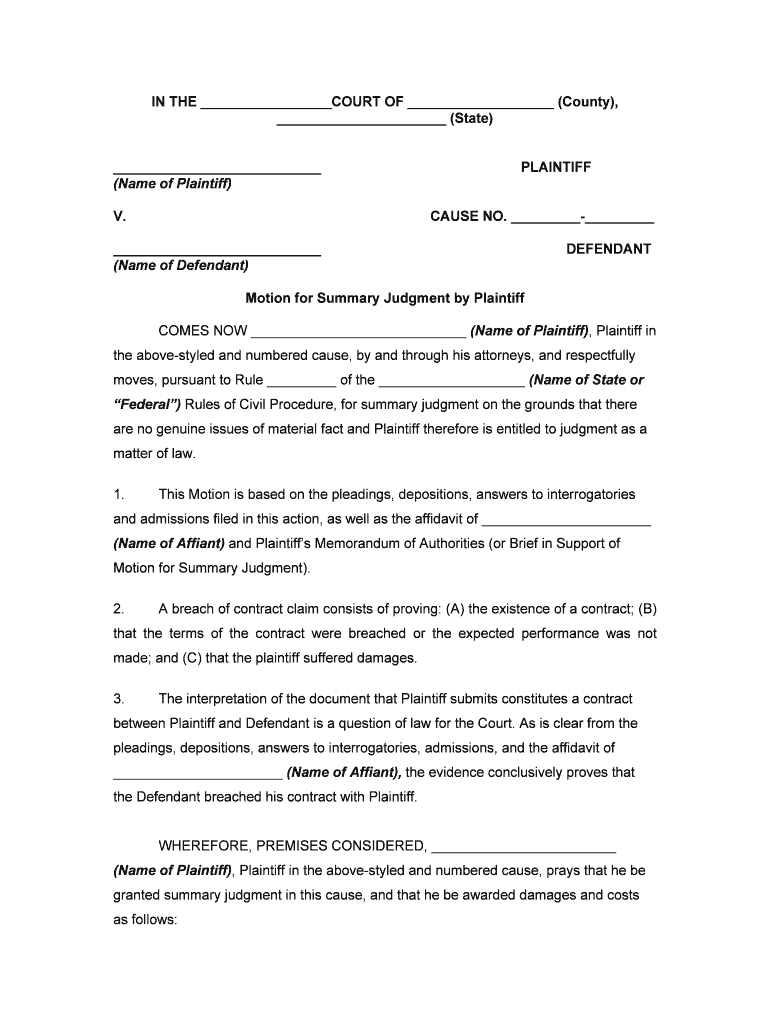
A summary judgment is a legal determination made by a court without a full trial. It occurs when one party in a lawsuit believes there is no genuine dispute regarding the material facts of the case, allowing for a decision based solely on legal questions. In the context of civil litigation, it enables the court to expedite the process by resolving certain issues in advance, saving time and resources. Summary judgments are sought through a motion filed by either the plaintiff or the defendant, who must demonstrate that the opposing party cannot prove an element essential to its case. A successful motion for summary judgment relies on evidence such as affidavits, depositions, and pleadings. While governed by specific rules under the Federal Rules of Civil Procedure, state court rules can vary.
Process for obtaining a Summary Judgment
To obtain a summary judgment, the moving party must first file a motion with the court. This typically includes a detailed memorandum of law, supporting affidavits, and relevant documentary evidence. The steps involved generally include:
-
Identify Undisputed Facts: The moving party must demonstrate that there are no genuine issues of material fact by highlighting evidence which conclusively supports the claim or defense.
-
Prepare Supporting Documents: Documents such as affidavits, depositions, or discovery responses are essential to substantiate the motion.
-
Submit a Motion and Memorandum: The motion should be accompanied by a legal memorandum outlining why the summary judgment should be granted.
-
Serve the Opposing Party: The motion, along with supporting documents, must be served to the opposing party to allow for a response.
-
Await Court's Decision: After the motion is argued or submitted, the judge will review the materials and issue a ruling.
Key Elements of a Motion for Summary Judgment
A motion for summary judgment must contain specific elements to be considered valid by the court:
- Statement of Undisputed Facts: A concise list of the material facts that are not in dispute, supported by evidence in the record.
- Legal Argument: An explanation of how the undisputed facts warrant judgment as a matter of law, often supported by case law or statutory references.
- Evidentiary Support: Attachments such as affidavits or deposition excerpts that substantiate the asserted facts.
- Notice of Hearing: Details regarding the hearing on the motion, often required to ensure procedural fairness.
State-Specific Rules for Summary Judgment
Summary judgment procedures can vary by state, although most are rooted in the principles of efficiency and resource conservation in litigation. States may have unique procedural nuances or additional requirements:
- Deadline for Filing: States have different timelines for when a summary judgment motion must be filed in the litigation process.
- Standard of Proof: Some jurisdictions may impose a higher evidentiary standard or employ a different interpretation of "genuine issue of material fact."
- Hearing Requirements: The necessity of oral arguments or hearings on summary judgment motions can depend on local rules.
Advantages of Seeking a Summary Judgment
- Quick Resolution: Summary judgment can lead to a faster case resolution by avoiding prolonged trial proceedings.
- Cost-Effective: Reducing the need for extensive trial preparation and participation saves legal costs for parties.
- Strategic Leverage: A summary judgment ruling in one party's favor can shift the dynamics of the case, potentially encouraging settlements.
Who Typically Uses Summary Judgment
Summary judgments are frequently used in civil litigation, especially where clear-cut issues of law are involved:
- Corporations and Businesses: Often used to address contract disputes or tort claims where evidence supports a decisive legal standing.
- Individuals in Civil Cases: Plaintiffs or defendants seeking an early resolution in straightforward disputes or to foreclose baseless claims.
Legal Use Cases and Examples
Summary judgment is applied in various legal scenarios, providing clarity in otherwise complex disputes:
- Breach of Contract: A plaintiff may seek summary judgment by demonstrating that a breach occurred, and evidence clearly establishes the defendant's non-performance.
- Tort Cases: Defendants might file for summary judgment where evidence shows no liability exists due to lack of causation or damages.
- Property Disputes: Used to resolve clear ownership questions based on documented evidence like deeds or titles.
Implications of Denied Summary Judgment
While seeking summary judgment can streamline proceedings, denial of the motion leaves the parties to proceed to trial. This outcome occurs when the court finds that material factual disputes require examination by a fact-finder, such as a jury. Denial does not reflect on the merit of the case but highlights unresolved factual questions, necessitating further exploration through trial proceedings.