Definition & Meaning
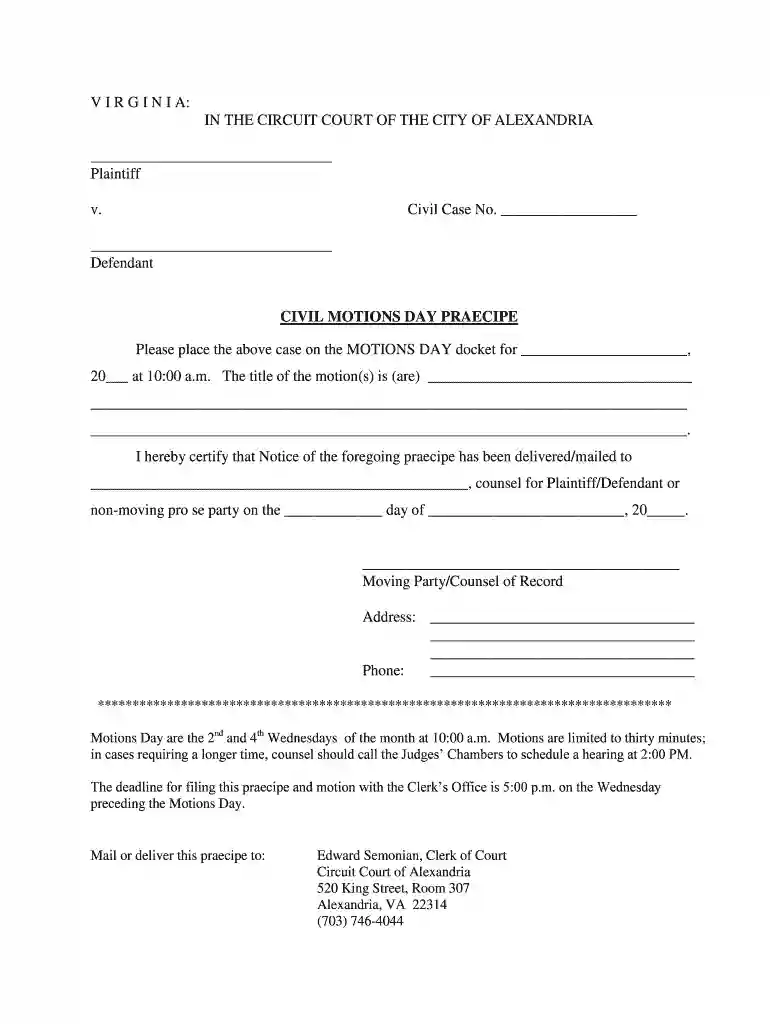
A "motions day praecipe" is a legal document used to schedule motions for a hearing in court. Specifically, it plays a critical role in informing the court of parties' intent to bring a motion before a judge on a designated Motions Day. The form ensures that legal processes are followed in a timely and orderly manner, outlining the procedures required to place a civil case on the docket. Motions Days are typically set by the court with specific days and time allocations, allowing a structured approach to legal proceedings.
Practical Examples and Scenarios
- Civil Disputes: In a civil dispute, parties may use a motions day praecipe to request a hearing to resolve a specific issue that has arisen during the litigation process.
- Family Law Cases: Such as divorce or custody, where motions might be required to address temporary orders or changes in circumstances needing immediate legal attention.
- Company Litigations: Businesses involved in legal battles may file these praecipes to resolve disputes about contractual obligations or damages.
Steps to Complete the Motions Day Praecipe
Completing a motions day praecipe is a detailed process requiring attention to court-specific protocols. Below are the steps typically involved, each of which must be carefully followed to ensure the filing is accepted.
-
Understand Court Requirements:
- Research the specific rules of the Circuit Court, such as the dates and times for Motions Days.
- Determine any limits on the type and length of motions applicable.
-
Complete the Form:
- Fill in the party names, case number, and relevant court details.
- Specify the nature of the motion and the desired outcome.
-
File by the Deadline:
- Submit the praecipe by the court's filing deadline, typically a few days prior to the scheduled Motions Day.
Important Considerations
- Filing Fees: Some jurisdictions may require a fee associated with filing a motions day praecipe.
- Document Accuracy: Ensure the accuracy of all information, as errors may result in delays or rejection.
Key Elements of the Motions Day Praecipe
The motions day praecipe consists of several key components that must be carefully included to ensure the document's validity and effectiveness.
Essential Components
- Case Information: Includes the case title, number, and the court where it is filed.
- Hearing Date and Time: Specifies the designated date and time for the motion to be heard.
- Nature of Motion: Clearly state the motion to be presented, such as a request for summary judgment.
Supporting Documentation
- Service of Process: Proof that all parties have been served with notice of the hearing adequately.
- Motion Details: Attach a separate document providing a detailed description of the motion’s basis, supported by legal arguments or case laws.
Important Terms Related to the Motions Day Praecipe
Understanding the terminology associated with a motions day praecipe is crucial for navigating its procedural and legal aspects effectively.
- Praecipe: A written request to a court or judge for action or information.
- Docket: A court's official schedule of proceedings and cases.
- Motions Day: A specific day allocated by a court to hear motions in various cases.
Contextual Explanation
- Temporary Orders: Orders that may be granted on a motions day affecting parties' rights while a case is pending.
- Summary Judgment: A motion seeking a decision on a particular aspect of the case without a trial.
State-Specific Rules for the Motions Day Praecipe
Different states may have variations in their requirements and rules governing the filing and hearing of a motions day praecipe.
- Virginia Circuit Court: Motions days occur on the 2nd and 4th Wednesdays each month, and motions are limited to thirty minutes unless additional time has been pre-arranged.
- California Local Rules: In some counties, motions days may be referred to as 'law and motion' calendars, with rules governing the filing timelines and service protocols.
Variations and Exceptions
- Emergency Motions: Some states allow for emergency relief outside of regular Motions Days, usually requiring a hardship or immediate threat to justify.
- Electronic Filings: Increasingly, states offer or mandate electronic submission of motions day praecipes, affecting filing procedures and deadlines.
Filing Deadlines / Important Dates
Meeting filing deadlines for a motions day praecipe is critical, as failure to do so can delay or deny the opportunity to be heard.
- Pre-Motions Day: Documents must be filed several days before the scheduled date to allow the court sufficient time to process submissions.
- Notification of Opposing Parties: Rule-based timelines exist for serving parties with notice of the intended motion; non-compliance can result in rescheduling.
Common Scenarios
- Weekend Scheduling: If a deadline falls on a weekend or public holiday, filings are typically due the prior business day.
- Unexpected Events: Adjustments might be permitted due to unforeseen circumstances, provided a motion for extension is filed promptly.
Who Typically Uses the Motions Day Praecipe
The motions day praecipe is utilized by various legal practitioners and parties involved in civil litigation.

Common Users
- Attorneys: Represent their clients by filing praecipes to facilitate the timely hearing of motions.
- Pro Se Litigants: Individuals representing themselves in court often utilize this form to manage their legal processes.
- Corporate Legal Departments: Companies involved in legal disputes use praecipes to efficiently handle routine court motions.
Benefits for Users
- Structured Approach: Allows organized scheduling of legal matters in a controlled court environment.
- Timely Hearings: Ensures motions are heard expediently, facilitating faster resolution of pending legal issues.
Legal Use of the Motions Day Praecipe
The motions day praecipe holds legal significance and is utilized to ensure adherence to procedural rules within the judicial system.
Legal Framework
- Court Orders: The praecipe aids courts in managing their caseload, ensuring priorities are established and adhered to.
- Regulatory Compliance: Filing ensures parties meet legal requirements, preventing sanctions or dismissals for procedural non-compliance.
Compliance Scenarios
- Legal Representation: Attorneys use it as a strategic tool to navigate court systems efficiently.
- Litigation Strategy: A well-timed motion can often lead to negotiated settlements or critical court orders.