Definition & Meaning
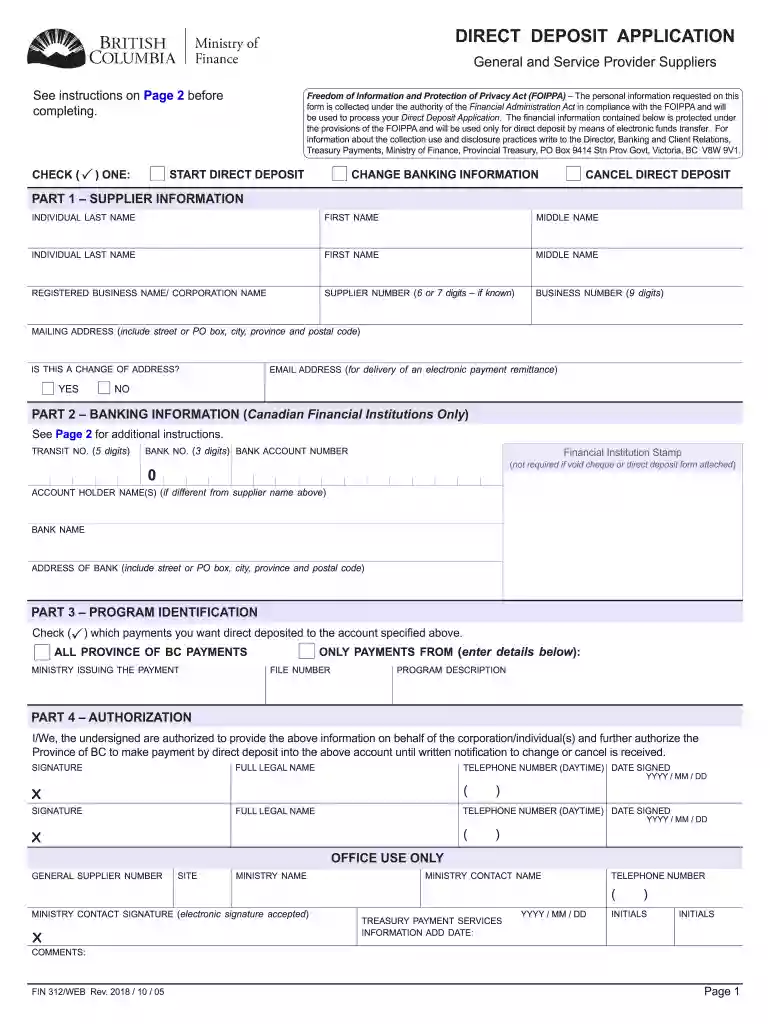
The FIN 312 Direct Deposit Application Provincial Treasury form is a specialized document used primarily by suppliers and service providers within British Columbia. This form facilitates the setup, modification, or cancellation of direct deposit payments for financial transactions involving the provincial treasury. It serves as a critical component in ensuring that payments are processed efficiently and securely, reflecting the modern preference for electronic fund transfers over traditional methods.
Understanding the Purpose
The underlying purpose of the FIN 312 form is to streamline the payment process for transactions between the provincial treasury and its suppliers or contractors. By moving away from checks and transitioning to electronic payments, this form not only saves time but also enhances the security and reliability of the financial transaction process.
Key Features
- Direct Deposit Setup: Allows new suppliers to establish electronic payment routes with the provincial treasury.
- Modification Option: Flexibility to update banking information or change the direct deposit arrangement.
- Cancellation Feature: Provides a streamlined process for discontinuing direct deposit agreements, if necessary.
How to Use the FIN 312 Direct Deposit Application Provincial Treasury
The usage of the FIN 312 form is straightforward, yet requires attention to detail to ensure accuracy and compliance.
Steps for Utilization
- Acquire the Form: Obtain the FIN 312 form from the official provincial treasury website or designated government offices.
- Complete Mandatory Fields: Fill in all required sections carefully, including personal identification, banking details, and any program identifiers related to the financial activity.
- Verify Information: Double-check entries for accuracy, specifically the banking details, to prevent processing errors.
- Secure Signatures: Ensure that all necessary signatures, such as from authorized financial representatives, are included.
- Submit the Form: Follow the submission guidelines provided, which typically include mailing, online submission, or hand-delivery to the provincial treasury office.
Steps to Complete the FIN 312 Direct Deposit Application Provincial Treasury
Completing the FIN 312 form requires a methodical approach to avoid common pitfalls and ensure timely acceptance.
Detailed Procedure
- Gather Required Information: Before starting, collect all necessary data, including your supplier ID, banking details, and contact information.
- Fill Personal Data Section: Enter your name, business name (if applicable), and supplier or contractor ID provided by the treasury.
- Include Banking Details: Provide the bank name, branch number, account number, and transit details. Use the information from a voided check for accuracy.
- Program Identification: Specify any program reference numbers that relate to your billing or payment agreements with the provincial treasury.
- Review Compliance Acknowledgment: Confirm understanding of the Privacy Act provisions concerning the collection and use of personal information.
- Attach Supporting Documents: Include any requested documents, such as verification of banking details or identification copies.
- Finalize and Sign: Ensure all sections are completed, then sign and date the form. If required, additional signatures from authorized personnel should be obtained.
- Submit According to Instructions: Send the completed form through the specified channel, keeping a copy for your own records.
Common Mistakes to Avoid
- Double-check for incomplete fields or missing information.
- Verify all signatures and authorizations are current.
- Ensure banking details match existing records to prevent payment issues.
Important Terms Related to FIN 312 Direct Deposit Application Provincial Treasury
Certain terminologies are frequently used in the context of the FIN 312 form.
Key Terms
- Direct Deposit: An electronic transfer of payment directly into a recipient’s bank account, bypassing the need for a physical check.
- Provincial Treasury: The governmental department responsible for managing public funds and coordinating financial transactions between the state and third parties.
- Freedom of Information and Protection of Privacy Act (FOIPPA): Legislation that governs the collection, use, and sharing of personal data, ensuring privacy and security.
Application Context
Understanding these terms is crucial when completing the form, as they offer insight into the operational processes and legal frameworks associated with direct deposit applications.
Legal Use of the FIN 312 Direct Deposit Application Provincial Treasury
Compliance with legal and regulatory requirements is essential when utilizing the FIN 312 form.
Compliance Guidelines
- Privacy Legislation Compliance: All personal information provided on the form must adhere to FOIPPA standards, which safeguards data from unauthorized use or disclosure.
- Accuracy Obligation: It’s imperative to ensure all data submitted is accurate and verifiable to comply with legal standards.
Consequences of Non-Compliance
Failure to comply may lead to delays in payment processing or legal repercussions, such as penalties or fines, emphasizing the importance of precise form completion.
Key Elements of the FIN 312 Direct Deposit Application Provincial Treasury
Several components are vital for the effective submission of the FIN 312 form.
Essential Components
- Supplier Information: Identifies the person or business receiving payments.
- Banking Details: Critical for setting up the correct deposit account for funds transfer.
- Program Identification: Connects the payment to the specific government program or service provided.
- Authorization Signatures: Necessary to validate the form’s legitimacy and consent.
Ensuring Efficient Processing
Attention to these key elements ensures that the payment process proceeds without hitches, reducing the likelihood of processing errors or delays.
State-Specific Rules for the FIN 312 Direct Deposit Application Provincial Treasury
While the FIN 312 form is specific to British Columbia, understanding state-specific guidelines can be crucial for correct application.
Regional Considerations
- British Columbia Legislation: Must align with the unique legislative environment governing financial transactions and data protection within the province.
- Forms Availability: Access to the FIN 312 is generally restricted to authorized users within British Columbia, ensuring localized compliance.
Example of Adaptations
Other provinces might employ different forms or have variable procedural requirements, illustrating the importance of understanding jurisdictional variations.
Required Documents for the FIN 312 Direct Deposit Application Provincial Treasury
The successful submission of the FIN 312 form often necessitates supplementary documentation.
Necessary Documentation
- Bank Verification Letter or Voided Check: Confirms the banking details provided.
- Identification Documents: Such as government-issued IDs to verify the identity of the supplier or contractor.
Importance of Supplementary Documents
Attaching these documents can expedite the approval process, providing the provincial treasury with assurance of the accuracy of the information submitted.
Form Submission Methods (Online / Mail / In-Person)
Submitting the FIN 312 form requires choosing the correct method based on availability and convenience.
Submission Channels
- Online Submission: Increasingly popular due to its convenience and speed, where digital forms are permissible.
- Mail: Traditional method allows sending hard copies when online options aren’t feasible.
- In-Person Submission: Direct handing over of the form ensures immediate receipt acknowledgment.
Best Practices
- Confirm Delivery: When mailing, use tracking to confirm receipt.
- Ensure Completeness: Check for all necessary forms and attachments before submission.
In conclusion, detailed understanding and meticulous completion of the FIN 312 Direct Deposit Application Provincial Treasury form ensures seamless financial transactions between suppliers and the provincial treasury, embedding efficiency, security, and compliance.