




01. Edit your statutory declaration victoria pdf free online
Type text, add images, blackout confidential details, add comments, highlights and more.

Type text, add images, blackout confidential details, add comments, highlights and more.

Draw your signature, type it, upload its image, or use your mobile device as a signature pad.

Send statutory declaration victoria pdf free download via email, link, or fax. You can also download it, export it or print it out.
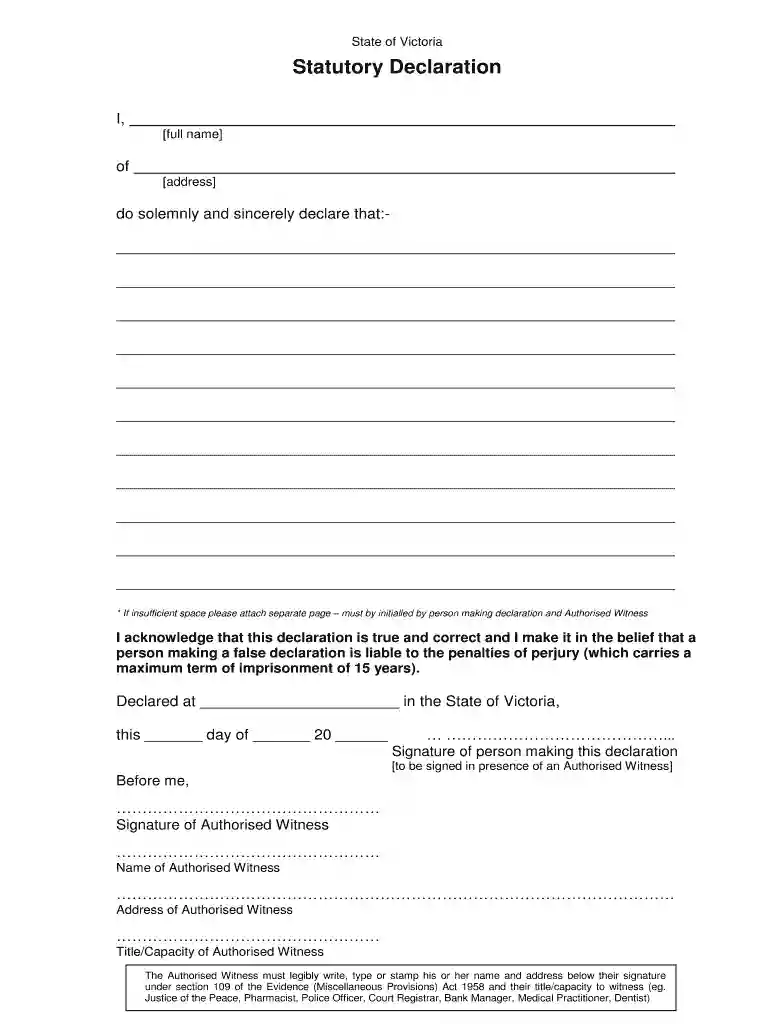
A statutory declaration form in Victoria serves as a legal document used by individuals to affirm the truthfulness of certain statements, typically made under oath. This form is governed by the Evidence (Miscellaneous Provisions) Act 1958 and is commonly utilized in situations where formal verifications are required. The document outlines the personal information of the declarant, asserts the accuracy of the declarations made, and specifies the consequences of providing false declarations, which may include legal repercussions.
These declarations are often required in various contexts, including but not limited to:
The statutory declaration functions as an alternative to an affidavit, allowing individuals to present their testimonies without the need for a court appearance for most situations.
Obtaining the statutory declaration form in Victoria is a straightforward process. Here are some common methods for acquiring this form:
Online access: The form can be downloaded in PDF format from various legal websites and government resources. Simply search for "statutory declaration form Victoria PDF" to find reliable sources for the document.
Local government offices: Individuals can visit their nearest council or government office to pick up a physical copy of the form.
Legal professionals: Consulting with a lawyer or legal advisor can also provide access to the form, along with guidance on how to properly complete it.
Access to the statutory declaration form Victoria PDF free download options is readily available, making it accessible for anyone needing to create a statutory declaration without incurring costs.
Completing the statutory declaration form requires careful attention to detail and accuracy. Below are the essential steps to follow:
Download and print the form: Access the statutory declaration form and ensure it is printed clearly.
Fill in personal information: Enter your full name, address, and other identifying details accurately in the designated sections.
State the facts: Clearly outline the statements you are declaring, ensuring they are true and can be substantiated as necessary.
Acknowledgment: Read through the form carefully, acknowledging the legal implications of providing false declarations.
Sign the form: The declaration must be signed in the presence of an authorized witness, as specified in the form.
Submit the form: Depending on your intended use, submit the form to the relevant parties, be it a court, regulatory body, or private individual.
This process ensures the statutory declaration is completed thoroughly, meeting all necessary legal requirements.
Several key elements are essential to ensure the statutory declaration form in Victoria is considered valid:
Personal information: Accurate details of the declarant must be included, such as full name, address, and contact information.
Declaration statement: A clear and concise statement of the facts being declared, which must be truthful and specific.
Witness details: The form usually lists authorized individuals who can witness the signing of the declaration. These can include police officers, legal practitioners, or registered medical practitioners, among others.
Date of declaration: The date when the statutory declaration is made must be specified to validate the timeliness of the statements.
Signature: The form must be signed by the declarant in the presence of the authorized witness, who will also sign and provide their details on the form.
These elements collectively contribute to the legal integrity and acceptance of the statutory declaration.
The legal use of the statutory declaration form in Victoria involves the acceptance of the document in various legal contexts. This primarily includes:
Evidence in legal proceedings: Statutory declarations can be used in courts as written evidence to support claims or counterclaims.
Regulatory compliance: Many government agencies require statutory declarations for compliance with laws and regulations, making them a critical aspect of legal proceedings.
Affirmation of identity or facts: When individuals need to affirm their identity or the facts surrounding a situation, statutory declarations serve to provide a formal mechanism for doing so without the need for a court appearance.
Understanding these legal contexts enables users of the statutory declaration form to utilize it effectively in various situations, ensuring compliance and validation of statements made.
The statutory declaration form in Victoria is utilized by a diverse range of individuals and entities, including:
Individuals applying for legal processes: Persons involved in court proceedings often use this form to substantiate their claims with truthful declarations.
Businesses and organizations: Companies may require their employees or stakeholders to submit statutory declarations for compliance purposes, particularly in dealings with government entities.
Beneficiaries of welfare services: Individuals applying for social security or welfare benefits often need to provide declarations to verify their claims.
Property owners: Individuals seeking to affirm ownership or certain facts pertaining to property transactions may be required to submit a statutory declaration.
The form's versatility makes it a valuable tool across various domains, reflecting its importance in affirming truths in legal and administrative contexts.


At DocHub, your data security is our priority. We follow HIPAA, SOC2, GDPR, and other standards, so you can work on your documents with confidence.
by D Dempsey 2019 Cited by 24 This paper reports on the information and contact sought by donor-linking applicants to the central and voluntary registers in the state of Victoria, Australia.Read more
This user guide is provided online in an DocHub Acrobat portable document format (PDF). This section will help familiarize you with using PDF documents inRead more


