Answer without attorney 2026

Get Form
how to answer a summons without an attorney in georgia Preview on Page 1

Here's how it works

01. Edit your how to answer a summons without an attorney in georgia online
Type text, add images, blackout confidential details, add comments, highlights and more.

02. Sign it in a few clicks
Draw your signature, type it, upload its image, or use your mobile device as a signature pad.

03. Share your form with others
Send how to answer a summons without an attorney via email, link, or fax. You can also download it, export it or print it out.

How to Use or Fill Out Answer Without Attorney

Form edit decoration
9.5
Ease of Setup
DocHub User Ratings on G2
9.0
Ease of Use
DocHub User Ratings on G2
  1. Click ‘Get Form’ to open it in the editor.
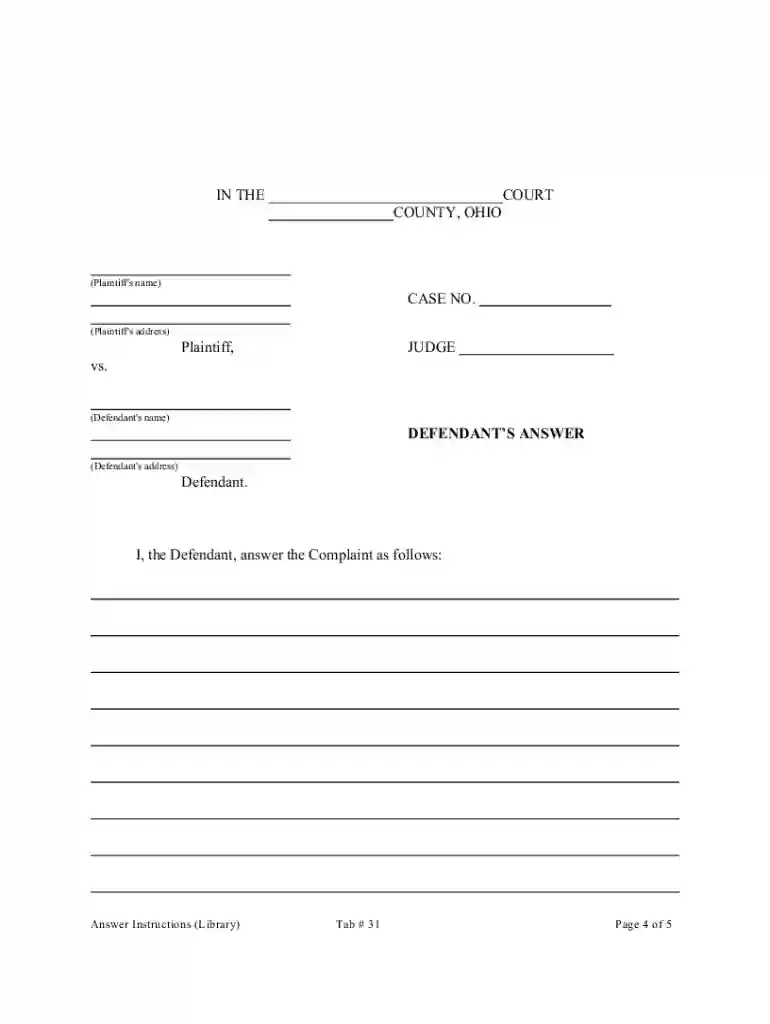
  2. Begin by entering the name of the Court and County at the top of the form, ensuring it matches exactly as stated in the Complaint.
  3. Next, fill in the name and address of the Plaintiff (the person who sued you) followed by your own name and address as the Defendant.
  4. Include the Case Number and name of the Judge as indicated on your documents.
  5. Address the Judge respectfully as 'Your Honor' and state that you are responding to a lawsuit filed against you. Admit any true statements from the Complaint and deny those that are not accurate, providing brief reasons for your denials.
  6. At the end of your Answer, request that the Judge dismisses the Complaint. Print your name, address, and phone number clearly.
  7. Complete the Certificate of Service section with the Plaintiff's address and date mailed. Make two copies of your Answer: one for mailing to the Plaintiff and one for filing with the court.
  8. Mail one copy to the Plaintiff or their attorney. Within three days, file your original Answer at the court clerk’s office for official recording.

Start using our platform today to easily fill out your Answer without an attorney!

be ready to get more

Complete this form in 5 minutes or less

Get form

Got questions?

We have answers to the most popular questions from our customers. If you can't find an answer to your question, please contact us.
Contact us
In a more formal setting such as a deposition, hearing or trial, the person might say: On the advice of counsel, I invoke my fifth amendment privilege against self-incrimination and respectfully decline to answer your question.
If asked a question, then you can tell the judge that, with all due respect, you do not wish to answer any questions, nor do you wish to clarify your position.
In California, drivers pulled over by police have rights protected by both state law and the U.S. Constitution, including the right to remain silent under the Fifth Amendment. You are not legally required to answer police questions beyond providing your license, registration, and proof of insurance.
Free Legal Answers is a secure, confidential website where individuals can ask an attorney for help with a legal issue. Volunteer attorneys respond through the website providing information and basic legal advice without any expectation of long-term representation.
Do you have to answer police questions? No, you can refuse to answer questions. For example, you can politely tell the officer: I dont answer questions without my attorney being present. If the officer continues to ask you questions, you can just repeat the answer or remain silent.

Security and compliance

At DocHub, your data security is our priority. We follow HIPAA, SOC2, GDPR, and other standards, so you can work on your documents with confidence.

Learn more

People also ask

Once theres a legal judgment against you, your wages can be garnished, and money can be taken out of your bank account if you dont pay. Luckily, responding is fairly simple. You just need to complete a document called an Answer and send it to the court and to the plaintiff (the entity suing you).
Regardless of your innocence, an experienced criminal defense attorney will help protect your rights, speak on your behalf, and counsel you before considering making any statements. If you talk to the police without an attorney, you risk incriminating yourself in a crime you didnt commit.
Generally in the US yes any person can defend themselves in court its called ``acting in pro per. However generally defending, or own prosecuting, your own case yourself is not advisable. Courts have to work within certain rules, generally court rules and the rules of evidence.

pro se forms georgia