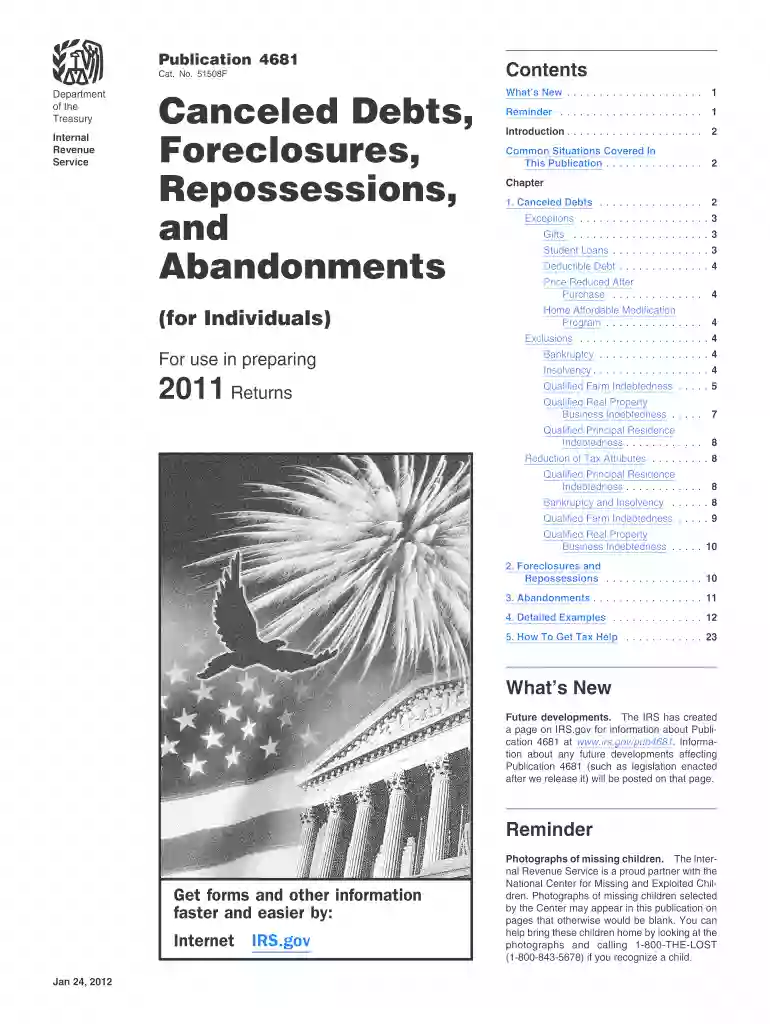
Publication 4681-2025

Get Form
publication 4681 Preview on Page 1

Here's how it works

01. Edit your publication 4681 online
Type text, add images, blackout confidential details, add comments, highlights and more.

02. Sign it in a few clicks
Draw your signature, type it, upload its image, or use your mobile device as a signature pad.

03. Share your form with others
Send pub 4681 via email, link, or fax. You can also download it, export it or print it out.

How to use or fill out publication 4681 with our platform

Form edit decoration
9.5
Ease of Setup
DocHub User Ratings on G2
9.0
Ease of Use
DocHub User Ratings on G2
  1. Click ‘Get Form’ to open publication 4681 in the editor.
  2. Begin by reviewing the introduction section, which outlines the federal tax treatment of canceled debts, foreclosures, repossessions, and abandonments. This will help you understand the context of the form.
  3. Fill in your personal information at the top of the form, ensuring accuracy to avoid processing delays.
  4. Proceed to Chapter 1 on Canceled Debts. Carefully read through each subsection and fill out any relevant fields based on your specific situation regarding canceled debts.
  5. If applicable, navigate to Chapter 2 for Foreclosures and Repossessions. Input details about any properties involved and follow the guidance provided for calculating gains or losses.
  6. Complete Chapter 3 on Abandonments if it pertains to your case. Ensure you provide all necessary information regarding abandoned properties.
  7. Review all entries for accuracy before saving or exporting your completed form. Utilize our platform's features to make edits as needed.

Start using our platform today for free to efficiently complete publication 4681!

be ready to get more

Complete this form in 5 minutes or less

Get form

Got questions?

We have answers to the most popular questions from our customers. If you can't find an answer to your question, please contact us.
Contact us
1205(E). In exercise of the powers conferred by the proviso to section 4 of the Insolvency and Bankruptcy Code, 2016 (31 of 2016), the Central Government hereby specifies one crore rupees as the minimum amount of default for the purposes of the said section. 2.1.
Publication 4681 explains the federal tax treatment of: Canceled debts. Foreclosures. Repossessions.
A taxpayer is insolvent when his or her total liabilities exceed his or her total assets. The forgiven debt may be excluded as income under the insolvency exclusion. Normally, a taxpayer is not required to include forgiven debts in income to the extent that the taxpayer is insolvent.
According to the IRS, nearly any debt you owe that is canceled, forgiven or discharged becomes taxable income to you. You should receive a Form 1099-C, Cancellation of Debt, from the lender that forgave the debt.
Defining insolvency The cashflow test: An organisation is unable to pay its debts as they become due. The balance sheet test: The value of an organisations assets is less than the value of its liabilities (overall, it owns less than it owes to other people).

People also ask

After notice of a decision making process has been sent to creditors, a physical meeting can be requestiioned if either of the following conditions is met: 10% of the value of creditors request a meeting. 10% of the total number of creditors request a meeting. 10 individual creditors request a meeting.
You must attach to your tax return a Form 982, Reduction of Tax Attributes Due to Discharge of Indebtedness (and Section 1082 Basis Adjustment) PDF to report the amount qualifying for exclusion and any corresponding reduction of those tax attributes.

irs publication 4681