




01. Edit your drama evaluation sheet online
Type text, add images, blackout confidential details, add comments, highlights and more.

Type text, add images, blackout confidential details, add comments, highlights and more.

Draw your signature, type it, upload its image, or use your mobile device as a signature pad.

Send drama score sheet via email, link, or fax. You can also download it, export it or print it out.
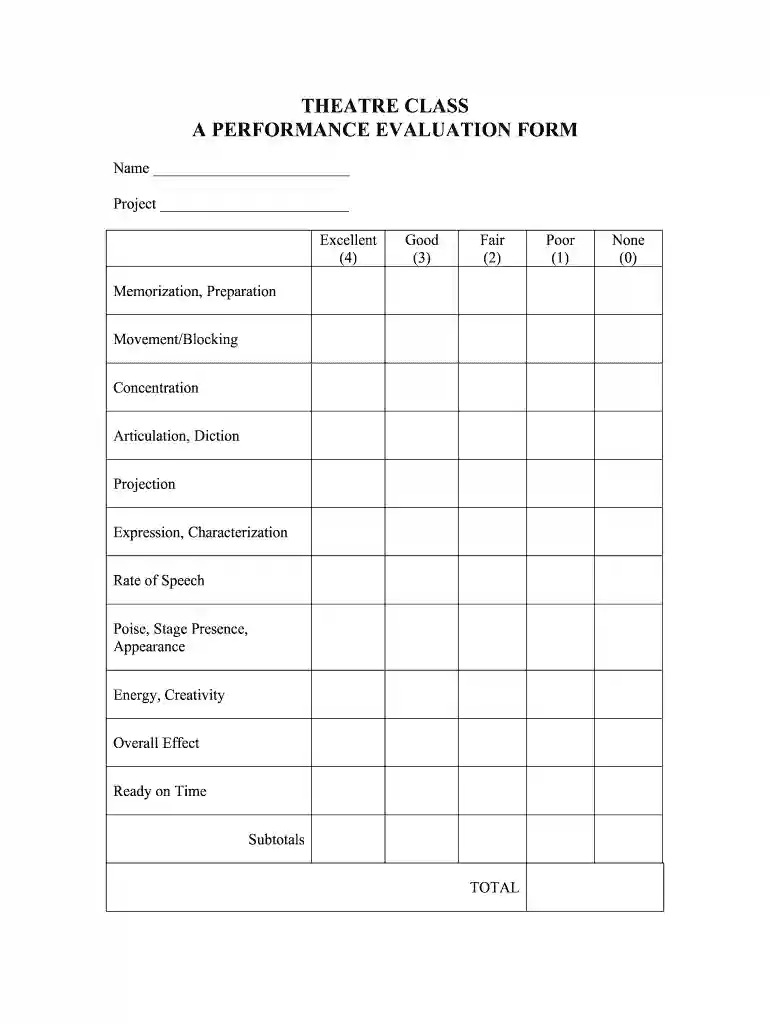
A theatre evaluation is a structured tool used to assess various aspects of a performance, providing valuable feedback to actors, directors, and educators. This document typically covers several performance elements to ensure a comprehensive assessment, including memorization, movement, articulation, and overall impact. By defining clear criteria for evaluating drama, this evaluation form allows for consistent and objective feedback, essential for performers seeking to improve their craft.
Memorization: This aspect focuses on how well an actor retains their lines and cues. Evaluators look for fluency in delivery, indicating strong memorization skills. Factors to consider include:
Movement and Physicality: An actor's movement is critical in conveying emotions and character. Observations may include:
Articulation and Projection: Clear communication is fundamental in theatre. Evaluators assess:
The theatre evaluation sheet often includes a scoring system to quantify the performance. This provides a concrete measure of an actor's strengths and areas for improvement. The common scale ranges from excellent to poor, allowing evaluators to articulate their feedback clearly.
Comprehensive theatre evaluations include feedback sections, where evaluators can provide specific comments on each performance element. This feedback is crucial for helping actors understand their performance critically. Examples of comment categories include:
Additionally, reflection questions can be included to prompt actors to analyze their performances. These may cover:
In many educational settings or community theatre environments, peer evaluations may also be incorporated to allow fellow performers to provide feedback. This can deepen the understanding of performance from multiple perspectives. Peer evaluations encourage collaboration and open dialogue, enhancing the learning experience for all participants.
Theatre evaluations are applicable in various contexts, including high school drama classes, community theatre productions, and professional settings. They help create a structured framework for assessing performances, fostering growth and development in acting skills.
In Educational Settings: Teachers can use these evaluations to grade students and provide constructive feedback, promoting artistic growth and understanding of performance techniques.
In Community Theatres: Directors can utilize evaluations to guide actors throughout the rehearsal process, ensuring collective understanding and cohesion in performances.
In Professional Theatre: Actors can refer to evaluations in preparation for future auditions, focusing on developing specific skills that may require improvement based on earlier assessments.
Ultimately, theatre evaluations serve as a vital resource for personal and collective improvement in the performing arts, promoting a culture of constructive feedback and continuous learning.
At DocHub, your data security is our priority. We follow HIPAA, SOC2, GDPR, and other standards, so you can work on your documents with confidence.
The following list, while not exhaustive, offers information and practices supporting program evaluation and performance measurement in the arts.Read more
You have to be able to provide a very brief summary of the play, a close objective analysis of the performance you attend, and an interpretation and evaluationRead more
by L Tronchin Cited by 2 In this paper, the subjective evaluation of room acoustics perception have been analyzed by means or virtual reconstruction of 3D characteristics of ancient.Read more


