




01. Edit your application in spanish online
Type text, add images, blackout confidential details, add comments, highlights and more.

Type text, add images, blackout confidential details, add comments, highlights and more.

Draw your signature, type it, upload its image, or use your mobile device as a signature pad.

Send employment application spanish pdf free download via email, link, or fax. You can also download it, export it or print it out.
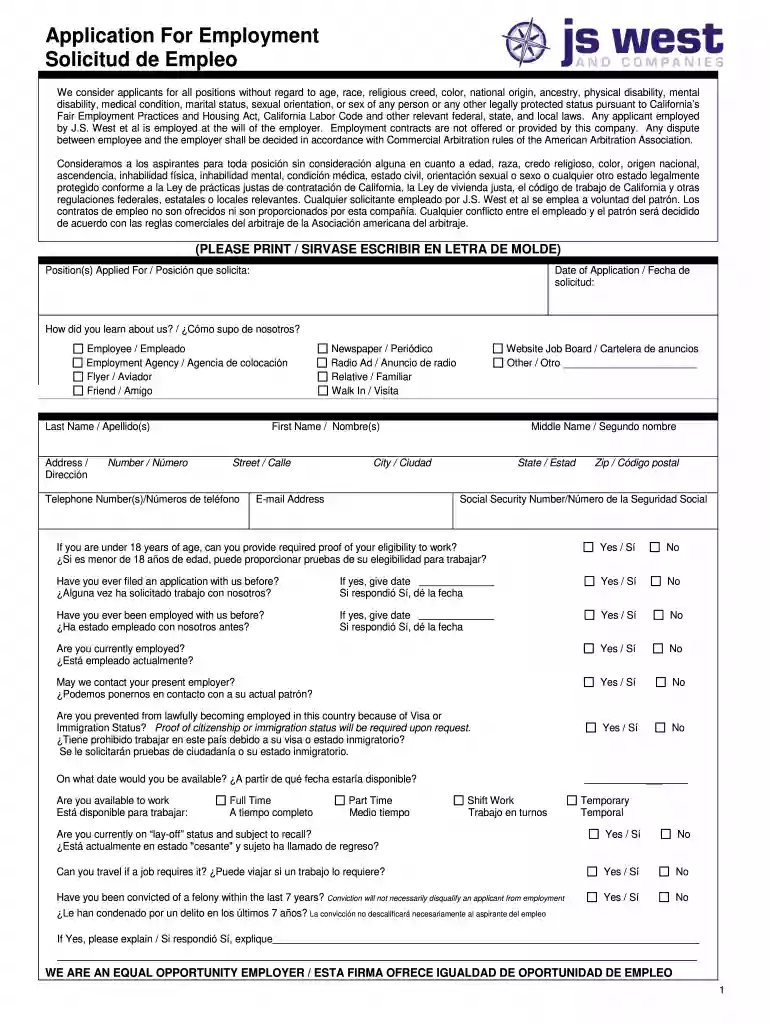
The Spanish employment application, or "solicitud de empleo en español," is an essential form used by employers in the United States to collect relevant information from job applicants who prefer to communicate in Spanish. This form is designed to ensure that all applicants, regardless of their primary language, can submit their credentials without language barriers.
A comprehensive Spanish employment application typically includes several crucial sections to collect personal data essential for the hiring process:
Personal Information
Job-Specific Sections
Eligibility Work
The education section of the application allows candidates to showcase their qualifications:
Formal Education
Continuing Education and Certifications
Prior work experience is vital for employers assessing the qualifications of applicants:
Previous Employment
Gaps in Employment
Another critical section focuses on unique skills and qualifications that portray the applicant as a fitting candidate:
Skills Inventory
Professional Development
The Spanish employment application must also include crucial legal disclaimers:
At-Will Employment Acknowledgment
Equal Opportunity Employment Statement
The final component of the Spanish employment application is:
By leveraging these comprehensive sections, the Spanish employment application ensures that both employers and applicants navigate the hiring process more effectively, minimizing misunderstandings due to language barriers and contributing to a more inclusive workforce.
At DocHub, your data security is our priority. We follow HIPAA, SOC2, GDPR, and other standards, so you can work on your documents with confidence.


Submit/upload a cover letter addressing the following: Describe how you use Spanish on a regular basis. List what days (morning, afternoon and/or evenings)
Employment Applications Employment Application * Spanish Employment Application * Additional Work Experience Form (Rev 03-2019).Read more
May 16, 1988 The Personnel Administrator shall promulgate an application which must be filled out according to instructions by all individuals seeking StateRead more


