
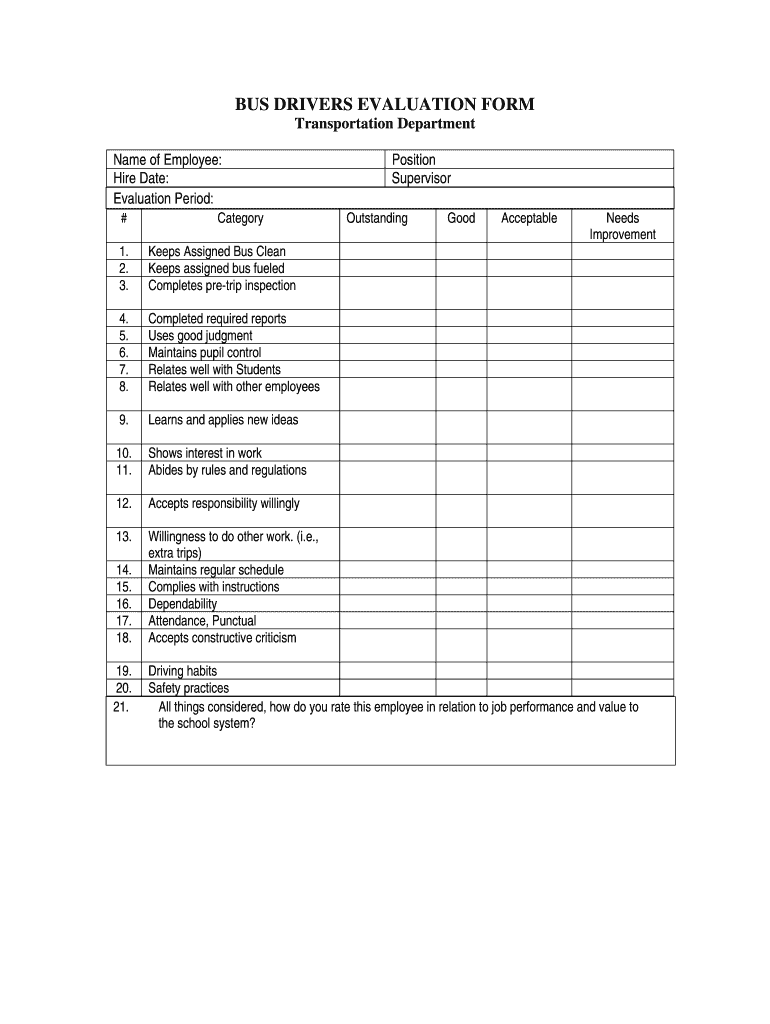







Definition and Purpose of the School Bus Driver Evaluation Form
The school bus driver evaluation form serves as a formal tool used to assess the competence and performance of school bus drivers. This document allows transportation departments to systematically evaluate various aspects of a driver’s performance, including adherence to safety regulations, punctuality, and overall behavior while operating a bus.
Detailed Components of the Evaluation Form
- Performance Categories: Common sections in the evaluation form include driving skills, communication with students, adherence to schedules, and compliance with safety regulations.
- Rating System: Many forms utilize a rating scale, such as numeric values or descriptive categories (e.g., excellent, satisfactory, needs improvement), to quantify a driver's performance.
- Comments Section: Supervisors can provide specific feedback, which may highlight strengths or identify areas for development.
How to Use the School Bus Driver Evaluation Form Effectively
Using the school bus driver evaluation form requires a structured approach to ensure objective assessment and constructive feedback. The process can generally be divided into several steps.
Steps for Effective Use
- Administrator Preparation: Transportation supervisors should familiarize themselves with the evaluation criteria prior to assessments.
- Observation: Supervisors should conduct ride-alongs or observe drivers in various situations to gather pertinent data for evaluation.
- Completing the Form: After gathering observations, the supervisor fills out the designated sections of the evaluation form, ensuring to provide both ratings and detailed comments.
- Discussion with Driver: Post-evaluation, supervisors should meet with the driver to discuss the findings, ensuring clarity and offering constructive feedback.
- Action Plan Development: If required, supervisors and drivers can formulate a plan to address noted areas needing improvement.
Key Elements of the School Bus Driver Evaluation Form
Understanding the essential components of the school bus driver evaluation form can significantly enhance its effectiveness. Each element plays a crucial role in ensuring comprehensive evaluations.
Essential Components
- Driver Information: This section collects basic details such as name, route, and vehicle identification.
- Evaluation Criteria: Various criteria should be outlined, typically focusing on driving skills, adherence to safety protocols, interaction with students, and overall professionalism.
- Rating Scale: A clearly defined rating scale helps ensure consistent assessments.
- Signatures: Final evaluations often require signatures from both the evaluator and driver to confirm that the assessment was reviewed.
Examples of Completing the School Bus Driver Evaluation Form
Practical examples can illuminate how to fill out the school bus driver evaluation form while addressing specific performance indicators.
Sample Evaluations
- Driving Skills: If a driver consistently adheres to speed limits and demonstrates proper maneuvering around school zones, a rating of "excellent" might be indicated.
- Respectful Interaction: If feedback indicates that a driver frequently engages positively with students, the evaluator may note specific instances in the comments section.
- Safety Compliance: Should any safety infractions arise, such as failure to conduct pre-trip inspections, the evaluator can document these events for follow-up.
Legal Considerations for the School Bus Driver Evaluation Form
The legal landscape surrounding the school bus driver evaluation form is significant, particularly regarding compliance and documentation.
Compliance Requirements
- Regulatory Standards: Many states enforce specific guidelines that govern how driver evaluations must be conducted and documented, aiming to uphold safety and accountability.
- Records Retention: Legal mandates often dictate how long evaluation records should be kept. It is essential to maintain complete files for potential audits or incidents.
Implications of Mismanagement
- Potential Liabilities: Inadequate evaluations can expose school districts to legal risks, such as liability in accident cases. Proper documentation can serve as evidence of compliance with training and evaluation protocols.
State-Specific Rules and Variations for the School Bus Driver Evaluation Form
Different states may have unique regulations regarding the school bus driver evaluation form, impacting its usage and requirements.
Notable Differences
- Evaluation Frequency: Some states may require evaluations to be performed annually, while others may have different timelines based on district policies.
- Training Requirements: Certain jurisdictions mandate specific training that must be documented within the evaluation form, ensuring all drivers meet established safety standards.
Understanding these variations can aid transportation departments in maintaining compliance with state laws.




